Sports News Onli brings the latest sports news, live match updates, scores, and highlights from cricket, football, hockey, and other international sports.
Tremors from a 6.0 magnitude earthquake were felt across several districts of Khyber Pakhtunkhwa and Punjab in the early hours of Monday, according to the authorities but no casualties or damage was reported.
According to the state-run PTV which cited the Pakistan Meteorological Department, the earthquake was recorded at 12:18am.
It added that the tremors were felt in Peshawar, Manshera, Abbottabad, Hangu, Malakand, Swat, Chitral, Rawalpindi, and Islamabad.
A Punjab Provincial Disaster Management Authority (PDMA) spokesperson said the quake was recorded at a depth of 10 kilometres with its epicentre located southwest of Asadabad, Afghanistan.
Shocks were also felt in Pakistan, Afghanistan, India, and Tajikistan.
Following the tremors, district administrations across Punjab began inspections of buildings to assess structural safety.
“However, no casualties or damage have been reported so far,” PDMA Director General Irfan Ali Kathia confirmed.
The PDMA stated that its provincial control room and all district emergency operation centers remain on 24/7 alert.
Citizens have been urged to report any earthquake-related losses or emergencies by calling the PDMA helpline at 1129.
Pakistan falls on three major tectonic plates — the Arabian, Euro-Asian and Indian — which create five seismic zones under the country. The intersection of multiple fault lines means that tectonic movements remain a frequent occurrence in the region.
The Finance Division announced on Sunday night that petrol price will remain unchanged, while the price of high-speed diesel (HSD) will be reduced by Rs3 per litre for the next fortnight.
Petrol, used mainly in private cars, small vehicles, rickshaws and motorcycles, directly impacts the budgets of middle- and lower-middle-income groups.
Most of the transport sector runs on HSD and its price is considered inflationary as it is mostly used in heavy transport vehicles, trains and agricultural engines like trucks, buses, tractors, tube-wells and threshers and particularly adds to the prices of vegetables and other eatables.
A notification from the Finance Division, available with Dawn.com, stated that the new price of HSD was Rs269.99, while petrol would remain at Rs264.61 — the same as the start of August. Additionally, the prices of superior kerosene oil and light diesel oil were slashed by Rs1.46 per litre and Rs2.40, respectively.
“The government has revised the petroleum product prices for the fortnight starting tomorrow (September 1), in line with the recommendations of Ogra (Oil and Gas Regulatory Authority) and the concerned ministries,” the Finance Division stated.
Earlier this week, the cabinet’s Economic Coordination Committee (ECC) approved a financial bailout for Pakistan Television (PTV), a recovery plan for Rs47 billion in outstanding petroleum levy from Cynergico Refinery, and the use of funds collected under the captive levy on gas to reduce electricity rates for all consumers.
On August 16, the Finance Division announced a cut of Rs12.84 per litre in the price of HSD for the next fortnight, while petrol prices remained unchanged. The prices of superior kerosene oil and light diesel oil were slashed by Rs7.19 per litre and Rs8.2, respectively.
The Oil and Gas Regulatory (Ogra) on Sunday notified the new price of liquified petroleum gas (LPG) at Rs214.19 per kilogramme for the month of September, according to a notification available with Dawn.com.
Last month, the price of LPG was set at Rs215.37 per kg for August, down from Rs233.10 in July — a decrease of Rs17.73 per kg. Consequently, the price of an 11.8kg domestic cylinder was fixed at Rs2,541.36.
According to today’s notification, Ogra set the per kg price of LPG at Rs214.19, down from Rs215.37 — a decrease of Rs1.18 per kg since last month. The price for an 11.8kg cylinder was set at Rs2,527.47 — making a cylinder Rs13.89 cheaper than the month prior.
These prices are effective from September 1 onwards.
“The LPG producer price is linked with Saudi Aramco-CP and US dollar exchange rate,” a separate Ogra press release read.
“As compared to [the] previous month, Saudi Aramco-CP remains unchanged. The average dollar exchange rate has slightly decreased by 0.69pc resulting in a decrease in LPG consumer price by Rs13.89 per 11.8 kg cylinder (0.54pc).”
Dominik Szoboszlai’s stunning free-kick gave Liverpool first blood against Arsenal with a 1-0 win in Sunday’s battle between the Premier League title favourites.
A tense tussle at Anfield looked set to end in a stalemate until the Hungarian’s 83rd-minute strike ensured the defending champions remain the only side with a perfect record from the opening three games.
In all three matches, Arne Slot’s men have scored late winners, also overcoming Bournemouth and Newcastle in dramatic fashion.
Liverpool may still be a work in progress after overhauling the squad that romped to the title last season. But they remain the team to beat thanks to an abundance of attacking talent capable of match-winning moments like the one Szoboszlai produced.
Liverpool could even be stronger come the end of the transfer window on Monday as they look to add Newcastle’s unsettled striker Alexander Isak and Crystal Palace captain Marc Guehi to bolster their defence.
Arsenal’s English midfielder Eberechi Eze (R) is challenged by Liverpool’s Hungarian midfielder #08 Dominik Szoboszlai (L) during the English Premier League football match between Liverpool and Arsenal at Anfield in Liverpool, north west England on August 31. — AFP
Arsenal have backed Mikel Arteta with over £250 million ($338 million) worth of new signings in a bid to usurp the Reds and win the Gunners’ first Premier League title since 2004.
The visitors were hampered by the absence of the injured Bukayo Saka and Kai Havertz. But Viktor Gyokeres did little to silence doubts that he can make the step up from a prolific spell at Sporting Lisbon to the Premier League. The Swede was easily marshalled by Virgil van Dijk.
To add to the Gunners’ injury woes, William Saliba went off inside the opening five minutes, replaced by Christhian Mosquera. The Spanish under-21 international is yet to make a Premier League start but was not seriously tested as Liverpool’s new-look attack struggled to click into gear.
Despite defensive issues this season, Slot again named a front four of club record signing Florian Wirtz, Cody Gakpo, Mohamed Salah and Hugo Ekitike.
At Arsenal, Noni Madueke’s arrival was not met with enthusiasm by fans who even started a petition to block the England international’s £48.5 million move from Chelsea. Deputising for Saka on the right wing, Madueke was by far the visitors’ biggest threat.
Liverpool’s Hungarian midfielder Dominik Szoboszlai (L) walks off with Liverpool’s Hungarian defender Milos Kerkez (C) and Liverpool’s Egyptian striker Mohamed Salah (R) at the end of the English Premier League football match against Arsenal at Anfield in Liverpool, northwest England on August 31. — AFP
Milos Kerkez has had a difficult start to his Liverpool career and was consistently beaten for pace by Madueke, who lacked the finishing touch. A desperate Kerkez challenge deflected Madueke’s strike over with the best effort of a disjointed first half.
The second half followed the same cagey pattern with both sides wary of risking a damaging early defeat in the title race.
Liverpool did have the ball in the net on the hour, only to be denied by the offside flag.
David Raya breathed a sigh of relief after he failed to hold Wirtz’s effort and then tripped Gakpo before Ekitike forced the ball in.
Psychological blow
However, Gakpo had strayed offside before collecting the rebound. That excitement did at least bring the Anfield crowd to life to inspire a late Liverpool push for all three points.
Arsenal had not conceded this season and it took something special to break down Arteta’s men. Szoboszlai’s free-kick dipped and curled perfectly in off the Raya’s right-hand post to leave the Spaniard helpless.
Arsenal had a penalty shout waved away for Joe Gomez’s challenge on Eberechi Eze in their pursuit of an equaliser.
Liverpool stood strong to register their first clean sheet of the season and land an early psychological blow in the title race.
COPENHAGEN: The EU called upon the United States on Saturday to reconsider its decision to deny visas to Palestinian officials seeking to attend next month’s UN General Assembly.
“In the light of the existing agreements between the UN and its host state, we all urge for this decision to be reconsidered,” Kaja Kallas, the bloc’s top diplomat, said following a meeting of EU foreign ministers in Copenhagen, Denmark.
Kallas invoked “international law” in calling for Washington to reverse the extraordinary step, which further aligns US President Donald Trump’s administration with Israel’s government.
The US move comes as France is leading a push to recognise the Palestinian state at the gathering of world leaders in New York. French Foreign Minister Jean-Noel Barrot spoke out in protest ahead of the Denmark talks.
Abbas ‘barred’ from UN summit; Israeli forces kill 50 more as death toll rises to 63,371
“A UN General Assembly meeting should not be subject to any restrictions on access,” Barrot told reporters.
A string of ministers in Copenhagen echoed France’s call for the United States to allow access to the Palestinian delegation.
The Palestinian Authority has likewise called for the United States to reverse its decision, which it said “stands in clear contradiction to international law and the UN Headquarters Agreement”.
Palestinian Authority President Mahmud Abbas, a veteran 89-year-old leader who once had cordial relations with Washington, had planned to attend the UN meeting.
Under an agreement as host of the United Nations in New York, the United States is not supposed to refuse visas for officials heading to the world body.
A US official said on Saturday that Mahmud Abbas is among 80 officials being denied visas to attend next month’s UN General Assembly, where France is leading a push to recognise a Palestinian state.
“Abbas is affected by this action along with approximately 80 other PA officials,” a State Department official said in a statement, detailing those impacted by the extraordinary decision announced on Friday by the United States.
The United States and Israel have accused France and other powers of rewarding Hamas through their recognition of a Palestinian state. Canada and Australia have also said they would recognise a Palestinian state, and Britain threatened to do so if Israel does not agree to a ceasefire in Gaza.
Meanwhile, heavy bombardment has been reported in Gaza City early on Saturday as Israel said its planned seizure of the besieged Palestinian territory’s largest area was progressing. At least 50 more people were killed in Gaza in a single day, taking the death toll of Palestinians in over 22 months to 63,371.
• Observers say move reminiscent of 2022 resignations, will strengthen treasury benches
• Lawmakers of ruling parties vie for coveted slots left vacant after over 40 opposition members quit standing committees
AS more than 40 PTI lawmakers quit parliamentary committees, including the apex Public Accounts Committee, in line with the order of their chief Imran Khan, the decision has been described by analysts as a “political blunder”, which will play into the government’s hands.
More PTI legislators are expected to submit their resignations to the National Assembly Secretariat on Monday — a move that will likely strengthen the treasury benches in parliament. According to observers, Imran Khan’s move to exit the committees was similar to his decision in 2022 when he decided to quit parliament after the 2022 no-trust vote instead of choosing to become a “heavyweight opposition” after his ouster from power.
According to the National Assembly Secretariat (NAS) officials, the decision to resign from the standing committees will not create any vacuum in parliament. The absence of three to four PTI lawmakers from a committee would not disturb the quorum that requires the presence of one-fourth of the members.
Therefore, the departure from these committees would not make any difference as members from the treasury benches would soon replace them, they added.
Against this backdrop, the treasury lawmakers were already vying for coveted slots left vacant by the PTI members, particularly the positions of the chairperson of at least 10 National Assembly standing committees. Once these positions are in the government’s hands, it will be smooth sailing for the ruling parties.
Previously, the government was facing immense resistance in these committees during debates on proposed legislation referred to respective committees for consultations. A senior PTI leader, on condition of anonymity, said many leaders were not in agreement with the decision taken by Mr Khan as they believed that this move would cede ground to the government.
“The resignations are being given at a time when the government (allegedly) is planning to get the 27th Constitutional Amendment passed,” he claimed.
He said the decision would force the party to rely on its street power and courts — a move that had proved counterproductive in the past. In 2022, the Supreme Court, in response to a PTI challenge against the NAB law, had asked the party why it did not raise its objections in parliament as “there was no alternative” to the house.
Talking to Dawn , Mudassar Rizvi of the Free and Fair Election Network (Fafen) said that despite the disqualification of its legislators, the PTI was still the largest party in both houses and should keep the opposition leader’s offices to maintain its strength. Anything else would be a “political blunder”, as some other party could get its hand on all the important positions despite having less representation.
For political analyst Ahmed Bilal Mehboob, who heads the Pakistan Institute of Legislative Development and Transparency (Pildat), it was quite ironic that PTI decided to leave all standing committees, including the PAC. “This is the same act the PTI had done when it exited the National Assembly and ceded (governments in) all provinces, where it was ruling, one by one,” he added. “A lack of opposition representation in this important committee will negatively impact the quality of parliamentary proceedings,” Mr Mehboob said.
Vying for slots
On the other hand, MNAs from the ruling PML-N, the MQM, and the PPP are making efforts to occupy the vacant chairperson slots previously held by PTI in different standing committees. It is likely that the PAC office would go to PPP’s Naveed Qamar, who also chaired the recent meeting in the absence of PTI’s Junaid Akbar, being its “most senior member”. Nadeem Afzal Chan, however, said the next meeting of the PAC would not take place unless a new chairman was elected. However, PPP Secretary Information Nadeem Afzal Chan told Dawn that the party had not held any discussions on the matter.
A senior leader of PML-N, on condition of anonymity, said those party MNAs who could not get lucrative positions in the standing committees earlier were flexing their muscles to grab the vacant positions, especially the chairperson slots in the committees.
Besides the standing committee, the offices of the opposition leaders in the Senate and the National Assembly are also vacant, following the disqualification of the NA Opposition Leader Omar Ayub and Senate leader Shibli Faraz. Though the PTI has nominated Pashtunkhwa Milli Awami Party (PkMAP) chief Mahmood Khan Achakzai and PTI Senator Azam Swati for these slots, the party has kept them as backup options.
According to Ahmed Bilal Mehboob, there is no specified timeframe for the election of the opposition leader, but the assembly rules suggest that they should be nominated as soon as possible due to their role in key constitutional functions, including consultations over the names of the next chief election commissioner and ECP members.
United States President Donald Trump has scrapped plans to attend an upcoming summit of the ‘Quad’ grouping in India amid deteriorating ties between Washington and New Delhi, US newspaper The New York Times (NYT) reported on Saturday.
Relations between the two countries have plummeted, with 50 per cent levies on many Indian imports into the US taking effect this week as punishment for New Delhi’s massive purchases of Russian oil; a part of US efforts to pressure Moscow into ending its war in Ukraine.
As ties between both nations deteriorate, NYTreported on Saturday that the breakdown in relations was caused after a phone call on June 17.
“After telling [Indian Prime Minister Narendra] Modi that he would travel to India later this year for the Quad summit, Mr Trump no longer has plans to visit in the fall, according to people familiar with the president’s schedule,” the NYT reported, citing “interviews with more than a dozen people in Washington and New Delhi”.
The NYT mentioned how Trump’s repeated claims about having ended the recent brief conflict between India and Pakistan reportedly “infuriated” Modi. The paper added that the dispute “dates back more than 75 years and is far deeper and more complicated than Mr Trump was making it out to be”.
India blamed Pakistan for the April 22 Pahalgam attack without evidence, triggering a military escalation. On May 6–7, New Delhi launched air strikes that killed civilians, followed by a week-long missile exchange. A US-brokered ceasefire ended the war.
“During a phone call on June 17, Mr Trump brought it up again, saying how proud he was of ending the military escalation,” the NYT reported.
“He mentioned that Pakistan was going to nominate him for the Nobel Peace Prize, an honour for which he had been openly campaigning. The not-so-subtle implication, according to people familiar with the call, was that Mr Modi should do the same.”
It added that the “bristled” Indian premier told Trump that American involvement had nothing to do with the ceasefire and the conflict had been settled directly between India and Pakistan.
“Mr Trump largely brushed off Mr Modi’s comments, but the disagreement — and Mr Modi’s refusal to engage on the Nobel — has played an outsize role in the souring relationship between the two leaders, whose once-close ties go back to Mr Trump’s first term,” the report reads, adding that the two leaders have not spoken since the June 17 phone conversation and Trump has only doubled down on taking credit for the ceasefire.
Amid this dispute, India has grown closer to Beijing and Moscow. Modi is currently in Tianjin, China, for the Shanghai Cooperation Organisation’s Council of Heads of State summit, where he is expected to meet with Chinese President Xi Jinping and Russian President Vladimir Putin.
“At its core, the story of Mr Trump and Mr Modi is about two brash, populist leaders with big egos and authoritarian tendencies, and the web of loyalties that help keep both men in power,” the NYT reported.
“But it is also the tale of an American president with his eye on a Nobel Prize, running smack into the immovable third rail of Indian politics: the conflict with Pakistan.”
Bloomberg reported earlier this month that Modi turned down an invitation from Trump to visit the White House after a G7 meeting in Canada, over concerns that he would set up a meeting with Chief of Army Staff (COAS) Field Marshal Asim Munir, who was visiting the US at the time.
Reporting the same, NYT said: “Modi declined an invitation from Mr Trump to stop by Washington before he flew home. His officials were scandalised that Mr Trump might try to force their leader into a handshake with Pakistan’s army chief, who had also been invited to the White House for lunch around the same time. It was another clear sign, a senior Indian official said, that Mr Trump cared little for the complexity of their issue or the sensitivities and history around it.”
The COAS carried out two visits to the US. The first, in June, saw him meet Trump at the White House for luncheon, making him the first sitting army chief to do so.
The field marshal termed his second visit to the US in just one-and-a-half months a “new dimension” in ties between Washington and Islamabad. During this trip, the COAS engaged in high-level interactions with senior political and military leadership, as well as members of the Pakistani diaspora.
Pakistan and the US also finalised a trade deal at the start of August, lowering tariffs to 19pc from the previously announced 29pc and helping develop Pakistan’s oil reserves while trade talks between the US and India have stalled.
• Senate panel regrets tourists were not barred from travelling to vulnerable areas, despite NDMA alerts
• Calls for revised Afghan refugee policy that balances humanitarian obligations and national security
ISLAMABAD: A parliamentary committee on Friday expressed concern over the lack of preparedness of Gilgit-Baltistan and Azad Jammu and Kashmir (AJK) governments and their failure to act on early warnings issued by the National Disaster Management Authority (NDMA).
A meeting of the Senate Standing Committee on Kashmir Affairs, Gilgit-Baltistan and States and Frontier Regions, presided over by Senator Asad Qasim at the Parliament House, voiced displeasure over the absence of the GB chief secretary, stressing that the participation of senior officials was vital for effective parliamentary deliberations and meaningful decision-making.
The committee decided to defer the agenda pertaining to Gilgit-Baltistan and directed that senior GB officers must ensure their presence at future meetings.
Senators Faisal Saleem Rehman, Attaul Haq and Nadeem Ahmed Bhutto, the ministry’s additional secretary and senior officials from relevant departments attended the meeting. The committee members were briefed on monsoon-induced damage, relief operations, and tourism-related challenges in Azad Kashmir.
The State Disaster Management Authority secretary informed the meeting that since June 26, AJK had faced nine spells of monsoon rains following a May cloudburst. These disasters claimed 28 lives, damaged over 2,100 houses and caused extensive destruction of public infrastructure, including roads, water supply schemes, schools and electricity networks.
Committee Chairman Asad Qasim observed that despite NDMA alerts, tourists were not restricted from entering vulnerable areas, which was the responsibility of the local administration. He also noted the absence of early warning systems in disaster-prone zones and suggested installing such systems at 100-kilometre intervals across AJK.
On financial matters, the chairman raised concerns over the monitoring of relief funds, including Rs3 billion provided by the Economic Coordination Committee (ECC) of the cabinet. He suggested setting up an ad hoc oversight mechanism comprising parliamentarians, the judiciary and other stakeholders to ensure transparency and accountability.
Mr Qasim also questioned the accuracy of official data, warning that incomplete surveys and underreporting undermined public trust.
About communication infrastructure, the senators regretted that private operators had failed to provide services in remote areas, leaving the Special Communication Organisation (SCO) as the only functioning network during calamities.
The committee recommended that the Universal Services Fund be used to expand coverage, particularly in tourist areas, as required by the law.
Refugee policy
The committee also called for a revised and coordinated policy on Afghan refugees that balances humanitarian obligations with national security needs.
Phase III of the deportation plan will begin on September 1, targeting Afghan refugees holding Proof of Registration (PoR) cards. The committee was briefed on the role and scope of the Commissionerate for Afghan Refugees (CCAR).
The CCAR chief commissioner informed the committee that, following the expiry of the voluntary repatriation deadline, Afghan refugees’ status had been changed to “aliens”.
The government’s “Illegal Foreigners Repatriation Plan”, announced in October 2023, required all undocumented migrants to leave under a three-phase regime. Phase I, launched in October 2023, covered the return of all illegal foreigners. Phase II, beginning April 1, 2025, included the deportation of illegal foreigners along with Afghan Citizen Card (ACC) holders. Since then, about 48,000 ACC holders have been deported. Phase III, starting September 1, will focus on POR card holders.
CCAR officials said that around 300,000 Afghans had voluntarily returned so far, with Sindh hosting nearly 80,000 refugees, and significant numbers residing in KP and Balochistan.
The committee members observed that undocumented refugees remained undercounted, while international funding for refugee management had largely dried up.
The officials said cooperation with the UNHCR was limited to humanitarian support, as agreements last revised in 2009 had expired.
The committee also sought clarity on the ownership of 54 refugee camps and their associated land assets.
“You know the numbers, you know the funds received, now we must ensure accountability, inter-ministerial cooperation, and clarity on the way forward,” the committee chairman said.
Skipper Salman Agha hit an unbeaten half-century and fast bowler Haris Rauf grabbed four wickets as Pakistan upstaged Afghanistan by 39 runs in the tri-series opener in Sharjah on Friday.
Agha hit a 36-ball 53 not out with three sixes and as many boundaries, which lifted Pakistan to 182-7 in their 20 overs.
Pacers Rauf took 4-31 and Shaheen Afridi 2-21, while spinners Mohammad Nawaz (2-23) and Sufiyan Muqeem (2-25) dismissed Afghanistan for 143 in 19.5 overs before a noisy capacity 16,000 crowd at the Sharjah stadium.
Afghanistan matched Pakistan with opener Rahmanullah Gurbaz, 27-ball 38 with a six and three boundaries, adding 51 for the second wicket with Sediqullah Atal, who made 23.
It was Rauf who changed the game with a two-wicket 12th over, sending Atal and Karim Janat back without conceding a run.
Afghanistan skipper Rashid Khan smashed five sixes and a four in his whirlwind 16-ball 39 but fell to Rauf to end his team’s fight.
Earlier, Pakistan was lifted by Agha’s fourth T20I half-century.
Agha anchored the innings admirably well after opener Sahibzada Farhan smashed two sixes and a boundary in his 10-ball 21 after Pakistan won the toss and batted.
Agha added 53 for the fifth wicket with Nawaz, whose 11-ball 21 had two sixes and a boundary as the duo helped Pakistan get 51 runs in the last five overs.
Pakistan play hosts United Arab Emirates on Saturday.
All three teams face each other twice, with the top two playing the September 7 final.
Former Jamaat-i-Islami (JI) senator Mushtaq Ahmad Khan will lead the Pakistani delegation aboard the Global Sumud Flotilla bound for the Gaza Strip, according to posts from his social media account on Friday.
Earlier this month, it was announced that Pakistan would be joining the Global Sumud Flotilla to break the Israeli siege of Gaza, according to a post on Instagram by the Pak-Palestine Forum, a platform aiming to advance support for the Palestinian cause.
According to its website, the flotilla is a “coordinated, nonviolent fleet of mostly small vessels sailing from ports across the Mediterranean to break the Israeli occupation’s illegal siege on Gaza”.
Reuters reports that dozens of boats carrying aid will depart Spain and Tunisia and set sail for the Gaza Strip. Swedish activist Greta Thunberg and Portuguese left-wing politician Mariana Mortagua are among hundreds of people from 44 countries participating in the flotilla. Sumud means “perseverance” in Arabic.
Among the participants is a five-member delegation from Pakistan, led by former senator Khan.
In comments to Dawn.com, the former senator said that the flotilla — the largest civilian aid mission in history — will depart the Tunisian capital on September 4.
“We will be trained on the vessel and the journey from September 1 to 3 in Tunis,” the ex-senator said. “There will be over 100 ships from over 50 countries … this is the biggest humanitarian operation led by civilians,” he said.
“This flotilla is made up of vessels from four different coalitions. One of them, the Sumud Nasantra, includes delegations from the Philippines, Thailand, the Maldives, Bangladesh, Indonesia, Malaysia and Pakistan, which I am leading,” he added.
Other coalitions participating in the flotilla include the Maghreb Sumud Flotilla, Freedom Flotilla Coalition and Global Movement to Gaza.
“Europe’s Freedom Flotilla will depart from Barcelona, Spain, on September 1,” Khan said. “We are further away, so we will depart on September 4 and converge with the other vessels in the Mediterranean on September 5. We will then travel to Gaza via a sea route.”
The former senator emphasised that the flotilla is legal, nonviolent and peaceful.
“It is legal because we will be travelling from international waters, from which we will transition to Palestinian waters, so we are not coming into contact with Israel,” he explained. “We are only carrying food and water.
“We need to break the blockade, establish a humanitarian assistance corridor and stand up against the genocide,” Khan said. “These are our goals.”
Khan noted that he was the only member of the delegation to arrive in Tunis, as the remainder of the delegation are struggling to obtain visas.
“At the moment, I am alone; however, I am trying to help group members obtain visas. They are four men, none of whom are prominent political figures,” he explained.
In a Facebook post, the ex-senator said he had a meeting with the Pakistani ambassador in Tunisia, who him assured of full cooperation.
When asked about the difficulties or even consequences of embarking on this journey to Gaza, the former senator painted three scenarios.
“There are three options. One is that we reach Gaza successfully and are able to break the blockade and show the world what is taking place there,” Khan said. “Another possibility is that they (Israel) could arrest and deport us.”
The former senator could not rule out the possibility of death, recalling that in the past, Israel attacked and killed those who attempted to challenge their stranglehold on the besieged enclave.
“We are putting ourselves at risk so that the world turns its attention to Gaza and it is moved to stop the genocide going on,” he said.
This flotilla is the latest attempt by activists to break Tel Aviv’s blockage of humanitarian aid into Gaza. The Freedom Flotilla Coalition’s previous attempts, the Handala and Madleen, ended in the detention and deportation of the volunteers on board.
Since October 7, 2023, Israeli strikes on Gaza have killed over 63,000 people and injured 157,951, according to the Palestinian health ministry.
The United Nations warned last week that with Israeli forces blocking aid, half a million people face “catastrophic hunger” in Gaza, with famine conditions likely to spread further across the Strip.
Meanwhile, Israel has continued its bombardment after approving a plan to seize control of Gaza City, calling it the “last bastion of Hamas.”
LAHORE: The floodwater in the River finally entered Lahore’s five residential localities on Thursday morning, inundating roads and damaging houses and other infrastructure. However, the timely evacuation saved the residents, as none of them was found stranded in the floodwater, it is learnt.
The localities suffered due to flood included Shafiqabad, Farrakhabad and Tallat Park near Shahdara bridge and Theme Park, near Chuhng (Multan Road) and Park View.
“At the moment, the Ravi is full of floodwater having flows of nearly 220,000 cusecs whereas the designed capacity of the river is 250,000 cusecs,” revealed Lahore Deputy Commissioner Syed Musa Raza while talking to Dawn on Thursday.
According to him, Lahore witnessed worst-ever floods in 1988 after Ravi received 345,000 cusecs flows - around 100,000 cusecs more than the designed capacity - and caused massive destruction in Shahdara and adjoining localities.
“After the 1988 floods, the water flows measuring 220,000 in the Ravi at the moment is so far the highest one,” he said, expecting reduction in the flows in coming days if no discharge of water from India up to downstream is done.
Human loss averted due to timely evacuation
Talking about the residents’ evacuation from the aforementioned localities, he said at present none of the families are present there as all have been evacuated on time. Some voluntarily left the area and temporarily shifted to their relatives in various parts of the city.
“Some preferred to shift to the relief camps set up by the administration in various schools. Meal is being served to them three times. Mattresses, pillows etc have also been provided to the affected people present in the camps,” he said, adding that most families have shifted their household goods to the first floor of their houses in a bid to save them from floodwater.
DC Mr Raza said the animals owned by the residents have also been shifted to safe places.
To a question, he said there is no danger to Park View Housing Society, as the developers have built a major embankment to save its one block situated near the river. “The developers have carried out round-the-clock work and built a huge embankment there. Now there is no danger at all. Moreover, evacuation of the residents has already been done,” he said, adding that Rescue 1122 and other relief services have been made available to deal with any flood-related emergency.
On the other hand, some residents of Park View scheme claimed that water flowed into two tail-end uninhabited blocks on Wednesday night.
In a late night (Thursday) development, the water entered some more blocks. However, the people left and locked their houses to shift to their relatives or the relief camps. “The floodwater has left us with no option but to leave this area,” said a resident while talking to Dawn on phone.
The district administration also stationed various officials at the society to monitor and deal with the flood situation in association with various departments concerned.
In Theme Park, the people panicked following announcements from the government to leave the area prior to arrival of the floodwater. “The floodwater entered several houses, including ours. Thanks God, all remained safe as we left the area well on time,” said Jannat Bibi, a resident of Theme Park. “At present we are living in a house at Samsani village, Johar town owned by our relative,” she added.
• PM Shehbaz, CM Maryam oversee massive relief and evacuation operation
• Over 1,400 villages inundated; grain crops submerged
• Chenab expected to swell to dangerous level at Head Trimmu
• Sialkot airport shut due to floodwater
• Minister says no compensation for structures built illegally in high-risk areas
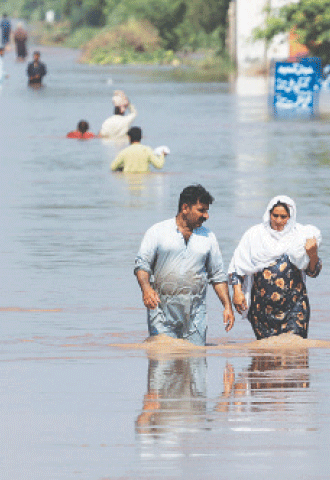
MANDI BAHAUDDIN: Residents wade through a flooded road in Qadirabad village near the River Chenab.—Reuters
LAHORE: The Punjab government has launched one of its largest evacuation operations in recent years, as floodwaters affected over 1.46 million people across the province, with the Chenab River expected to swell to dangerous levels at Head Trimmu.
Extremely high floods in the Sutlej, Ravi and Chenab rivers have also resulted in the loss of 17 lives.
The province is battling its worst flooding in four decades, which has caused havoc in hundreds of villages and submerged vital grain crops.
Torrential monsoon rain and India’s release of excess water from its dams swelled the three rivers that flow into the province, forcing authorities to breach riverbanks in some places and causing flooding in more than 1,400 villages.
Authorities warned that between 700,000 and 800,000 cusecs of water could pass through the Chenab River system in the next 48 hours, threatening widespread devastation.
The relocation effort covers several districts and hundreds of towns, including Jhang, Shorkot, Khanewal, Multan, Muzaffargarh, Shujaabad, Jalalpur Pirwala and Alipur.
Water levels
As of 12am on Friday, Trimmu near Jhang was in normal flow at 117,534 cubic feet per second (cusecs), but was showing a rising trend, according to the Flood Forecasting Division.
The division reported falling trends upstream. At Marala Headworks near Sialkot, the flow has dropped to 106,496 cusecs (low flood), while both Khanki and Qadirabad headworks stand at 305,436 cusecs.
While the Ravi River has stabilised at Jassar near Narowal (95,580 cusecs), Shahdara was in “exceptionally high flood” with a water outflow of 219,770 cusecs, though the trend was steady. The next stop, Head Balloki near Pattoki, was in the “high flood” category at 114,110 cusecs and showing a rising trend.
Further downstream, Head Sidhnai near Abdul Hakeem showed a rising trend, with an inflow of 25,443 cusecs and outflow of 10,093 cusecs.
On the Sutlej River, Ganda Singh Wala near Kasur was in “exceptionally high flood” at 261,053 cusecs, Sulemanki near Bahawalnagar was in “medium flood” at 113,124 cusecs, and Head Islam was in “low flood” at 52,706 cusecs.
Meanwhile on the Indus River, Tarbela Dam showed a normal flow with an outflow of 155,400 cusecs.
Scale of damage
According to PDMA data, over 1.46 million people in 1,692 mouzas have been affected due to extremely high floods in the Sutlej, Ravi and Chenab rivers, with a total of 17 lives lost.
The government has evacuated over 265,000 people, of whom 1,372 were living in 355 relief camps and 6,656 were provided with medical help, whereas 90,348 people and 154,980 cattle were transported to safety.
A total of 991 villages were submerged due to flooding in the Chenab River. Some 395 villages were affected by the floods in Sialkot, 127 in Jhang, 124 in Multan, 48 in Chiniot, 66 in Gujrat, 51 in Khanewal, 45 in Hafizabad, 41 in Sargodha, 35 in Mandi Bahauddin, and 19 villages in Wazirabad.
Due to flooding in the Chenab, more than one million people have been evacuated and relocated to safe locations so far. Some 73,000 animals have been moved to safe locations, and 72 veterinary camps have been set up in affected districts.
In the Ravi, around 80 villages were submerged, including 75 in Narowal, four in Sheikhupura, and one in Nankana Sahib. Around 11,000 people have been evacuated and relocated to safe locations so far. Nearly 4,500 animals have been moved to safe locations. A total of 52 veterinary camps have been set up in affected districts.
As for the Sutlej River, a total of 361 villages were submerged, including 72 in Kasur, 86 in Okara, 24 in Pakpattan, 27 in Multan, 23 in Vehari, 104 in Bahawalnagar and 25 villages in Bahawalpur. Nearly 127,000 people have been evacuated and relocated to safe locations so far. A total of 70,000 animals have been moved to safe locations, whereas 90 veterinary camps have been set up.
‘No compensation’
Information Minister Attaullah Tarar on Thursday lauded the exemplary coordination among all stakeholders for averting a major flood disaster in Gujranwala and Wazirabad.
Speaking to the media in Wazirabad, he assured that arrangements were in place for the provision of relief items, including tents, food and medical supplies.
A survey is currently underway to estimate livestock losses, and compensation will be provided to affected individuals. However, he stressed that no compensation would be given for structures built illegally in these high-risk areas.
Meanwhile, flooding also disrupted flight operations at Sialkot International Airport, where services were suspended for 24 hours on Thursday.
![ .]https://ift.tt/XnL9P4a)
The airport spokesperson confirmed that the runway and terminal were safe, with drainage work underway.
An official told Dawn that the last flight from Sialkot airport — a Dubai-bound Flydubai — departed on Thursday morning.
PM, CM visit affected areas
Prime Minister Shehbaz Sharif, accompanied by Punjab Chief Minister Maryam Nawaz Sharif, conducted an aerial survey of affected areas on Thursday. NDMA Chairman Lt Gen Inam Haider briefed the premier on the overall situation.
During her visit to the Ravi, CM Maryam expressed regret that the crisis had been aggravated by the opening of spillways by India but noted that the province’s early warning system was functioning effectively, allowing the timely evacuation of residents.
International support
President Recep Tayyip Erdogan of Turkiye phoned PM Shehbaz to express solidarity and offer assistance in rescue and relief efforts.
“Turkiye stands ready to help in any way possible, including during the rescue and relief efforts,” President Erdogan said, according to the PM Office.
PM Shehbaz thanked him for the support, calling it reflective of the “deep-rooted fraternal ties” between the two nations.
Zulqernain Tahir in Lahore, Waseem Ashraf Butt in Gujrat and Syed Irfan Raza in Islamabad also contributed to this report. With input from APP and Reuters
Iran’s Foreign Minister Abbas Araghchi said on Thursday that Tehran would respond to a decision by France, Britain and Germany to trigger a mechanism reimposing UN sanctions under a moribund 2015 nuclear deal.
“The Islamic Republic of Iran will respond appropriately to this illegal and unjustified action by the three European countries, in order to protect and guarantee its national rights and interests,” Araghchi told his French, British and German counterparts in a phone call, according to a statement from his ministry.
He called on the three countries to “appropriately correct this wrong decision in the coming days”.
While Araghchi did not specify what retaliatory measures Iran might take, Tehran has previously warned that such a move could lead to the exclusion of the European powers from any future negotiations on Iran’s nuclear programme.
In a statement, the Iranian foreign ministry said: “This decision by the three European countries will seriously undermine the ongoing process of interaction and cooperation between Iran and the International Atomic Energy Agency (IAEA),” the foreign ministry said in a statement, calling the move a “provocative and unnecessary escalation”.
The move by the European trio — known as the E3 — took place just days after Iranian and European diplomats held talks in Geneva, the second since Israel’s attack on Iran that started a 12-day war in June.
The E3 had been threatening in recent weeks to activate the so-called “snapback” mechanism, citing Iran’s continued non-compliance with its commitments under the 2015 nuclear agreement.
The three powers launched a 30-day process to reimpose sanctions, fearing they would otherwise lose the prerogative in mid-October to restore them.
French Foreign Minister Jean-Noel Barrot said the decision did not signal the end of diplomacy, while his German counterpart, Johann Wadephul, urged Iran to now fully cooperate with the UN nuclear watchdog agency and commit to direct talks with the United States over the next month.
That deal was torpedoed in 2018 when Donald Trump, during his first term as president, unilaterally withdrew the United States and slapped crippling sanctions on Iran.
Tehran and Washington had begun nuclear talks in April with the aim of reaching another deal, but these negotiations were derailed by the war with Israel, during which the United States also struck Iranian nuclear sites.
THIS monsoon season has laid bare how politics is seeping into the riverbanks, eroding one of South Asia’s most enduring mechanisms of cooperation at a time when the region needs it most.
After all, New Delhi has used the devastating floods sweeping across northern India and Pakistan to reassert its unilateral suspension of the Indus Waters Treaty (IWT), while trying to present its ‘limited alerts’ as gestures of concern.
The IWT, signed in 1960, has long been hailed as a rare success story in an otherwise conflict-prone relationship. Through wars and diplomatic standoffs, it provided a framework for data sharing, water allocation, and flood management.
Between July and October, this system used to enable near-continuous updates on river flows, with information exchanged via the Permanent Indus Commission (PIC), a joint body established for that very purpose.
That arrangement had been gradually eroding over the past decade, but it effectively collapsed this year after India, in April, placed the treaty in what it termed “abeyance” following the Pahalgam terrorist attack. It was an unprecedented step in the treaty’s history.
Since then, the routine flow of data has dried up. Before the decline that began around 2013–14, the IWT framework enabled a highly detailed exchange of flood information.
Notifications were not limited to generic warnings; they included advance forecasts of potential flood volumes, expected timings, and specific rivers likely to be affected. The data shared was granular down to daily, site-specific measurements covering river levels, discharges, and projected inundation zones.
This monsoon, however, India issued flood alerts concerning the Tawi and Sutlej rivers. But instead of using the PIC, the notifications were sent via the Indian High Commission in Islamabad.
These alerts were skeletal, often containing little more than a “high flood” classification, leaving Pakistani authorities to guess at the discharge volumes and timings.
Former Federal Flood Commissioner Ahmed Kamal voiced frustration at this vagueness: “The Indian side is just providing the information in a very generic way by stating only the flood classification (High Flood) with no specific details on discharge magnitude.”
India insists these alerts are acts of goodwill rather than treaty obligations, citing its declaration of abeyance. Its media has portrayed them as evidence of New Delhi’s “humanitarian face” despite strained ties.
‘Weaponisation’
Experts, however, warn that bypassing the PIC undermines the treaty’s institutional framework and risks turning flood management into a political instrument.
Abdul Basit, a former high commissioner to India, observed: “India’s move to notify the floods through diplomatic channels carried a threefold message – to the domestic audience, it signaled that New Delhi would show no flexibility on the issue of suspension of the IWT; to Pakistan, it conveyed that its pressure for the treaty’s revival would be ineffective; and to the world, it projected that India had acted on humanitarian grounds, showcasing a humane and considerate side despite prevailing tensions.”
On the ground, the human toll has been severe. Punjab’s Narowal district, one of the worst affected, has seen extensive displacement and destruction of crops and homes. Planning Minister Ahsan Iqbal, visiting his inundated constituency, accused New Delhi of aggravating the disaster.
“It appears India had deliberately accumulated water and released it in massive volumes to inflict severe damage on Pakistan. The weaponisation of water and its use as a tool of aggression must be condemned, though climate change had also played a role. Had India cooperated with Pakistan under the Indus Waters Treaty to manage this crisis, the scale of devastation could have been mitigated,” he said.
Islamabad, for its part, has continued to honour the treaty’s mechanisms despite rising tensions.
Water politics
On Wednesday, Pakistan issued its own flood alerts for the Ravi, Sutlej, and Chenab rivers using the traditional channel of the Pakistan Commissioner for Indus Waters – the very route India has chosen to sideline. This contrast underscores a broader reality that while India frames its limited notifications as moral gestures, Pakistan is striving to preserve the institutional framework that for decades allowed both countries to prepare for and sometimes avert monsoon catastrophes.
The implications go far beyond the immediate floods. Article IV para 8 of the IWT, along with Annexure F, clearly mandate advance notification, mutual consultation, and data sharing to avoid material damage across borders.
By placing the treaty’s provisions in abeyance, India risks setting a precedent where water becomes another arena of political manoeuvring. This is especially perilous in an era of intensifying climate change, when glacial melt and erratic monsoons are increasing both the frequency and severity of floods.
The question now is not only whether the Indus Waters Treaty can withstand this political storm, but also what the cost of its erosion will be for the millions living along the Indus basin. Floods do not respect borders and their destruction is indiscriminate. When vital data is withheld or diluted for political signalling, it is farmers, villagers, and urban dwellers downstream who pay the price through lost crops, submerged homes, and forced displacement.
When officials warn of a “medium”, “high”, “very high” or “exceptionally high” flood, what does that actually mean?
Over the past week, as Punjab’s rivers have swollen, these technical terms have dominated official updates. Behind these terms lies a simple story about water, river capacity and the limits of infrastructure.
What is a cusec?
Flood levels are measured in cusecs — short for “cubic feet per second.” One cusec equals the flow of one cubic foot of water every second, or about 28 litres. Put simply, a flow of 100,000 cusecs means nearly 283,000 litres of water rushing past in just one second. On Wednesday, the Ravi at Jassar was recorded at 229,000 cusecs at one point — enough to overwhelm the river’s safe capacity.
How flood levels are decided
However, flood intensity is not judged by one number alone. It depends on the size of each river and how much water it can normally carry. Smaller rivers such as the Ravi and Sutlej reach critical levels quickly — 200,000 cusecs here is already “very high flood”. Larger rivers such as the Chenab or the Indus can hold far more. At Head Marala, the Chenab swelled to over 750,000 cusecs this week and was declared in “very high flood”. By contrast, the Indus at Chashma carried 284,000 cusecs but remained below flood level, thanks to its massive capacity.
Medium vs high flood
Officials use categories to describe the severity of flooding:
Medium flood: The river is within capacity but under pressure.
High flood: Water far exceeds normal limits, threatening banks, farmland and villages.
Very high flood: Extreme pressure where engineers may need to breach embankments or canals to save a barrage.
Exceptionally high flood: The most dangerous category, when water flow is far beyond a river’s design capacity and poses a risk to major infrastructure and large populations.
What are headworks and barrages?
Headworks and barrages are built across rivers to regulate flow, divert water into canals and maintain levels for irrigation. Each has a design limit for maximum water passage. If inflows exceed those limits, all gates are opened — but if pressure still builds, authorities may deliberately cut embankments or canals to protect the structure, even if that means sacrificing farmland or nearby villages.
Another suspect in the torture of two brothers by street vendors in Raiwind was arrested, a lawyer representing the victims said on Wednesday.
The incident went viral on social media when a video clip showed some street vendors subjecting both brothers to severe torture on a road in the Raiwind area a few days back. They were lying in a pool of blood, and the suspected attackers, holding clubs in their hands, were spotted torturing them at a public place with many onlookers and passersby standing around. One brother died of severe torture marks at the spot, while the other succumbed to his injuries on Sunday.
The main suspect was arrested and handed over to the Crime Control Department (CCD) on Tuesday.
Ali Ahmed Awan, a lawyer representing the victims’ father, told Dawn.com that police have arrested the main suspect from Sahiwal.
“A total of six suspects are named in the case and so far, three have been arrested,” Awan said. “Police arrested the suspect from Sahiwal with the help of modern technology.”
The lawyer added that the suspect fled Raiwind after the incident and went into hiding in Sahiwal.
“The police are cooperating with us and we are satisfied with their performance,” Awan said. “Police raids are also being carried out to arrest the other suspects.
“All the suspects should be arrested and strict action should be taken,” he continued.
A first information report (FIR) of the incident was filed on the complaint of the victims’ father on August 22 at the Raiwind City Police Station under Sections 147 (punishment for rioting), 149 (unlawful assembly) and 302 (murder) of the Pakistan Penal Code.
It said the incident occurred on August 21 at 5:45pm when the brothers were returning home and stopped to buy some fruit. “Due to a dispute over money, the owner of the fruit cart … and his brother … began beating my sons and called some other people,” the complainant said.
In June, Karachi police arrested a main suspect along with his two employees over charges of beating a citizen after a video of the incident went viral on social media, prompting authorities to take notice of it.
ISLAMABAD: The National Commission for Human Rights (NCHR) launched a study on Tuesday exposing human rights abuses against brick kiln workers in the country.
The study, titled “Unveiling exploitation and abuse in the brick kilns of Punjab”, was conducted in collaboration with the Pakistan Partnership Initiative.
The investigation highlighted systemic exploitation, gender-based violence, debt bondage, and widespread denial of basic labour rights to brick kiln workers.
The report was based on extensive field research in Faisalabad and Kasur — two of Punjab’s brick kiln hubs. Surveys of 200 workers and in-depth interviews with 30 victims led to documented case studies. The study engaged trade unions, kiln owners, and officials from the Punjab Labour Department to provide a multi-stakeholder perspective.
Speaking at the launch event, NCHR Chairperson Rabiya Javeri Agha said: “Today’s report follows months of fieldwork, interviews, and surveys identifying violence, exploitation, and abuse in Punjab’s brick kilns. It documents laws ignored, promises broken, and dignity denied.”
She said the NCHR had long been demanding reform in this most inhumane of sectors. “For all of us, ending bonded labour is not charity. It is not a favour. It is justice and human dignity. It is the fulfilment of our Constitution’s promise.”
Justice Jawad Hassan of the Lahore High Court, the chief guest, said the evolution of bonded labour from colonial bondage to constitutional protection showed progress, but the brick kiln horrors reminded of unfinished work.
“It is incumbent not just on the judiciary but also on the legislative and executive branches to work towards correcting these horrors and let this report ignite collective action for a Pakistan where no worker is bonded, and dignity prevails,” Justice Jawad Hassan said.
He called for legislative reforms, judicial and institutional strengthening and collaborative action to end this extreme form of exploitation.
Violation of Constitution
Abdul Khalique Shiekh, the Secretary, Ministry of Human Rights, said: “Bonded labour is a violation of our Constitution, our laws, and our commitments under international human rights treaties.” He said the government had taken important steps to ensure that brick kiln workers live a life of dignity, citing amendments to labour laws, initiatives like the Elimination of Bonded Labour in brick kilns project and efforts to regulate advances. “But we know more is needed.”
Abdul Khalique Shiekh said such studies were essential to show where gaps remained between law and enforcement, between policy and practice. “They remind us that passing laws is only the first step. Implementation is the true test of justice.”
Ashraf Wadhawa Mall, the PPI CEO, said the study had exposed the extreme conditions faced by brick kiln workers. He said so far 2,339 families from brick kilns across the country had been rescued and rehabilitated.
The study documents extreme abuses ranging from verbal and physical harassment to cases of abduction and even murder. Women workers remained especially vulnerable, subjected to rampant sexual harassment, coercion, and forced marriages. Workers continued to labour in unsafe, unhygienic, and exploitative conditions under extreme weather, often receiving wages well below the legal minimum and having no access to social security.
The study showed that 97 per cent workers entered kilns because of urgent loans, 90pc had no written contracts, leaving them invisible to labour protection efforts and over 70pc of families lived in a single cramped room. It said 92pc workers reported verbal abuse, many described beatings, torture and even abductions.
ISLAMABAD: Google has launched its new ‘AI Mode’ in Pakistan, offering users access to its most advanced AI-powered search experience.
First introduced in the United States this year, the feature is now expanding globally, with Pakistan among the latest countries to gain access.
The tool, powered by a custom version of Gemini 2.5, enables people to ask longer and more complex questions that previously required multiple searches. Available in English, AI Mode can be accessed via the Google app on Android and iOS, as well as on mobile and desktop web.
In a statement, Google said that early testers have shown that queries are already two to three times longer than traditional searches, highlighting the tool’s usefulness for exploratory tasks such as comparing products, planning trips, or tackling “how-to” questions.
“It dives deep to answer multiple questions at once, with helpful links for further exploration,” the company said.
Google explained that Pakistani users can use ‘AI Mode’ for different use cases, including “Planning a trip” by writing a prompt about a trip to any place at a particular time and seeking suggestions from the AI mode for a five-day itinerary that balances sightseeing, adventure and local food experiences, with a follow-up prompt: “Can you recommend some local food spots or traditional dishes in that particular area?”
At the same time, the other prompts could be related to the education of children, such as the example of a child in grade 9 struggling with math. “Can you suggest free online resources in Pakistan to help with algebra and geometry?” and the follow-up prompt like “Can you recommend interactive apps or YouTube channels for grade 9 math practice?”
Behind the scenes, AI Mode uses a “query fan-out” technique, breaking down a user’s question into subtopics and running multiple searches simultaneously.
This approach allows Google to surface highly relevant content from across the web, combining it with information from the Knowledge Graph and real-time shopping data for billions of products.
The feature is also multimodal, allowing users to interact through text, voice or images. For example, a photo of unfamiliar spices at a local market could be uploaded with the question: “What are these spices and how can I use them in Pakistani cooking?” Follow-up questions can then be asked in a conversational style, creating a seamless browsing experience.
Google said AI Mode is designed to deliver deeper, smarter and more comprehensive results, but acknowledged that, as with any early-stage AI system, responses may not always be accurate.
At least 25 countries have decided to suspend package deliveries to the United States, as concern grows over the impact of President Donald Trump’s looming tariffs, a UN body said on Tuesday.
The Trump administration said late last month that it would abolish a tax exemption on small packages entering the US from August 29.
The move has sparked a flurry of announcements from postal services, including in France, Britain, Germany, Italy, India, Australia and Japan, that most US-bound packages would no longer be accepted.
The United Nations’ Universal Postal Union (UPU) said it had already been advised by 25 member countries that their postal operators “have suspended their outbound postal services to the US, citing uncertainties specifically related to transit services”.
It said the suspensions would remain in place until there was more clarity on how US authorities planned to implement the announced measures.
The UPU did not provide a list of postal services it had heard from.
‘Considerable operational changes’
The organisation, which was established in 1874 and counts 192 member states, warned that the new US measures would “entail considerable operational changes for postal operators around the world”.
From Friday, the UPU said the measures would require postal carriers delivering packages to the US “to collect customs duties from senders in advance”, on behalf of the US Customs and Border Protection agency.
India’s communications ministry said at the weekend that Trump’s executive order issued last month required transport carriers or other “qualified parties” approved by US authorities to collect and remit the tariff duties.
But “several critical processes relating to the designation of ‘qualified parties’ and mechanisms for duty collection and remittance remain undefined,” it said in a statement.
Under the new US measures, individual customers will still be able to send documents and items worth up to $100 as presents to the country without being taxed.
But anything above that value is expected to be hit with the same tariff rates applied to other imports from the sending country.
That means 15 per cent for countries in the European Union and 50pc for India.
And Germany’s postal service DHL warned last week that even exempted items would be subject to extra checks to prevent the service from being used for commercial goods.
‘Sustainable solutions’
The UPU stressed that it was “taking all possible measures to prepare its member countries for the impacts [the new measures] may have on their postal flows”.
UPU chief Masahiko Metoki had sent a letter to US Secretary of State Marco Rubio on Monday to convey member countries’ concern regarding the operational disruptions, it said.
Pointing to the short implementation timeline and voicing particular concern over the impact on the delivery of e-commerce items, the union said it was “working with the relevant US authorities to ensure that information on the operational requirements of the measures is communicated effectively to other member countries”.
In parallel, it said it was working with “relevant postal stakeholders” to help find sustainable solutions, including one initiative aimed at developing a system to facilitate duty collection and remittance across its network.
RELATIONS between Pakistan and Bangladesh, which had hit a low point during Sheikh Hasina Wajed’s rule, are on the mend under the interim administration in Dhaka.
Foreign Minister Ishaq Dar recently wrapped up a trip to Bangladesh — the first time a Pakistani foreign minister has visited Dhaka in 13 years. He received a warm reception, with six “instruments” signed to bolster ties in various sectors, while Chief Adviser Muhammad Yunus and Bangladesh’s adviser on foreign affairs both expressed a wish to deepen relations. There was also talk of reviving Saarc, though both states differed on how to approach the tragic events of 1971.
Dhaka insists on an apology for the violent upheaval that led to the break-up of united Pakistan as well as reparations, while Islamabad feels these questions have already been settled.
Sheikh Hasina’s regime used the 1971 war to justify its hostile attitude towards Pakistan and warm ties with India. But there have been changes in Bangladesh since then.
For example, after the ouster of the Awami League government last year, there have been violent attacks on statues and institutions linked to Sheikh Mujibur Rahman — once virtually deified as ‘Bangabandhu’ — and the interim set-up has removed his visage from Bangladeshi currency.
These reactions have occurred largely because Sheikh Hasina’s government had promoted a personality cult around Sheikh Mujib, and unleashed a ruthless crackdown on all opposition forces. Therefore, while both Islamabad and Dhaka should continue their discussions on how to approach the 1971 events, this issue should not become an obstacle to better ties, as both capitals have common grounds for friendship.
In this context, there is merit in the Pakistani state’s argument that differences over the separation of East Pakistan and the creation of Bangladesh have been addressed by Pakistan’s 1974 recognition of Bangladesh, and Gen Pervez Musharraf’s expression of “regret” during his 2002 visit for the excesses of 1971.
There is indeed a need for all sides to come to terms with the tragedy of 1971, but this does not mean that Islamabad-Dhaka ties should remain forever hostile.
Meanwhile, while the suggestion to revive Saarc may be well-intentioned it is impractical at this point because of India’s intransigence — even if it is worth a try. There is already a trilateral cooperation mechanism involving China, Pakistan and Bangladesh.
This forum can be further explored to deepen ties between the three states, and other regional countries who wish to work together for progress can be invited to join. Pakistan and Bangladesh share a common history and culture, and despite the painful events of 1971, they can become partners in regional progress through trade and people-to-people ties. It is hoped that the next elected government in Dhaka will also work to improve ties.
United States President Donald Trump said on Monday that he expects to visit China this year or shortly afterwards, noting that economic ties between the two countries have improved — even as he kept the door open to steeper tariffs.
Speaking to reporters as he met South Korean President Lee Jae Myung in Washington, Trump pointed to recent talks with Chinese counterpart Xi Jinping: “At some point, probably during this year or shortly thereafter, we’ll go to China.
“We’re going to have a great relationship with China,” Trump vowed.
The US leader added: “They have some cards. We have incredible cards, but I don’t want to play those cards. If I played those cards, that would destroy China.”
Tensions between the world’s two biggest economies have been simmering this year, but have significantly cooled since April, when both countries slapped escalating tariffs on each other’s exports.
At one point, the tit-for-tat duties reached triple digits on both sides, snarling supply chains as many importers halted shipments to try and wait for the governments to work things out.
Since then, Washington and Beijing have reached an agreement to de-escalate tensions, temporarily lowering tariffs to 30 per cent on the United States’ side and 10pc on China’s part.
But Trump on Monday kept the door open to hiking tariffs again if China did not hold up its end of the bargain.
“They have to give us magnets,” Trump said. “If they don’t give us magnets, then we have to charge them [a] 200pc tariff or something.” “But we’re not going to have a problem, I don’t think, with that,” he added.
The US-China truce has been an uneasy one, with Washington previously accusing Beijing of violating their agreement and slow-walking export license approvals for rare earths.
China is the world’s leading producer of rare earths, used to make magnets essential to the automotive, electronics and defence industries. The countries have since agreed to move forward.
This month, they delayed the threatened reimposition of higher tariffs on each other’s exports for another 90 days — meaning the pause on steeper duties will be in place until November 10.
Trump says he wants to meet with North Korea’s Kim this year
Trump said, “I have a very good relationship. I understand them. I spent a lot of free time with them, talking about things that we probably aren’t supposed to talk about. And you know, I just, I get along with him really well. I think he has a country of great potential, tremendous potential.”
Asked if he wanted to meet with Kim this year or next year, Trump replied, “Well, I’m meeting a lot of people. I mean, it’s hard to say that, but I’d like to meet him this year.”
Trump, who met Kim Jong Un three times in his first term, hailed their relationship and said that he knew him “better than anybody, almost, other than his sister”.
“Someday I’ll see him. I look forward to seeing him. He was very good with me,” Trump told reporters earlier today.
Trump contended that North Korea has been firing fewer rockets since he returned to the White House on January 20.
He has boasted that he has solved seven wars in as many months back in the job — a claim that is contested — but has been quiet on North Korea despite the unusually personal diplomacy during his 2017-2021 tenure.
Trump once said that he and Kim “fell in love.” Their meetings reduced tensions but failed to produce a lasting agreement.
Since then, Kim has forged a close relationship with Russia, including sending troops to fight against Ukraine, and has dug in on refusing any dismantlement of North Korea’s nuclear program.
US will back Ukraine’s security, details being worked out, Trump says
The US president stated that he has not discussed specific security guarantees for Ukraine and reaffirmed the US commitment to support the country. The potential security guarantees for Ukraine represent a major obstacle to ending Russia’s war in Ukraine.
Trump also said that during his August 15 meeting with Russian President Vladimir Putin in Alaska, the two leaders discussed limiting the size of their countries’ massive nuclear arsenal once the Ukraine crisis is resolved.
“We would like to denuclearise. It’s too much power, and we talked about that also. That’s part of it, but we have to get the war over with,” Trump told reporters gathered in the Oval Office.
Asked why Putin appears reluctant to sit down with Ukrainian President Volodymyr Zelensky, Trump replied, “Because he doesn’t like him.”
• First meeting of 11th NFC scheduled for Friday
• PTI’s Muzammil Aslam says KP will seek disincentivising population, propose prosperity and forestation as criteria for resource distribution
• KP minister rues imbalance in Centre’s approach to smaller provinces
NATHIA GALI: For a change, the federal government led by the PML-N and the Khyber Pakhtunkhwa government headed by the PTI seem to be in agreement on changes to the oversized population factor in determining the share of the federation and its federating units under the new National Finance Commission (NFC), set to hold its introductory meeting later this week.
“We will demand that population and backwardness should be disincentivised for resource distribution among the provinces,” said KP Minister for Finance Muzammil Aslam while speaking at the first two-day ‘Prosper Pakistan’ conference organised by the FPCCI Regional Office Peshawar in collaboration with KP’s Board of Investment and Trade.
The federal ministers, particularly development minister Ahsan Iqbal, had been publicly calling for disincentivising the population for NFC shares, although no political party in any province has ever called for the population to secure more funds from the divisible pool. However, the allegations of irregularities in the population census have cropped up in the past, which required improvement in census methodologies. The first meeting of the 11th NFC, constituted last week, has been scheduled for August 29 (Friday) to set the stage for subsequent deliberations.
The apparent converging stance of the two arch rivals — the PML-N and the PTI — is likely to put the two larger provinces, Punjab and Sindh, under immense pressure for disincentivising population as the key determinant for the distribution of divisible pool resources. The revision, however, also benefits Balochistan, the sparsely populated largest province by area.
Led by President Asif Ali Zardari and Prime Minister Shehbaz Sharif, the political partners at the Centre and backed by the relevant quarters, it would be very challenging for junior leaderships of the ruling parties in Sindh and Punjab to resist reducing the importance of population to work out vertical shares of the federation and its federation units and then decide horizontal shares of the provinces.
Mr Muzammil said the KP government would demand changes in the formula of the horizontal resource distribution within the federating units during the upcoming NFC deliberations. He said 82pc resource distribution among the provinces was based on the population criterion and 10.6pc on the basis of backwardness, but the KP government would now stipulate reduction in population, prosperity, and forestation as criteria for the distribution of resources.
He said the new NFC had been constituted to evolve a consensus on the vertical and horizontal distribution of financial resources. The provinces currently receive 57.5pc share under the vertical formula, while the remaining amount goes to the federal government. He said the KP would demand changes in the criteria for the horizontal distribution as well.
‘Imbalance in development approach’
KP’s finance minister, who hails from Karachi, criticised the federal government, saying the National Highway Authority (NHA) was used for the road and highway projects in Punjab and Sindh, but it ignored the KP and Balochistan.
“This imbalance in the development approach has aggravated the situation in the smaller provinces”, while the planning minister Ahsan Iqbal was talking about the collapse of the federal government in five years due to its financial constraints as the development budgets of Sindh and Punjab exceeded that of the Centre.
He told the participants that 12 hydropower projects were currently under construction in KP capable of producing 1,000MW at an estimated supply cost of 8 US cents per unit. However, he said the government had increased the wheeling charges to Rs27 per unit that would block cheaper electricity from the province.
He regretted that the Left Bank Canal could not be constructed in more than three decades since the water apportionment accord was signed in 1991.
Under the 7th NFC award delivered in 2009 and still in force after 15 years instead of a five-year constitutional term, the provincial share had increased to 57.5pc from about 47pc which further increased to about 59pc given special allocations to Balochistan, KP and Sindh on different grounds and reduced the federal share to 42.5pc.
In subsequent years, the Centre imposed a petroleum levy (about Rs1.5 trillion) on petroleum products and secured about Rs1.5tr cash balances from the provinces on an annual basis, effectively reversing the financial balance to its favour. The Centre, however, has been advocating disincentivising the population factor and provincial shares to common responsibilities like dams, natural disasters, climate change and national security etc.
Manchester United remain without a Premier League win this season after being held 1-1 at Fulham on Sunday, while a Jack Grealish-inspired Everton opened their new stadium with a 2-0 victory over Brighton.
Ruben Amorim’s United were left to rue Bruno Fernandes’ wayward first-half penalty as they were pegged back at Craven Cottage.
Rodrigo Muniz’s own-goal put United in front on the hour mark, but Emile Smith Rowe came off the bench to rescue a point for Fulham.
Amorim is seeking an upturn on a disastrous 15th-placed finish last season, but so far his new £200 million ($270 million) forward line of Matheus Cunha, Bryan Mbeumo and Benjamin Sesko, who again started on the bench, has yet to fire.
Despite an encouraging performance, United lost 1-0 to title-chasing Arsenal in their season opener last weekend and will feel another two points slipped away in west London.
Manchester United’s English defender Harry Maguire reacts following the English Premier League football match against Fulham at Craven Cottage in London, England on August 24. — AFP
Fulham, though, felt the visitors got the better of two controversial calls. United’s penalty was awarded after a VAR review for grappling by Calvin Bassey on Mason Mount.
Fernandes is normally reliable from the spot, but blasted his effort high over the bar.
When United did finally get their first goal of the season it came via a Fulham body as Muniz deflected Leny Yoro’s header into his own net.
However, the home side were furious that this time VAR did not intervene for a push by Yoro on Bassey.
Fulham still managed to rescue a point when former Arsenal midfielder Smith Rowe’s run into the box was not tracked and he turned in Alex Iwobi’s cross 17 minutes from time.
Everton’s new era
After an emotional goodbye to Goodison Park, the club’s home since 1892, Everton is hoping the move to a new 53,000-capacity stadium will rekindle their bygone glory days.
Only four clubs have won more English top-flight titles than Everton’s nine. However, they have not won a major trophy for 30 years and spent their final seasons at Goodison battling relegation.
“We’re trying to find a way of moving the club on. I think this is a big step forward for Everton,” said manager David Moyes.
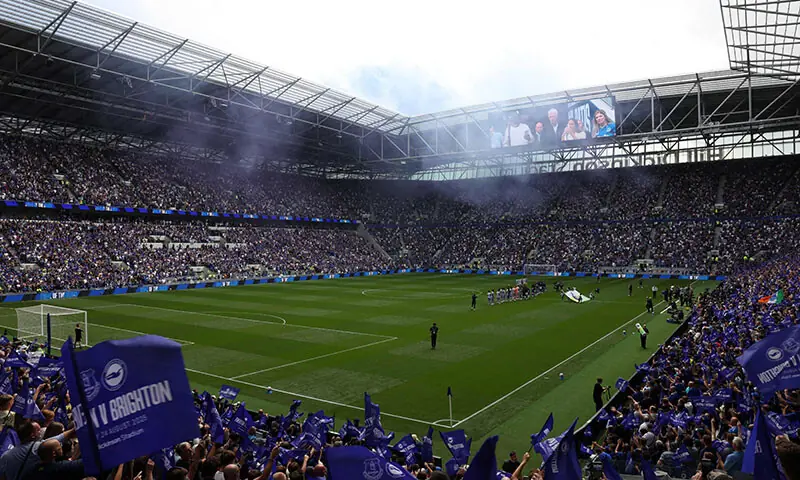
Players walk out onto the pitch ahead of the English Premier League football match between Everton and Brighton and Hove Albion at Hill Dickinson Stadium in Liverpool, northwest England on August 24. — AFP
Grealish has so far been the marquee new addition to Moyes’ squad and showed glimpses of the talent that saw Manchester City pay Aston Villa 100 million for him four years ago, providing the assist for both goals.
Iliman Ndiaye scored the final goal at Goodison against Southampton in May and made more history with the first goal at Everton’s new home. Grealish was the creator with a drilled left-foot cross that Ndiaye timed his run perfectly to meet at the back post on 23 minutes.
Brighton should not have come away from Merseyside empty-handed but wasted a series of chances.
Kaoru Mitoma struck the bar and Jan Paul van Hecke’s effort came back off the post, while Danny Welbeck spooned over with the goal gaping. James Garner doubled Everton’s lead early in the second period with a blistering strike from Grealish’s lay-off.
Brighton still had the chance to set up a nervy finale, but Jordan Pickford saved Welbeck’s poor penalty to round off a memorable afternoon for the Toffees.
Nuno no go
Nottingham Forest manager Nuno Espirito Santo insisted he wants to remain in charge after his side’s 1-1 draw at Crystal Palace.
Callum Hudson-Odoi rescued a point for Forest after Ismaila Sarr’s first-half opener for Palace.
Nottingham Forest’s English midfielder James McAtee (R) vies with Crystal Palace’s English midfielder Romain Esse (L) during their English Premier League football match at Selhurst Park in south London, England on August 24. — AFP
Nuno said on Friday his relationship with owner Evangelos Marinakis had deteriorated as odds on him being the first Premier League manager of the season to be sacked were slashed.
“That is nonsense. That does not make any kind of sense,” said the Portuguese coach on whether he is trying to engineer an exit from the club.