Sports News Onli brings the latest sports news, live match updates, scores, and highlights from cricket, football, hockey, and other international sports.
US President Donald Trump says Iran’s Supreme Leader Ayatollah Ali Khamenei “is dead”.
His claim came hours after Israel and the US launched an attack on Iran and followed reports quoting Israeli officials as saying that Khamenei had been assassinated.
But, subsequent Iranian media reports said that Khamenei was “steadfast and firm in commanding the field”.
Khamenei, 86, became Iran’s highest authority in 1989, following the death of the Islamic Republic’s founder, Ayatollah Ruhollah Khomeini.
As supreme leader, he has held ultimate control over Iran’s political, military and religious institutions, shaping domestic policy and guiding foreign relations.
An article published in Al Jazeera says “critical to Khamenei’s power is the loyalty of two of Iran’s premier security institutions – the Islamic Revolutionary Guard Corps (IRGC) and the Basij paramilitary forces, which have hundreds of thousands of volunteers”.
Khamenei upheld the conservative vision of his predecessor, Khomeini, quashing the ambitions of elected presidents who sought more open policies at home and abroad. Under his rule, authorities crushed repeated protests and sidelined reformists pushing for less confrontation with the West.
He backed the 2015 nuclear deal brokered with world powers and pragmatist former Iranian president Hassan Rouhani, which briefly eased Iran’s isolation. But tensions spiked after US President Donald Trump abandoned the accord in 2018 and reimposed sanctions.
Israel has long seen him as a destabilising force in the Middle East, citing his alleged backing for a network of militant allies.
When Israel and Iran fought a 12-day air war in June 2025, Israeli Defence Minister Israel Katz threatened to assassinate him, saying the supreme leader “cannot continue to exist.”
The government on Saturday raised the price of petrol by Rs8 per litre and that of high-speed diesel (HSD) by Rs5.16 per litre for the next fortnight, according to a press release issued by the Petroleum Division.
Following the increase, the price of petrol has jumped from Rs258.17 to Rs266.17 while the HSD price now stands at 280.86.
According to the press release, the government has revised the petroleum products’ prices based on the Oil and Gas Regulatory Authority’s recommendations.
The new prices are effective from March 1, the press release said.
Petrol is mostly used in private transport, small vehicles, rickshaws and two-wheelers and has a direct bearing on the budget of the middle and lower-middle class.
While the heavy transport sector runs on HSD, its price is considered inflationary as it is mostly used in heavy transport vehicles, trains and agricultural engines like trucks, buses, tractors, tube-wells and threshers, and particularly adds to the prices of vegetables and other eatables.
Prime Minister Shehbaz Sharif on Saturday directed all relevant institutions at the federal and provincial levels to immediately ensure comprehensive and effective security measures in view of the prevailing situation.
The premier chaired a high-level review meeting in Lahore on the overall security situation in the country, according to the report.
The development comes in the wake of Pakistan launching Operation Ghazab lil-Haq after the Afghan Taliban opened unprovoked fire on multiple locations across the border in Khyber Pakhtunkhwa on Thursday.
PM Shehbaz emphasised that all institutions must discharge their responsibilities with mutual coordination and complete harmony.
The participants of the meeting informed the prime minister that all security agencies were on alert in light of the current situation and that all necessary measures were being taken to safeguard national security.
In view of the evolving situation in Iran, which was struck by US and Israel earlier in the day, the premier directed the Ministry of Foreign Affairs to take all necessary steps to ensure the safe repatriation of Pakistanis in the country.
He directed that they be brought back safely to Pakistan via Azerbaijan.
In this regard, the prime minister further directed the ministry to immediately contact the government of Azerbaijan.
PM Shehbaz stated that the people of Pakistan and the armed forces were fully prepared at all times to safeguard the country’s security, sovereignty and territorial integrity.
“Under the leadership of Chief of Defence Forces and Chief of Army Staff Field Marshal Asim Munir, the armed forces of Pakistan are performing their duties in the best possible manner with national spirit and dedication,” he said.
The prime minister further said, “The entire nation salutes the sacrifices being rendered by the security forces in the war against terrorism.”
• Israel’s Supreme Court freezes ban on foreign aid organisations in enclave
• US public sympathy shifts to Palestinians over Israel, new Gallup poll reveals
CAIRO: Relentless Israeli attacks killed at least seven Palestinians in Gaza on Friday, medics said, adding to a death toll of at least 600 people killed by Israeli fire since a US-brokered ceasefire agreement came into effect last October.
Gaza’s health officials reported that in southern Gaza, five people were killed and several others were injured, some critically, in Israeli drone strikes. The strikes targeted two police checkpoints in Khan Yunis and in the Abu Hujair area northwest of the Bureij refugee camp later in the day, medics said.
Separately, an Israeli airstrike against a group of Palestinians in Gaza City’s Tuffah neighbourhood in northern Gaza killed two people and wounded several others.
Ban on NGOs frozen
Meanwhile, Israel’s Supreme Court decided in a ruling published on Friday to freeze a government ban on 37 foreign NGOs working in Gaza and the occupied West Bank pending a final decision.
“Without taking any position, a temporary interim order is hereby issued,” the court said in a ruling responding to a petition from more than a dozen NGOs, seeking to reverse the ban after Israel’s government revoked their status in Israel.
The decision theoretically allows the NGOs to work in Gaza and the West Bank until a final ruling, but aid groups are unsure about the freeze’s implementation.
Organisations like MSF, Oxfam, the Norwegian Refugee Council, and CARE were informed on Dec 30, 2025, that their Israeli registrations expired and they had 60 days to renew them by providing Palestinian staff lists.
If they failed to do so, they would have to cease operations in Gaza and the West Bank, including east Jerusalem, from March 1.
The NGOs, through AIDA, petitioned the Supreme Court after losing their charity registration in Israel, following a year-long refusal to disclose their Palestinian employees to Israeli authorities.
The court said in its ruling that there existed a “genuine legal dispute” due to the foreign NGOs’ responsibilities to their employees’ privacy under European law.
“We are still waiting to see how the injunction will be interpreted by the state and whether or not this will mean an increase in our ability to operate”, Athena Rayburn, AIDA director, told AFP, calling it “a step in the right direction”.
Sympathy shifts to Palestinians
Separately, a fresh Gallup poll shows that for the first time, Americans sympathise more with Palestinians than with Israelis in their decades-long conflict.
The poll, released on Friday, found that 41 per cent of Americans sympathise more with the Palestinians and 36pc sided with Israel, a sharp reversal from just a year ago when Israel led in sympathies 46 to 33pc.
For the first time in over two decades, Israel is not leading in Gallup’s poll, though the gap is not significant.
Partisan views on the Middle East show more independents shifting towards Palestinians, with an 11-point preference over Israel in the past year.
Democrats overwhelmingly support Palestinians, with 65pc sympathising with them versus 17pc for Israel.
Democrats blame ex-president Joe Biden for insufficient action to curb Israel’s offensive in Gaza after October 7,2023, escalation.
Gallup surveyed 1,001 US adults by telephone from February 2 to 16.
ISLAMABAD: The upper House of Parliament on Friday passed a bill for regulating virtual assets as well as the ‘establishment’ of the Pakistan Virtual Assets Regulatory Authority (PVARA) — a body already set up under an ordinance approved by the president in July last year.
The development comes as the ordinance was set to lapse in early March.
The rules were suspended in the Senate to take up the bill, which was moved by Finance Minister Muhammad Aurangzeb, for immediate consideration.
The preamble of the bill, a copy of which is available with Dawn, stated that it was expedient to establish a dedicated virtual assets regulatory authority to licence, regulate and supervise virtual assets and virtual asset service providers to “ensure investor protection, transparency and market integrity in Pakistan”.
It further stated that it was necessary to provide a comprehensive legal framework to empower the said authority to combat money laundering, terrorist financing, proliferation financing and other illicit activities involving virtual assets, in accordance with international standards.
Regulatory authority
The bill provides for the establishment of the Pakistan Virtual Asset Regulatory Authority, envisioning it as an autonomous corporate body empowered to licence, regulate and supervise virtual asset service providers and issuers in the country.
Elaborating on the body’s functions, the legislation says it will “protect customers and investors and the integrity of Pakistan’s virtual asset markets by establishing and enforcing appropriate safeguards and conduct of business requirements, prudential and operational-resilience, risk-management standards, and measures to prevent money laundering, terrorist financing and other illicit use of virtual assets”.
It shall also attract investment and encourage companies operating in the field of virtual assets to base their businesses in Pakistan.
Moreover, PVARA shall “promote responsible innovation, digital financial inclusion and the development of compliant virtual asset markets within a framework that manages risks and supports financial stability and market integrity”.
The body shall promote, develop, govern, and regulate the adoption, deployment, and scalable use of blockchain technology and distributed ledger technology across Pakistan, the bill further states.
The legislation also states that PVARA will coordinate with the Financial Monitoring Unit, National Anti-Money Laundering and Counter Financing of Terrorism Authority and other relevant authorities, as well as law enforcement agencies, to combat money laundering, terrorist financing and other illicit activities associated with virtual assets, in accordance with the Anti-Money Laundering Act, 2010, other applicable laws and international standards.
The regulatory body will also advise the government on “regulatory, supervisory, technical or emerging-risk matters relating to virtual assets, digital asset markets, tokenisation, stablecoin structures, blockchain, distributed ledger technology, cyber-risks or any matter connected with its mandate”.
The bill also authorises PVARA to devise “regulations, standards, directives, guidelines, handbooks and circulars, or any other instrument”, consistent with the objectives of the legislation and other applicable laws.
It will also be authorised to set risk-management, cybersecurity, data protection and technical standards and “issue, vary, suspend or revoke licences, approvals or directives under this Act and prescribe conditions for such actions”.
The bill further states that it may prescribe licencing conditions, eligibility criteria, renewal requirements and any additional obligations for those issued licences under the yet to be formalised PVARA law.
It will also be authorised to conduct on-site inspections and off-site monitoring of licencees and other entities to ensure compliance with this PVARA law and other relevant rules and regulations.
Moreover, the bill states, the body may also ensure compliance with “data protection, data governance and cyber security obligations by virtual asset service providers subject to supervisory follow-up”.
It will also be empowered to impose administrative sanctions in accordance with the provisions of the PVARA law and “levy such fees, charges and penalties as may be prescribed by rules” devised under this law.
PVARA will also operate regulatory sandboxes in a “transparent and accountable manner” and “enter into cooperation or mutual assistance arrangements with domestic and foreign regulators and law enforcement agencies to facilitate information sharing and coordinated action, including mutual recognition of regulations and licences”, the bill states.
It further details that the body will comprise a chairperson — who will be appointed by the federal government — two secretaries, from the law and finance ministries each, State Bank of Pakistan’s governor, Securities and Exchange Commission of Pakistan chairperson, National Anti-Money Laundering and Counter Financing of Terrorism Authority chairman, Pakistan Digital Authority chairperson and two independent directors “with proven expertise and a strong track record possessing expertise relevant to virtual asset markets, digital technology and digital finance”.
The directors will also be appointed by the federal government.
“The members of the authority, other than ex-officio members, shall hold office for a term of three years and shall be eligible for one further term of three years,” the bill states.
Penalties
The bill states that “whoever, willfully, provides an unlicenced virtual asset service shall be punishable with imprisonment for a term up to five years, or with fine up to Rs50 million, or both”.
It adds that whoever conducts an initial virtual asset offering in contravention” of the rules and regulations established under the PVARA law shall be punishable with imprisonment for a term up to three years or with fine up to Rs25m or with both.
The bill also penalises market manipulation and insider trading.
It further states that “a virtual assets appellate tribunal shall be established and no court shall take cognisance of a legal dispute under this Act or the rules or regulations made thereunder to which the jurisdiction of the Virtual Assets Appellate Tribunal extends”.
The tribunal’s jurisdiction has been described as: “Any virtual asset service provider, licencee, or any other person aggrieved by an order of the PVARA may prefer an appeal before the Virtual Assets Appellate Tribunal within 30 days of the date on which the order was communicated.”
In July last year, the government had announced that President Asif Ali Zardari had approved the ‘Virtual Assets Ordinance, 2025’ to establish an independent regulator for virtual assets and cryptocurrencies.
However, an official statement from the office of the state minister referred to it as the ‘Virtual Assets Act, 2025’, leading to confusion and concerns about why the draft law had not been moved to the National Assembly or Senate, as required for a bill to become an act of parliament.
The confusion was clarified later when the authorities confirmed to Dawn that the regulation was not an act of parliament but rather an ordinance, issued under Article 89 of the Constitution. The provision allows the president to issue an ordinance in urgent matters when both houses are not in session; such ordinances remain in effect for 120 days and do not require passage through the National Assembly and Senate.
ISLAMABAD: After Afghan Taliban forces used “rudimentary drones” to target various parts of the country, a ban has been imposed on flying unmanned aerial vehicles (UAVs) of any kind across the country.
The development comes as several ‘drone attacks’ were reported from across part of Khyber Pakhtunkhwa. Subsequently, during his press briefing, Inter-Services Public Relations (ISPR) chief Lt Gen Ahmed Sharif Chaudhry stated that Afghan forces attempted to use “rudimentary drones” to attack areas like Swabi and Abbottabad.
“However, the anti-drone system over there and the effective deployment took them out,” he said.
According to local reports, at least six people were injured in three drone attacks in Bannu, Swabi and Abbotabad.
In Bannu, a mosque in the Mirbaz Barkazai area was targeted by a quadcopter around Iftar, leaving five worshippers injured. The attack occurred in the evening, while people were inside the mosque breaking their fast.
The incident in Swabi, which occurred near a girls’ school, was one of the first reported incidents of a drone attack in the area. According to Assistant Superintendent of Police Muhammad (ASP) Numan, at least one schoolgirl was injured, while other children narrowly escaped.
The incident occurred in Pabbini, a village located in the mountainous region of Gadoon Amazai, when children were playing near the school. The school had closed early on account of Friday, and the injured girl, identified as Amna, had just stepped out when the drone struck.
ASP Numan said that the injured girl was taken to the hospital for treatment, while residents of the village gathered in large numbers at the site of the attack.
“It was a self-made drone that also contained explosives,” he told Dawn.
Meanwhile, in Abbotabad, no loss of life or property was reported when a drone flying over the cantonment area was brought down by forces around 1pm, the local DPO confirmed.
Ban on drone flying
In view of drones being used, ostensibly by Afghan Taliban forces, to stage attacks inside Pakistani territory, drone-flying has been banned across the country.
In a letter addressed to the chief secretaries of Punjab, Karachi, Khyber Pakhtunkhwa, Balochistan, Azad Jammu and Kashmir and Gilgit-Baltistan as well as the Islamabad chief commissioner, the interior ministry said, “It has been decided to impose an immediate ban on outdoor flying of quadcopters/ UAVs with immediate effect and until further orders.”
It added: “In this regard, the provincial governments are requested to ensure strict enforcement of said ban.”
Subsequently, the administrations of Islamabad, Khyber Pakhtunkhwa, Gilgit-Baltistan, Sindh and Balochistan notified a comprehensive ban on flying UAVs of any sort, for different periods of time.
Punjab had already banned the flying of drones and UAVs in its jurisdiction for 30 days, starting on Wednesday.
The Islamabad administration banned the use of drones, phantoms and camcopters in the federal capital for a period of two months under Section 144 of the Code of Criminal Procedure, which can be extended for another two months.
The ban applies to everyone, except law enforcement agencies and the Islamabad administration.
A spokesperson for Gilgit-Baltistan police told Dawn that flying drones had been banned in all districts with immediate effect, on the orders of the interior ministry.
The region witnessed demonstrations in favour of the Pakistan Army, and security checking was also heightened following the skirmishes between Pakistan and Afghanistan.
In Khyber Pakhtunkhwa, the Home and Tribal Affairs Department issued a notification banning the use of drones, quadcopters and UAVs for one month, classifying it as a “direct or indirect threat and … potential risk to the lives and properties of citizens as well as infrastructure of the government”.
In a separate notification, the additional chief secretary of Sindh also imposed a similar restriction on the use of helicams, drones, UAVs and quadcopters for two months.
The ban, however, would not apply to law enforcement or intelligence agencies and would be enforced by local police.
The Balochistan home department also imposed an immediate and complete ban on the use, possession, and operation of drones, UAVs, quadcopters, camcopters, and other remote-controlled aerial devices across the province.
According to an official notification, the decision was taken in view of security concerns, including the potential use of such devices for surveillance, espionage, transportation of prohibited items and explosives, spreading fear and panic, and disrupting law and order.
The measure was described as necessary to safeguard public safety and protect sensitive installations, public gatherings, key personalities, and official convoys.
Syed Irfan Raza and Iftikhar A. Khan in Islamabad, Jamil Nagri in Gilgit, Manzoor Ali in Peshawar, Rashid Javed in Abbottabad, Muqaddam Ali Khan in Swabi and Muhammad Waseem Khan in Bannu contributed to this report.
• Explosion occurs in Killi Mahmoodabad on outskirts of border town
• Children gathered at a tribal elder’s house to receive yoghurt after breaking their fast
• President Zardari extends condolences to victims’ families
QUETTA: Seven children aged between 8 and 14 years were killed and 22 others, including women and children, were injured when a gas cylinder exploded in a house in Chaman, a town on the Pak-Afghan border, on Thursday.
Officials said the tragic incident occurred in Killi Mahmoodabad, a locality on the outskirts of the district headquarters, Chaman.
According to police officials, children from neighbouring houses had gathered at the house of one of a tribal elder to receive yoghurt to eat after breaking their fast. Meanwhile, a powerful explosion occurred in the kitchen, rocking the border town. The blast blew off the roof of the kitchen and damaged other rooms of the house. The children waiting for yoghurt were buried under the debris.
Rescue teams, along with police, rushed to the site and launched a rescue operation. “Seven children were found dead when the debris was removed,” police said, adding that 22 injured persons, including four women and 18 children, were shifted to the Civil Hospital Chaman.
“We had received seven bodies of children and 22 injured at the Civil Hospital Chaman,” Dr Owais, Medical Superintendent of the hospital, confirmed. He added that the injured included four women and 18 children.
Police said the intensity of the blast completely destroyed the kitchen and badly damaged other rooms of the house. “The children lost their lives after being buried under the debris, while the injured were also trapped beneath the rubble,” officials said, adding that the women injured in the blast were cooking food when the gas cylinder exploded.
Four women and six children who sustained serious injuries were later shifted to the Civil Hospital Quetta for further treatment.
The district administration expressed deep sorrow and grief over the incident, extended condolences to the families of the deceased children, and ordered an investigation to determine the cause of the explosion.
Authorities have urged citizens to take precautionary measures while using domestic gas cylinders to prevent such tragic incidents in the future.
Meanwhile, in a statement, President Asif Ali Zardari extended his heartfelt condolences to the bereaved families, particularly those who lost their children in the blast. “I share the grief of the families who have lost their loved ones, and my thoughts are with them during this difficult time,” he said.
“May the departed souls rest in peace, and may the bereaved families be granted patience and strength,” he added. The president also prayed for the speedy recovery of those injured in the incident.
Pakistan launched Operation Ghazab lil-Haq against the Afghan Taliban, after the neighbouring country opened unprovoked fire on multiple locations across the border in Khyber Pakhtunkhwa on Thursday.
In response, leaders across the political spectrum were united in their stance, lauding the country’s armed forces and asserting that any aggression from Kabul would be responded to firmly.
President Asif Ali Zardari said Pakistan will not compromise on peace and territorial integrity.
“Our armed forces’ response is comprehensive and decisive. Those who mistake our peace for weakness will face a strong response — and no one will be beyond reach,” he warned.
In a statement released by the Prime Minister’s Office, Prime Minister Shehbaz Sharif said the people and armed forces of Pakistan were always ready to protect the security, sovereignty and territorial integrity of the country.
“There will be no compromise on the defence of the beloved homeland and every aggression will be met with a befitting reply,” he said.
“The Pakistani armed forces are equipped with professional capabilities, high training and effective defence strategies and are fully capable of dealing with any internal or external challenge,” PM Shehbaz said.
He said that while Pakistan has always promoted peace, the integrity of the country will not be compromised, and the Pakistani armed forces will resolutely confront every aggression.
Defence Minister Khawaja Asif said: “Our brave armed forces are currently delivering a crushing response to the proxy Taliban and Afghan aggression from India. Defeat is the enemy’s inevitable fate, God willing.”
In a post on X, he also called on the PTI government in Khyber Pakhtunkhwa to stand shoulder-to-shoulder with the federation and other provinces in defending the homeland.
Balochistan Chief Minister Sarfraz Bugti, in a post on X, strongly condemned Afghan Taliban’s unprovoked firing along the Pak-Afghan border in KP.
He said it “has been met with an immediate and effective response” by Pakistan’s security forces under the command of Chief of Defence Forces and Chief of Army Staff Field Marshal Syed Asim Munir.
“Pakistan will defend its territorial integrity and ensure the safety of its citizens at all costs,” he said, adding that the “safe heavens of terrorists in Afghanistan will not be spared at any cost”.
Punjab Chief Minister Maryam Nawaz kept her message short, saying, “Long live Pakistan.”
Sindh Senior Minister Sharjeel Memon, shared a verse from the Holy Quran, adding: “Long live Pakistan.”
National Assembly Speaker Ayaz Sadiq, meanwhile, strongly condemned the unprovoked aggression by Afghanistan along the Pak-Afghan border, and paid tribute to the security forces for their immediate and effective retaliation.
“Afghanistan has become a proxy of India and is destabilising peace in the region, he said, adding: “Afghanistan, at India’s behest, is carrying out terrorist activities against Pakistan.”
“The entire nation stands shoulder to shoulder with its security forces for the protection of national sovereignty and security,” the NA speaker said.
PTI Chairman Barrister Gohar Khan said that while “we will establish peace with our neighbours wherever possible, we will never hesitate to counter the threats posed to Pakistan from their side”.
“Response to Afghanistan’s aggression against Pakistan will be given with full force. Pakistan’s security forces, God willing, will defend their homeland with the prayers of the nation — our prayers and support are with them. Long live Pakistan!” he said.
Defending champions India thrashed Zimbabwe by 72 runs in their Super Eights T20 World Cup match on Thursday, a result that guaranteed South Africa a place in the semi-finals.
India posted a mammoth 256-4 and then restricted Zimbabwe to 184-6 in Chennai to make their clash with West Indies in Kolkata on Sunday a winner-takes-all decider for the last semi-final berth.
South Africa hammered the West Indies by nine wickets earlier in Ahmedabad.
At Chennai’s M A Chidambaram stadium, opener Abhishek Sharma blasted 55 and Hardik Pandya an unbeaten 50 as India piled up the second highest total in the history of the tournament after being invited to bat first.
“I think we wanted to leave everything behind. We didn’t think too much about what we did in the league stage or in the last game in Ahmedabad,” said India captain Suryakumar Yadav.
“With contributions from the top order right down to number seven, I think there was hardly anything missing in our performance.
He said they had not thought about what is now a knockout match against the West Indies on Sunday.
“Once we reach Kolkata, we’ll sit down and plan properly for that game,” Suryakumar said.
“For now, it’s about taking a day off, travelling, and relaxing.”
Zimbabwe, who stunned Australia and Sri Lanka to reach the Super Eights, were never in the chase despite a brisk start as the asking rate kept rising.
Opener Brian Bennett was not out 97, the highest individual score by a Zimbabwean in T20 World Cup history, as his side exited the semi-final reckoning with a game still to play.
India’s left-arm quick Arshdeep Singh took 3-24 from his four overs.
‘Willing to improve’
“We are also a work in progress,” said Zimbabwe captain Sikandar Raza.
“We have a lot of youngsters, most of them are playing their first World Cup, first time ever in India for us.
“Not that I want to use that as an excuse, but certainly the lessons from the last game, from a batting point of view, I thought we took them really well.
“And you can see how quickly these boys are willing to improve and they showed up today.”
Zimbabwe’s bowlers conceded 510 runs in 40 overs in two Super Eights matches after West Indies posted 254-6 against the tournament’s surprise packages on Monday.
Raza won the toss and opted to field for the second match running, and again saw his bowlers flogged to all parts.
Left-handed Abhishek, who had struggled with three ducks in four innings in this tournament, hit four fours and four sixes to return to form.
Pandya and left-handed Tilak Varma, who hit a 16-ball 44, put on an unbeaten stand of 84 at the end, but India came up just short of the T20 World Cup record score of 260-6 made by Sri Lanka against Kenya in 2007.
Wicketkeeper-batsman Sanju Samson returned to the team to break the left-handed opening combination of Abhishek and Ishan Kishan and handed India a flying start.
Samson fell for 24 off Blessing Muzarabani but Abhishek kept up the charge, reaching his fifty off 26 balls in a 72-run stand with Kishan (38).
Abhishek fell to Tinotenda Maposa, caught at long-on, but his knock laid the platform for a big total. Skipper Suryakumar hit 33 off 13 balls.
Pandya finished with a flourish with two sixes off Brad Evans to get to 50 on the final ball of the innings.
WITHIN hours of the bombing of an Islamabad Imambargah on Feb 6, Pakistani intelligence and law enforcement zeroed in on a home in Hakimabad, Nowshera, 49km east of Peshawar.
“It was a race against time. Sifting through technical data, establishing coordinates and isolating the target,” a senior security official said. “It didn’t take long before we knew the location.”
By late evening, they had already laid siege to the residence, taken up position and called out those inside to come out, hands raised, and surrender.
For a moment, there was no movement. But then, someone showed a raised hand from behind the door, indicating their willingness to surrender. Except that he didn’t.
Aiming a 9mm gun straight at the security cordon, the lone gunman fired straight shots, hitting an assistant sub inspector of the police right in the chest, killing him on the spot, and injuring two intelligence officers.
The exchange of fire didn’t last long, though.
Within minutes, the gunman, said to be in his mid-thirties, was shot and killed. But the brief distraction offered by the gun battle gave those inside the house sufficient time to destroy cellphones and any other evidence of communication that could possibly betray them.
The gunman turned out to be a high-value target — identified as Yousaf alias Qasim aka Idrees — the leader of the militant Islamic State-Khorasan (IS-K) group in the Bajaur region, and the main handler of the Imambargah suicide bomber, carrying a reward of Rs12 million.
What followed was more startling, as the counter-terrorism department dug further into this cell’s activities. The gang, it turned out, had been involved in a series of assassinations and suicide bombings before stepping out of the tribal district to relocate to Gujranwala, Lahore and finally to Nowshera’s Hakimabad.
Investigators now have enough evidence to link them to the targeted assassination of all 20 men involved in the lynching to death of an IS-K operative, out to kill a local JUI-F leader for issuing a scathing attack against it.
They were also linked to the assassination of senior JUI-F figure Mufti Sultan Mahmood in Bajaur in October 2019, a suicide bombing at the party’s convention on July 30, 2021 that left more than 54 dead and over a hundred wounded, and the bombing and assassination of ANP leader Maulana Khanzeb on July 10, 2025.
Additionally, investigators say, the group was involved in the killings of at least 15 policemen, as well as the murder of the Nawagai assistant commissioner in a bombing on July 2, 2025.
Investigators say that Idrees — a tailor by profession — had been on their radar for some time, but had managed to evade capture by changing locations, moving with women and children, and avoiding staying at one location for longer periods.
“Pretty much living like nomads, leaving whatever little they had behind before moving onto the next location without notifying the landlord,” was how one official described his movements.
What surprised investigators the most was the role of the women in the group. Investigators have now established that not only did the suicide bomber travel to Afghanistan’s Kunar in May 2025, the women had also crossed the border using tampered passports.
Not only that, but one of the women had carried the suicide vest from Bajaur to Islamabad, and handed it over to another woman in the group. “They are all indoctrinated. The whole family is radicalised,” a senior investigator said.
As investigators dig deeper into the working and operations of IS-Khorasan, there is a realisation that its network is far bigger and more spread out than previously thought — from the Middle East to Central Asian Republics, and onwards into Afghanistan and Pakistan.
They use cryptocurrency for money transfer and employ encrypted communication apps, making their communications very hard to break.
Based on what they have learned, investigators now consider IS-Khorasan a much bigger threat than the outlawed Tehreek-i-Taliban Pakistan in terms of its capability for mass killing, compartmentalisation, commitment to ideology, resources and the sophistication of their operations.
ISLAMABAD: President Asif Ali Zardari has summoned a joint session of Parliament on March 2, at the start of the new parliamentary year.
A notification issued by the National Assembly Secretariat on Wednesday said that in exercise of the powers conferred by clause (1) of Article 54 read with clause (3) of Article 56 of the Constitution, the president has summoned both Houses of Parliament to assemble together at the Parliament House in Islamabad on March 2 (Monday) at 10:30am.
Earlier, a post on the Presidency’s X account stated that he had approved the summary for convening the session.
The post also said that the session would be convened at 3pm on March 2. Later, the National Assembly Secretariat issued its notification, in which the time was revised to 10:30am.
The session is being convened in continuation of the practice of a joint sitting behind held at the start of every parliamentary year.
According to Article 56 of the Constitution, the president addresses both Houses of parliament at the start of the first session of each parliamentary year.
This will be President Zardari’s ninth address to a joint session of Parliament in the capacity of a president.
During his address, he is expected to outline national priorities, democratic stability, constitutional supremacy and sustainable economic development.
His speech is also expected to cover the regional and global situation, terrorism and the resolve and commitment to eradicate it.
It is also expected that President Zardari could be ‘harsh’ towards the government, as in the recent past he has criticised some of its policies and complained that it did not take ruling allies, including the PPP, on board in the decision-making process.
One reflection of this stance was seen when the president recently returned some important government bills without his consent, despite them having been passed by both Houses of Parliament.
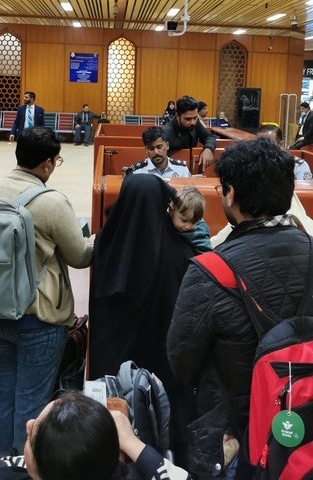
• Passengers travelling abroad have complained of long queues stretching out of terminals, repeated questioning, delays in immigration at three main international airports
• Situation ‘has improved’ in recent weeks; officials insist there are ‘no unnecessary delays’, added scrutiny takes time
• Airport authority, FIA deflect blame for overcrowding onto other agencies
THE never-ending queue had already spilled beyond the glass doors when Jawad Ahmad Rizvi arrived at Lahore airport for his flight to Dubai. The line snaked past the entrance, with passengers clutching their passports and boarding passes, shifting their luggage inch by inch.
“On my arrival, I found the queue extending beyond the entrance of the main terminal, making me wonder how many people were travelling by air these days.
“As the queue was moving slowly, it took me about 20 minutes to put my luggage on the scanner belt, and an additional 15 minutes for the belt to clear,” he told Dawn.
The checks did not end there. Mr Rizvi said that after the luggage was cleared by the scanner, a security official checked his and other passengers’ passports a second time — the first check being conducted upon their entrance to the terminal.
“The official asked me, where are you going, for what purpose, what do you do, and how much cash do you have?”
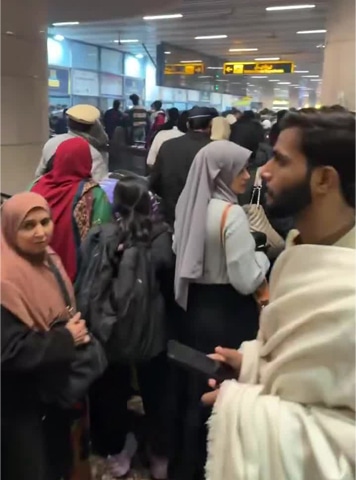
TRAVELLERS mostly complain of long wait times at immigration counters.—X / Usman
After obtaining a boarding pass, another “long queue at the passport control counter [awaited me], which was really tiresome. The authorities need to set up more counters to break the long queues.”
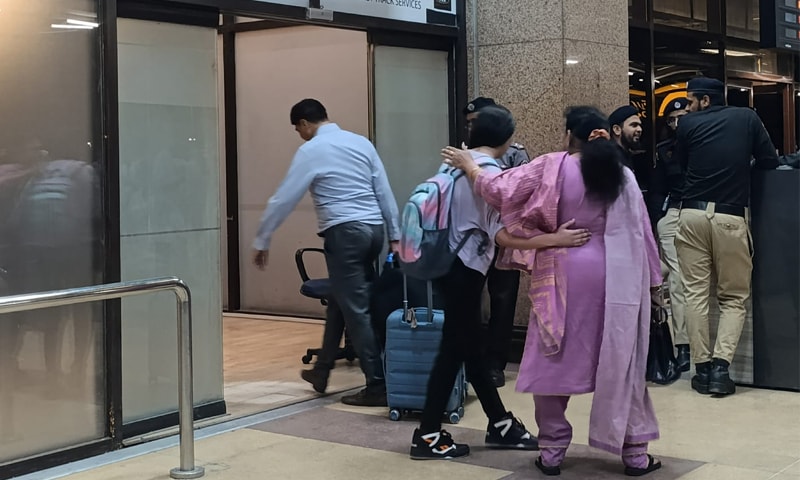
Over the past few months, passengers travelling abroad from Karachi, Lahore and Islamabad have increasingly complained of long queues, repeated questioning and prolonged immigration clearance.
The tightening of checks follows a wider crackdown on human smuggling in the wake of several boat tragedies involving illegal migrants, as well as complaints from Gulf countries about the number of beggars travelling there.
In response, authorities have stepped up scrutiny at airports, intensifying document verification and offloading hundreds of passengers who did not pass strict checks. According to the interior ministry, at least 51,000 passengers were offloaded at airports in 2025, mostly at Lahore and Karachi, over insufficient or unverified documentation.
Lahore: scrutiny and space constraints
At Lahore’s Allama Iqbal International Airport, at times, queues stretch outside the terminal buildings during peak departure hours.
The Federal Investigation Agency (FIA) has acknowledged that it has been carrying out stricter screening of passengers travelling to destinations including Saudi Arabia, Iran, Azerbaijan, the United Arab Emirates, Thailand, Malaysia, Qatar, Egypt and various European countries, in an effort to curb human smuggling and travel by beggars.
When Dr Amir Butt intended to travel from Lahore to Baku, he found himself caught in that net.
“To my surprise, I found unusually long queues at the immigration counter. Finally, when my turn came, the FIA official at the passport control counter asked me that since I was going to Baku for the fourth time in the last few years, was there any specific reason for that?
“I told him the trip to Baku does not cost me much. He then asked me to see another FIA official in a room next to the counter, where I was further quizzed about my profession and the purpose of my trip. After that cumbersome process, I was allowed to board the plane,” Dr Butt told Dawn.
“The FIA official [looks] at you as if he or she [has] seen a human for the first time, then looks at [the] passport, then stares at you, and looks at your passport again… This process continues for 3 to 4 mins… [while the government] is investing $1 billion in artificial intelligence!”
When approached, an FIA official defended the heightened scrutiny.
The photo taken on Feb 20, shows a marked improvement.— X/rabiaazfar / Dawn
“Security checks, like those manned by the Airports Security Force (ASF) and Customs, as well as baggage checks, the check-in flight counter and passport control counter were already in place at the airports. But the long queues and delays at immigration counters have cropped up since the agency placed a strong security check to weed out potential illegal immigrants and beggars,” he said.
He added that there were clear instructions from the interior ministry that passengers with invalid, incomplete or bogus documents should not be allowed to travel abroad.
“Every FIA official at immigration gets more conscious of this fact and takes extra time in screening the passengers. There is a need for more counters with dedicated staff to avert long queues,” he said, pointing to a shortage of immigration personnel and limited space at Lahore airport.
Yet, FIA Lahore immigration head Avais Shafiq denied that there were long queues at immigration counters. “I haven’t seen any queues at immigration counters. They are outside the airport entrance where the ASF checks them,” he maintained.
In 2025, Lahore airport handled 6.86 million passengers. The sheer volume, coupled with tighter checks, has put visible strain on infrastructure.
Canadian national Navid Manzoor said travelling alone is manageable, but flying with family is another matter altogether.
“In the very first place, not finding the trolley (for luggage), kids getting upset with long queues and multiple checking points … as a whole … the system at the airport should be well organised like that of any developed country. The government can [do so] it has the will,” he said.
Karachi: from chaos to control?
THIS screengrab from a video shows overcrowding at Lahore airport’s departure lounge.—X / anooshayabid
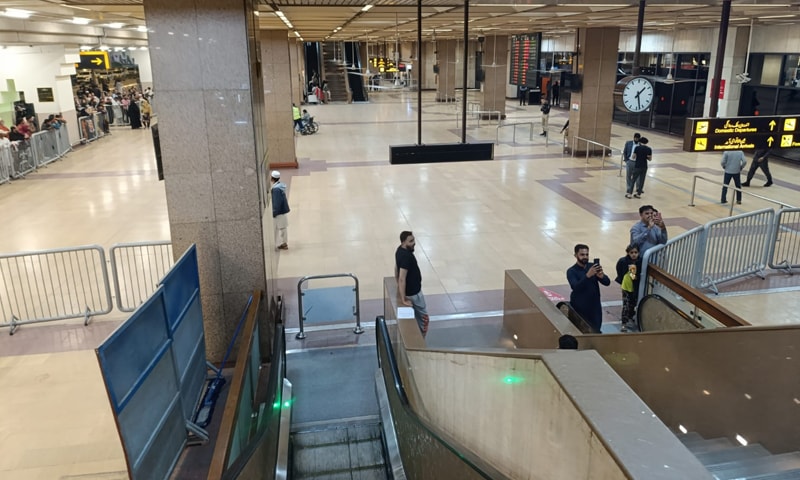
A few weeks ago, social media was flooded with images of overcrowding at Karachi’s Jinnah International Airport. Passengers described it as “a place of embarrassment for international travellers and a daily humiliation for Pakistani citizens, thanks to basic operational incompetence.”
The situation, however, has changed drastically over the past few days, and things have started to return to normal.
An official said the FIA’s strict measures contributed to delays, but insisted the agency’s role begins inside the passengers’ lounge.
“It is true that the FIA has taken certain measures, but their sole purpose is to strictly enforce the law and not to cause inconvenience to people,” he said.
“How can the agency be held responsible for overcrowding at entry points, the unavailability of trolleys or the long queues at the airport’s main entrance?”
Recently, the official said, all relevant authorities had come together and devised a joint strategy that helped bring the situation under control. “This achievement is the result of the collective efforts of the FIA, Pakistan Airports Authority, Airport Security Force and the airlines.”
Some travellers, however, still speak of difficulties at Jinnah International. Muaaz Ibrahim said his brother, who has been working in Saudi Arabia for four years, faced an unexpectedly long scrutiny.
“My brother’s documents were checked at the FIA counter for so long that he almost missed his flight. He said that nothing like this had ever happened before, and the experience took him by surprise,” Mr Ibrahim told Dawn.
The FIA says it has made 20 counters operational during midnight hours, when multiple international flights depart, and deployed a full-strength shift from 2am onwards.
“These measures have not only [helped] crack down on illegal travel, but also prevent wrongdoing within the agency itself,” an official said. “I can say with full confidence that these measures have greatly helped in eliminating organised corruption.”
TO AVOID the hassle of additional checking, many travellers are now opting for ‘fast track’ services, for a substantial fee.—Dawn
FIA Karachi Zone Director Muntazar Mehdi, during a recent surprise visit to the airport, expressed satisfaction with immigration operations and said ensuring security while respecting the dignity of passengers remains the agency’s top priority.
Islamabad: speed vs suspicion
Complaints about repeated questioning have not been limited to Lahore and Karachi alone. Passenger Khurram Zuberi recently posted about his experience at Islamabad International Airport.
He said his passport was first checked at the airport entrance, then again by Customs officials, followed by the Anti-Narcotics Force. He then navigated the airline counter, the immigration counter where he was quizzed by an FIA officer, then at the airline gate, and once more before he entered the tunnel leading to the plane.
“The FIA official [looks] at you as if he or she [has] seen a human for the first time, then looks at [the] passport, then stares at you, and looks at your passport again, then looks at your ticket, and looks at your passport again, then looks at you again, and looks at passport again. This process continues for 3-4 min, and all that continues where the [government] is investing $1billion in artificial intelligence!!,” he wrote on X, describing his experience.
Officials at the Islamabad airport, however, paint an altogether different picture.
FIA Islamabad Director Shahzad Nadeem Bukhari claimed that immigration clearance takes an average of one minute and 25 seconds, with 15 counters operational at departure and 14 at arrival.
A dedicated counter facilitates diplomats and Chinese nationals associated with the China-Pakistan Economic Corridor (CPEC) projects.
Officials argue that vigilant screening has reduced illegal travel attempts relative to overall passenger flow. Islamabad airport handled 7.87 million passengers in 2025, including 5.41 million international travellers.
In 2024, 6,435 people were offloaded at Islamabad airport; in 2025, the number rose to 7,115.
Responding to complaints that immigration officers ask questions already answered on boarding passes, the director said staff must ensure passengers know where they are going and for what purpose.
He cited cases in which individuals carried what appeared to be official letters from the Federal Board of Revenue (FBR) to attend a conference in Europe. When questioned, they failed to provide basic details and it later emerged that they had paid Rs2.3 million each to an agent.
Azmat Hussain, a Rawalpindi resident who recently travelled from Islamabad airport, described a smoother experience.
“As I walked towards the international departure lounge, a security official standing there asked me to show my ticket, and then asked me, ‘Where are you going?’. After I replied to him, I was allowed inside for another baggage scanning.”
He added: “Nobody asked me anything at the immigration counter, so I moved towards the waiting area to board the flight.”
When questioned about the layered approach, an official told Dawn that the process was like a “defence shield”.
“Airport security works … [has] multiple rings: outer ring — entry control, middle ring – initial screening, inner ring — final boarding security. More layers mean more safety,” he said.
“As someone deeply connected with ASF history and security culture, one should know that aviation security is about prevention, not reaction,” he added.
Between dignity and deterrence
The Pakistan Airports Authority (PAA) maintains that infrastructure at major airports is operating within defined capacity, and that immigration staffing falls under the FIA’s mandate.
The ASF says enhanced vigilance, including vehicle checks and additional personnel, may lengthen procedures but is necessary in light of recent security concerns.
Yet, public frustration persists, and it is not just limited to the common man; even Senator Sherry Rehman recently posted about her experience at Islamabad airport.
“What is happening at Pakistan’s airports? At Islamabad airport this morning, the second gate for women was routinely closed, while a long line of women stood waiting only on the one open gate. They opened the second gate earmarked for women when I insisted that these passengers, too, are entitled to public services,” she posted on X earlier this month, before boarding an international flight.
“Unfortunately, when I went back to check 10 minutes later, the gate was firmly closed again. It was opened yet again after I stood there and repeated the whole exercise, but now that I’ve boarded, I’m pretty sure it’s closed again. This is a fight I regularly have at Karachi airport too, but there is no change in behaviour.”
After England beat Pakistan in the T20 World Cup Super Eight clash by two wickets on Tuesday, Pakistani pacer Shaheen Shah Afridi acknowledged that his side’s fate was not in its hands anymore.
Pakistan have only one point from two Super Eight matches so now must win their final game and rely on other results going their way to have any hope of reaching the semi-finals.
“We know our fate is not in our hands,” he admitted, “But we need to beat Sri Lanka in our last match on Saturday and then hope other results go our way.”
“It’s not ideal, but it’s like this,” Shaheen said during a press conference after the match.
He also hailed Harry Brook’s century in the match against England as a “world-class knock”.
Brook reached his maiden T20 International hundred off 50 balls, with four sixes and 10 fours, as England went past their 165-run target with five balls to spare to win by two wickets.
Afridi jolted the England top order with a burst of three wickets before Brook played the ultimate captain’s innings to steer his side home.
“In my opinion this will be the best innings of his life,” Afridi told reporters. “It wasn’t an easy pitch to bat on but he took the game away from us.”
Promoted to number three after a morning conversation with England coach Brendon McCullum, Brook walked in after Afridi dismissed Phil Salt off the first ball of the innings.
Afridi then removed Jos Buttler and Jacob Bethell to leave England wobbling at 35-3 in the power play.
Brook stood firm, adding 45 for the fifth wicket with Sam Curran and 52 with Will Jacks for the sixth.
His century was the second fastest in T20 World Cup history, and the first ever by a team’s captain.
Only West Indies great Chris Gayle, against England in the 2016 T20 World Cup, reached three figures quicker. He took just 47 balls.
Afridi was clobbered for a six and a four as Brook raced through the “nervous nineties” in two balls, going from 90 to 100 before raising his bat.
The tall paceman bowled Brook with a yorker next ball, but did not celebrate wildly – instead he immediately went to congratulate the England captain in a superb show of cricket sportmanship.
“Brook played proper cricketing shots and he desreved a handshake, so I went to him and shook his hand in appreciation,” said Afridi.
EVERY body part is important, but few are as important as an eye. I use the singular for a body part that comes in pairs because its function is so crucial that one outweighs the combined functions of many others. Even diminished sight is so essential that ‘in the land of the blind, one-eyed man is king’ has become an idiom. Its vernacular version goes something like ‘andhon mein kana raja’ (‘among the blind, the one-eyed rules’).
In an old interview, one of Imran Khan’s sisters reminisced that even as a child he likened himself to a tiger. It’s a coincidence that a very charismatic Indian cricketer of the 1960s and 1970s, Nawab Mansoor Pataudi, was nicknamed Tiger Pataudi. He was a stylish right-handed batsman and considered the best fielder of his day, despite losing vision in his right eye in a traffic accident. He was named captain of the national team at the age of 21. Gen Amir Abdullah Niazi, who surrendered during the 1971 war, also styled himself as ‘Tiger Niazi’. Though his sight was not impaired, he was handicapped in vision and character.
Some physical features are stereotyped in history as characteristics; some archetypes are restricted to a geographical region, while others have universal appeal. For instance, what would a pirate be without an eyepatch? In modern times, the look became notorious when Israeli Gen Moshe Dayan wore an eyepatch. Salman Rushdie lost an eye to a knife attack and uses a dark lens on that side of his spectacles.
Maharaja Ranjit Singh, the famous Sikh ruler who extended Punjab’s borders to Kashmir and the Khyber Pass, did not cover his bad eye. In his early years, he may have been conscious of it, leading to his profile portraits which show only the good eye. Later in life, he wore his disability with aplomb and turned it to his advantage, asserting, “I look at all my subjects with one eye.”
Some physical features are stereotyped in history.
In the olden days, disabilities were described by their attributes, as in the Central Asian tyrant Temur’s name, ‘Lang’, which refers to the limp he walked with. In the Western canon, ‘lame’ became ‘lane’; Tamerlane is the distorted version of Temur-lang. It is another matter, though, that his brutal ways could have earned him the epitaph ‘Temur-out-of-lane’. There was a time when cinegoers were enticed by vernacular translations of English titles. A blockbuster martial arts movie One-Armed Boxer was translated as Tunda Badmash in Pakistan.
Etymology, an utterly fascinating field, does not always make it entirely clear how a particular word or term develops. For instance, in colloquial Urdu, making someone an accomplice to keep them in check is referred to as ‘kana karna’ (blinding someone in one eye). Another proverb in this vein is ‘kana mujhey bhai nahin; kaney bina suhaey nahin’. It roughly translates to ‘cannot live with them, and without them.’ Its applicability in the current political context cannot be denied.
In the game of thrones, especially in South Asia, succession politics included blinding the heir apparent or a pretender by gouging out their eyes. This barbaric practice of rendering the opponent unfit to rule in the rough-and-tumble of dynastic politics and the battlefield demands of physical fitness is generally thought to be a male preserve; however, mothers and even grandmothers are known to have resorted to this.
Allama Iqbal, in his poem ‘Ghulam Qadir Rohilla’, depicts the revenge the Afghan chieftain exacted against the Mughal king Shah Alam II — gouging out his eyes and ordering the women of the royal household to dance in court to entertain the victor. The Rohilla was captured from the battlefield as an eight-year-old boy when the uprising by his father Zabita Khan, an erstwhile army chief of Shah Alam, was crushed. The boy was raised in the royal household and was purportedly castrated. He was returned to his father as a youth after a patch-up with the Mughal ruler. After the elder Rohilla’s death, Ghulam Qadir attacked Delhi and exacted his revenge on the king. As he retreated, he was pursued and captured by the Maratha. Shah Alam II was restored to the throne. He demanded that the Maratha leader, Mahadaji Shinde, send him the Rohilla’s eyes, who obliged. The first line of Iqbal’s poem goes, ‘Rohilla kis qadar zalim, jafaju, keena parwar tha …’ (how brutal, unjust, and begrudging was the Rohilla…). One hopes that an eye-for-an-eye vendetta stops.
As for the pirates, they didn’t always wear an eyepatch because of injury; it gave them a tactical advantage in combat. The human eye takes time to adapt between bright light and pitch darkness. Moving between the mayhem on the upper and lower decks of ships, all they had to do was to switch the patch and strike.
The writer is a poet. His latest publication is a collection of satire essays titled Rindana.
Parliamentary Affairs Minister Tariq Fazal Chaudhry briefed the Senate on Monday on recent strikes targeting terrorist hideouts in Afghanistan, pointing out that they were carried out following multiple attacks by militants in Pakistan and saying that Islamabad “cannot tolerate this anymore”.
Pakistan carried out airstrikes on Afghanistan in a retaliatory operation late on Saturday night, targeting groups responsible for recent attacks in its territory.
The strikes were conducted in retaliation for a series of suicide attacks in Islamabad, Bajaur, and Bannu that had claimed the lives of Pakistani security personnel and civilians.
Mentioning these incidents, Chaudhry said they were “linked” to Afghanistan-based actors, adding that it was subsequently decided to give a “decisive response” to the neighbouring country.
“As a result, our Air Force carried out strikes in three Afghan provinces, Paktika, Nangarhar and Khost on February 21,” he said, adding that there were reports of the deaths of over 100 militants who “controlled terrorist networks” in the operation.
He said the February 21 strikes were “precise” and “intelligence-based”.
The minister insisted that they only targeted terrorists’ hideouts and training camps. He dispelled what he described as “false propaganda of civilians, mosques and seminaries getting hit” during the strikes.
Chaudhry warned that if terrorist attacks in Pakistan from Afghan soil continued, Pakistan reserved the right to carry out strikes in its defence.
“We are not supposed to just attend funerals. The civilian leadership and armed forces are resolute that this cannot be tolerated anymore,” he asserted.
He said, “Every drop of blood of our martyrs, be they from the security forces or civilians, will be avenged. Every corner of the country will be defended.”
KARACHI: A food delivery rider lost his life after a speeding vehicle flipped over and crashed into his stationary motorcycle in Karachi’s Defence Housing Authority (DHA) area, according to police.
The video of the incident that took place on Sunday was widely shared on social media.
South Deputy Inspector General (DIG) told Dawn that the food delivery rider was on his motorcycle outside a bungalow in DHA’s phase IV when a speeding car turned over and crashed into his vehicle.
“Both the rider and the car driver were injured in the incident,” he said, adding that they were initially taken to a private hospital in the Clifton area. The rider was later taken to Jinnah Postgraduate Medical Centre in critical condition and died during treatment, the official said.
Meanwhile, the car’s driver was at the private hospital in Clifton, and a police mobile was deployed outside the facility for the arrest of the car driver after treatment, DIG Raza said.
QUETTA: Armed men abducted 14 workers of a construction company working on a government project and at a crushing plant at two different places in Khuzdar and Barkhan districts of Balochistan, police said on Sunday.
A senior police officer said the armed men barged into the construction company’s camp in Mula area, some 60 km from Khuzdar, and kidnapped 11 workers including a project manager.
“Six labourers belonged to Sindh province who were working with the company while five others are residents of Khuzdar and other areas of the province,” the police official said.
He said the armed men attempted to take away arms and ammunition of the police station but police personnel offered resistance, forcing the kidnappers to flee.
Six out of 11 labourers have been identified as Project Manager Gul Sher, Ghulam Sarwar, Abdul Malik Bugti, Maulana Bakhsh, Muhammad Irfan and Ikhtiar.
Security forces reached the area after getting information of the incident and launched a search operation in the area. However, no arrest of kidnappers or recovery of labourers was reported despite the passage of 24 hours.
The second kidnapping incident took place in Barkhan district where officials said over 30 armed men attacked the crushing plant in Dhola Nadi area and after damaging the plant they kidnapped three workers and fled from the area.
“Armed men abducted three labourers working at the crashing plant in Musakhail area,” Barkhan deputy commissioner Abdullah Khosa said, adding that the kidnappers also damaged the plant.
They also took away three police personnel posted at a check post along with their weapons.
Soon after the incident, SSP Barkhan Dr Saad Afridi reached the area along with a heavy police contingent and launched a search operation.
“Prompt response of the police forced the armed men to release the kidnapped police personnel and escape to nearby mountains along with three labourers,” the SSP said, adding that the operation is continuing in the mountainous area. “Soon the labourers will be recovered,” he said.
Ramazan, the ninth month of the Islamic calendar, is a time when Muslims fast from dawn to sunset, focusing on prayer, charity and deepening their connection with the Almighty.
Homes and mosques come alive with pre-dawn meals (sehri) and the evening ritual of breaking the fast.
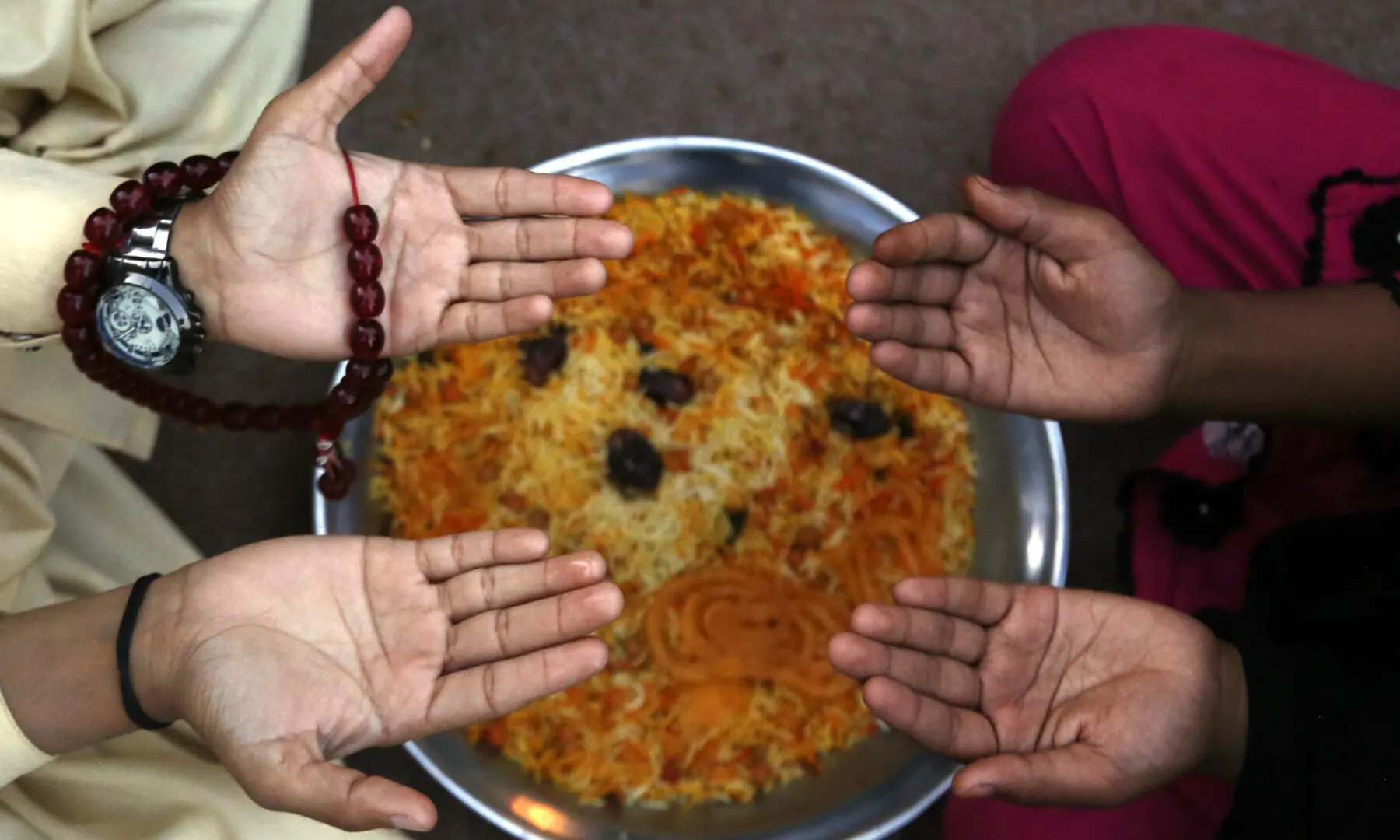
Across Pakistan, communal iftars bring people together, as neighbours, friends and even strangers share meals to end the day’s fast. Held in mosques, community centres and public spaces, these gatherings are about more than just food, as they nurture unity, strengthen bonds, and foster a sense of togetherness.
They also create spaces for conversation, understanding and generosity, embodying the spirit of the holy month.
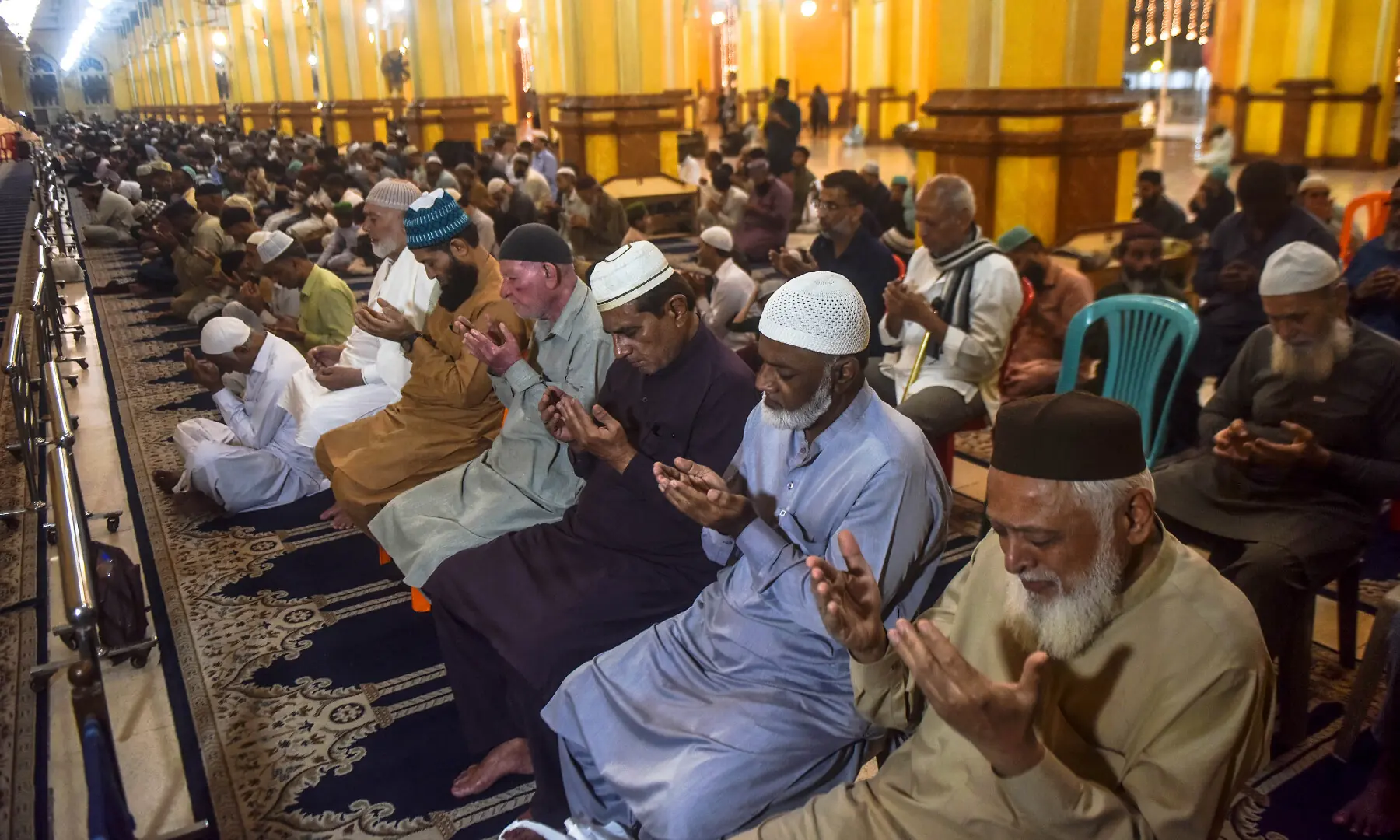
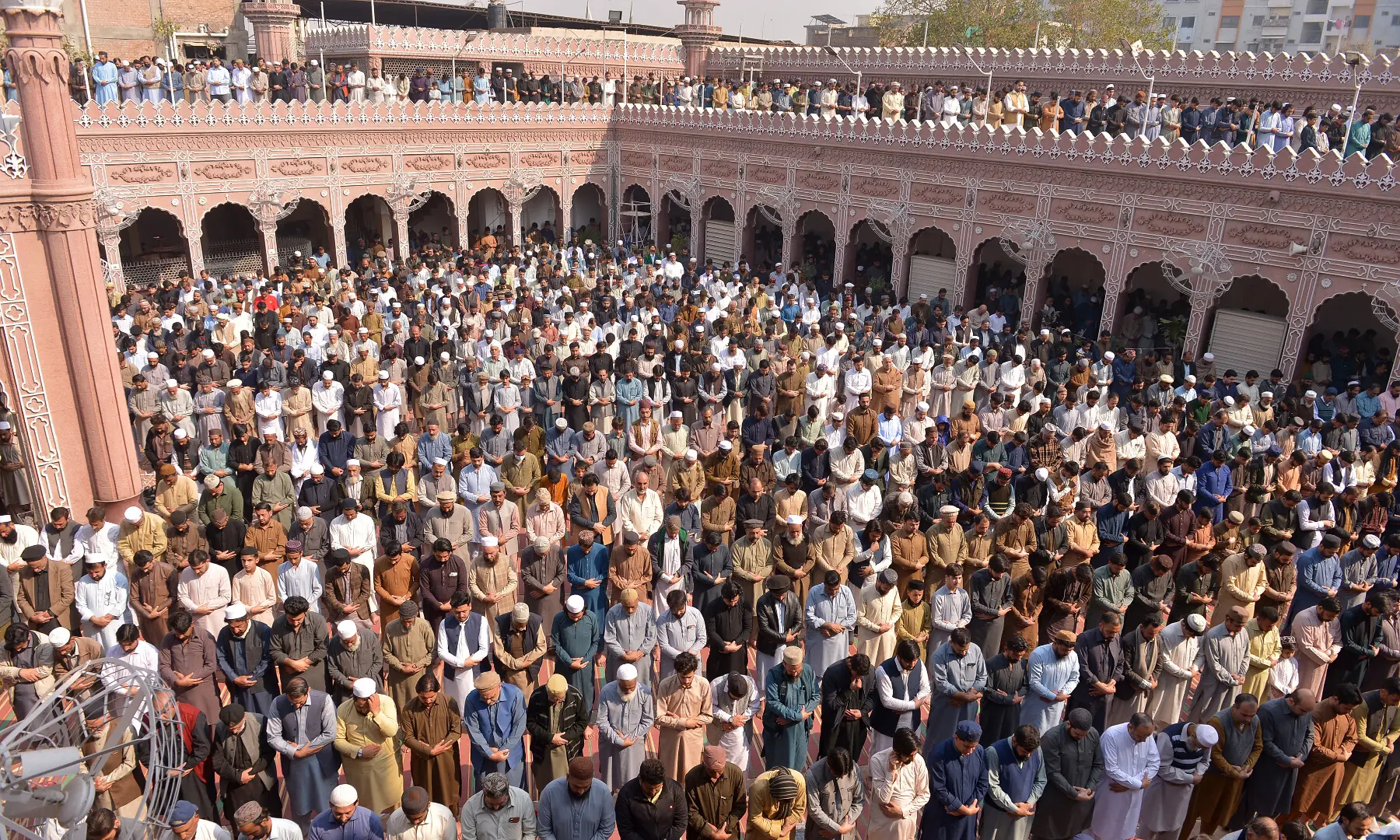
Photographs from cities across Pakistan capture these quiet, meaningful moments: prayers in reflection, the preparation of iftar, the laughter and chatter around shared tables, and the calm anticipation as the sun sets.
Together, they paint a picture of Ramazan as a time of patience, gratitude, humility and spiritual renewal.
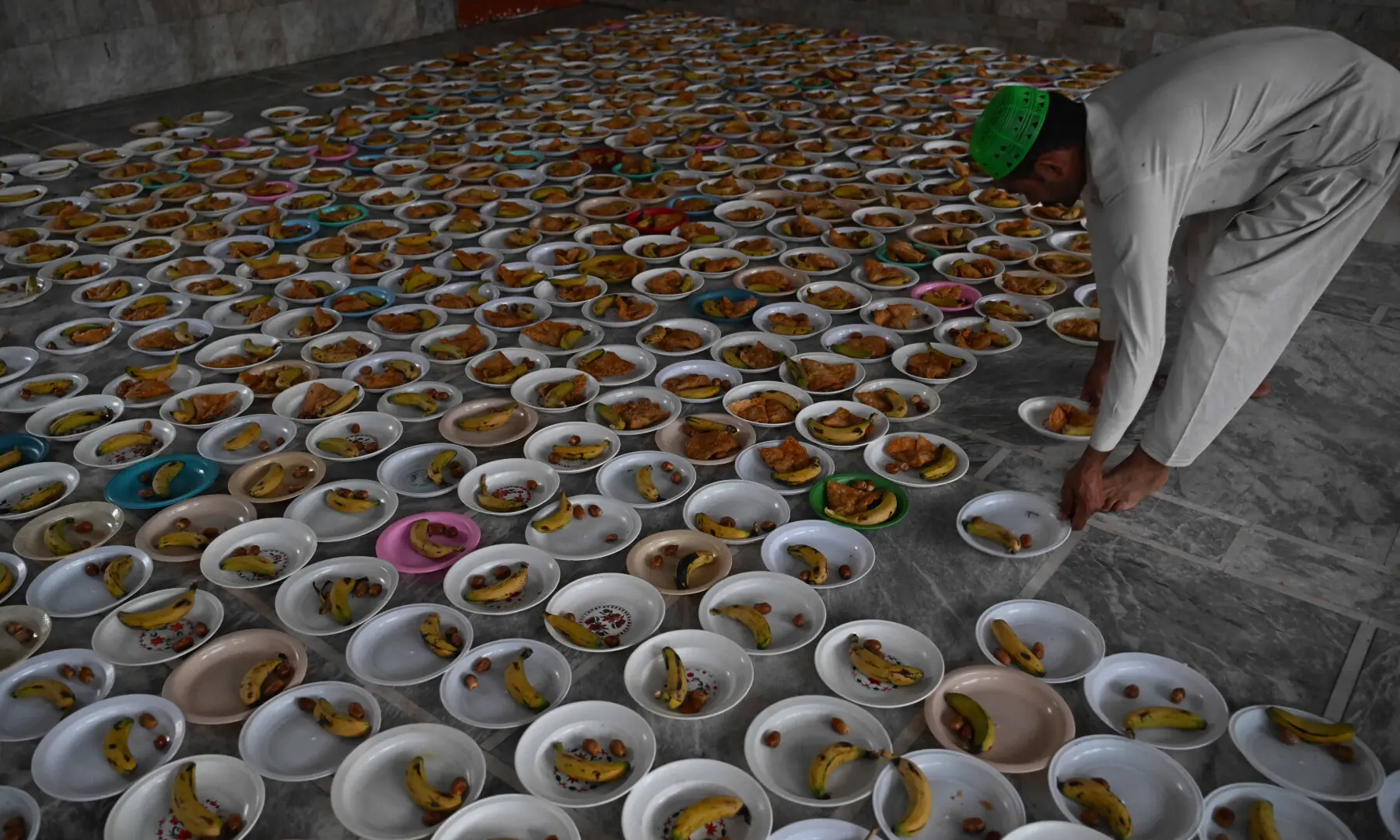
A man arranges iftar plates in a mosque on the first day of Ramazan, at the Data Darbar. — Arif Ali / White Star
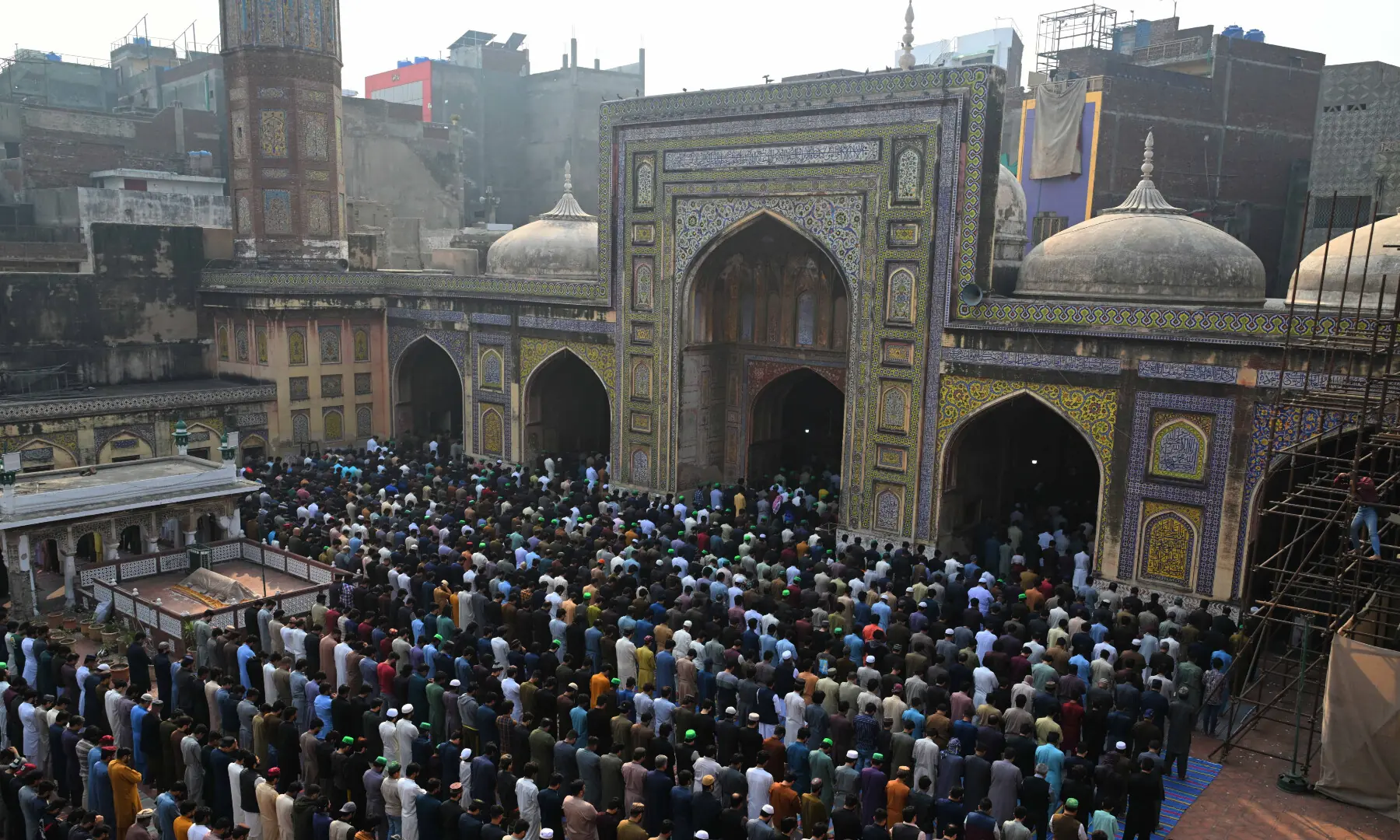
Muslim devotees offer the first Friday prayers during the Islamic holy fasting month of Ramazan at Lahore’s Wazir Khan Mosque. — Arif Ali / White Star
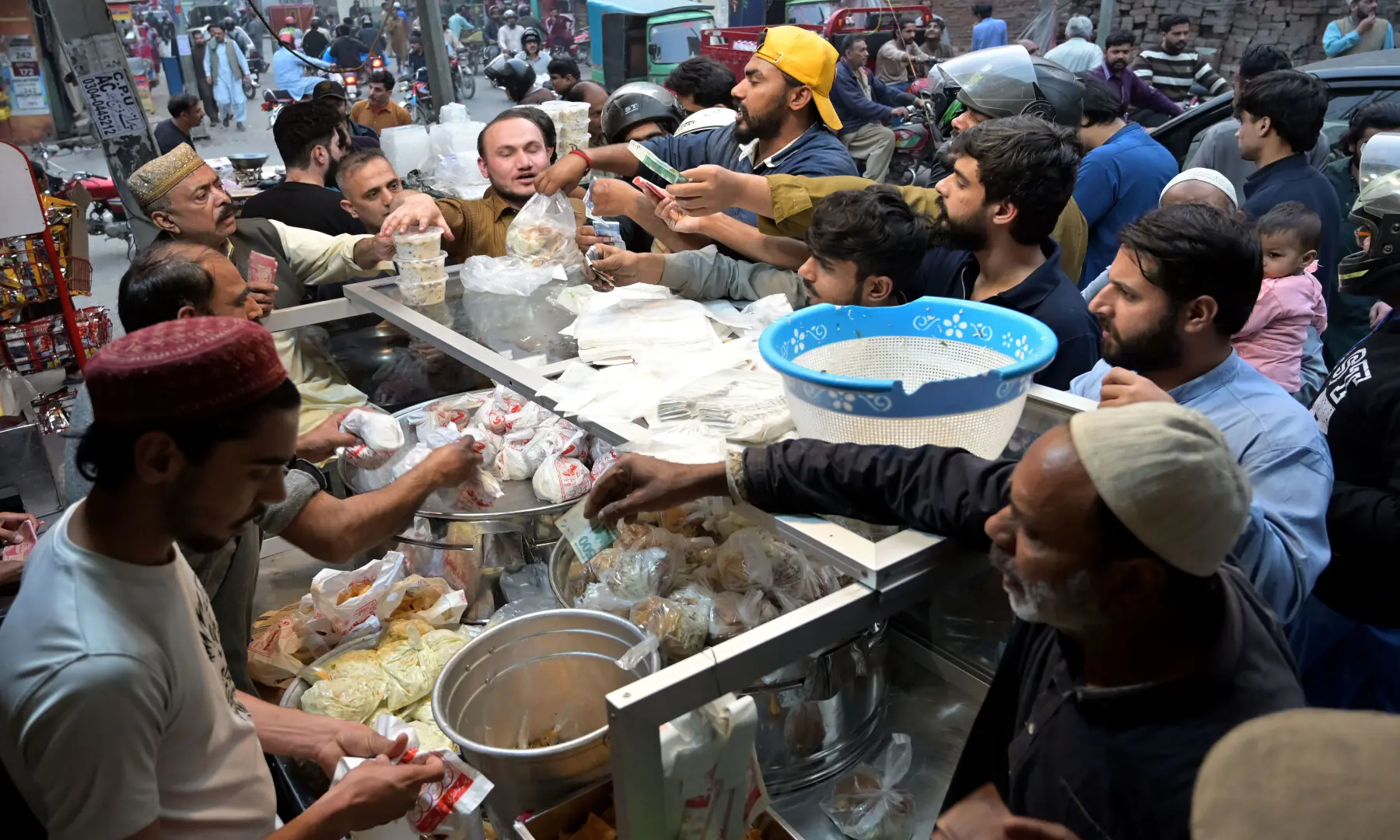
People buy Iftar food before breaking their fast on the first day of the Islamic holy month of Ramazan, at Lahore’s Lakhshami Chowk. — Arif Ali / White Star
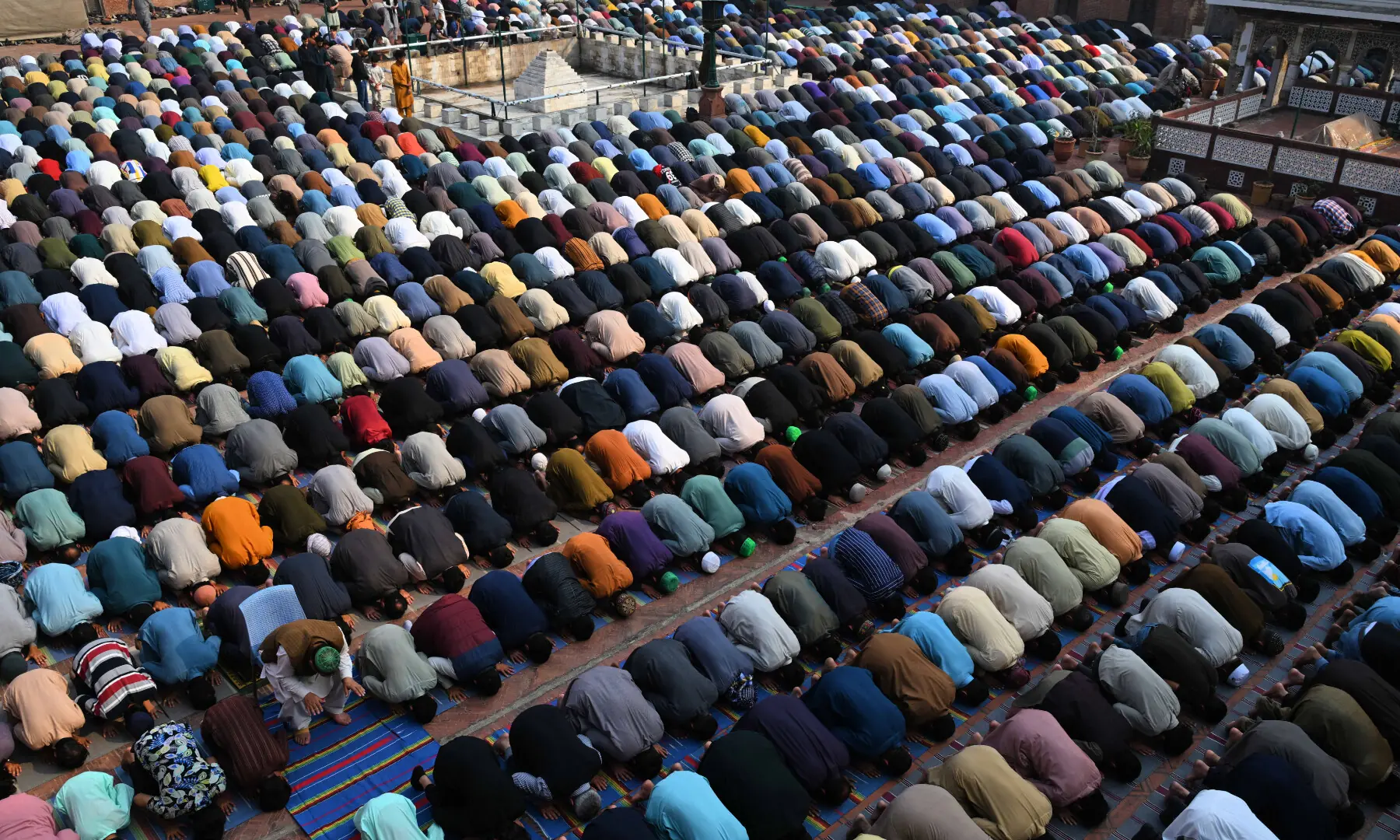
Muslim devotees offer the first Friday prayers during the Islamic holy fasting month of Ramazan at Lahore’s Wazir Khan Mosque. — Arif Ali / White Star
People offering taraweeh at Karachi’s New Memon Masjid. — Fahim Siddiqui / White Star
People offer prays on occasion of first Friday prayer of Ramazan at Lahore’s Sunehri Masjid on Friday. — Shahbaz Butt / White Star
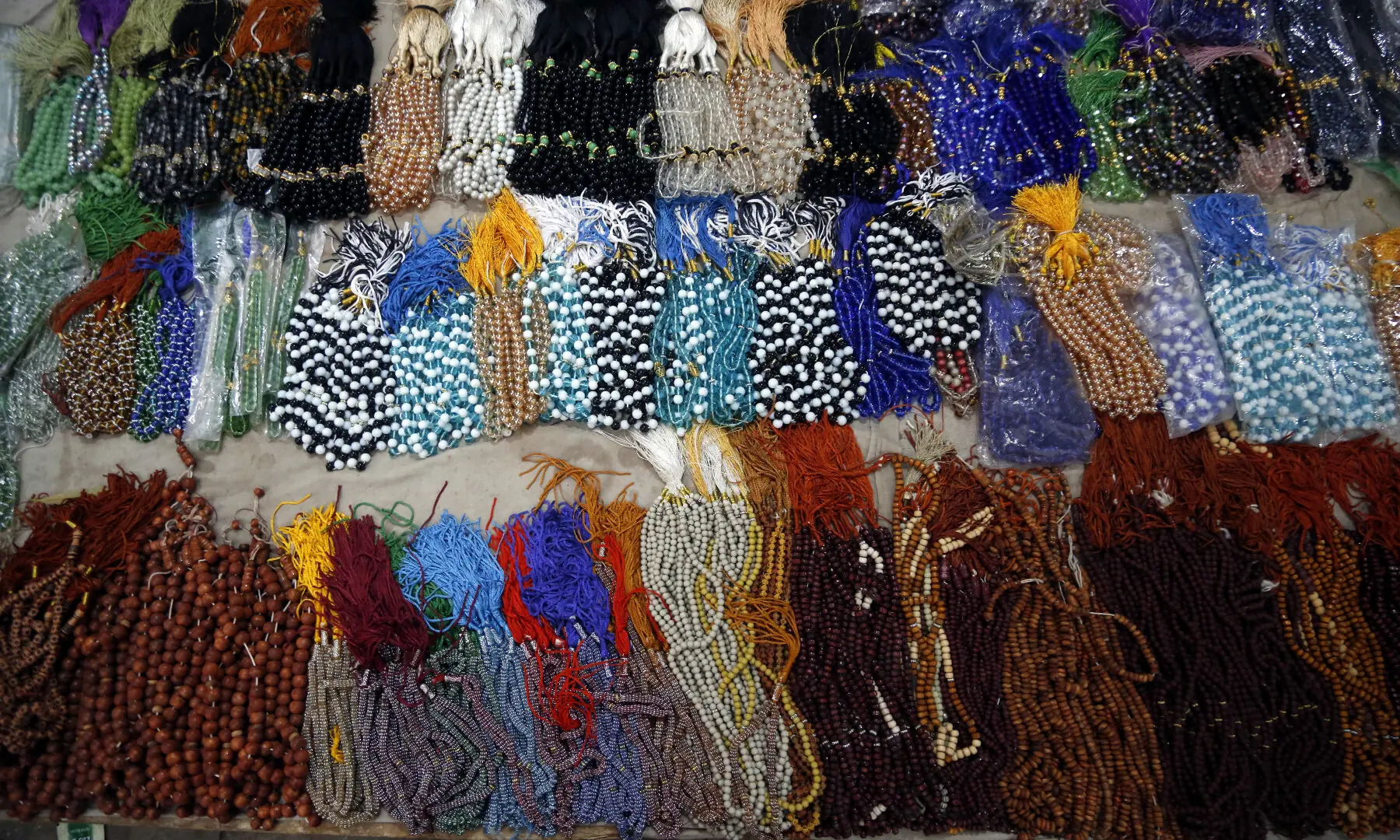
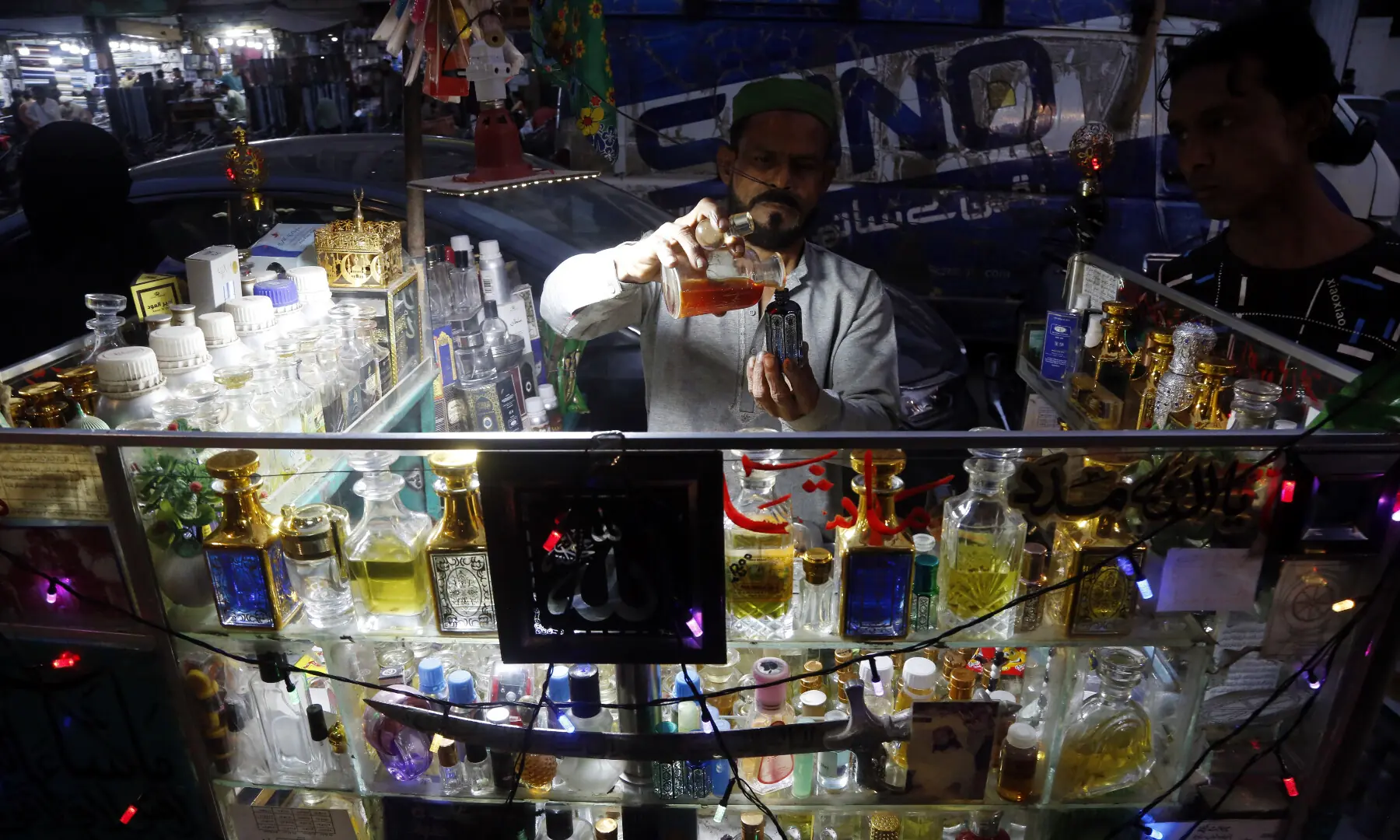
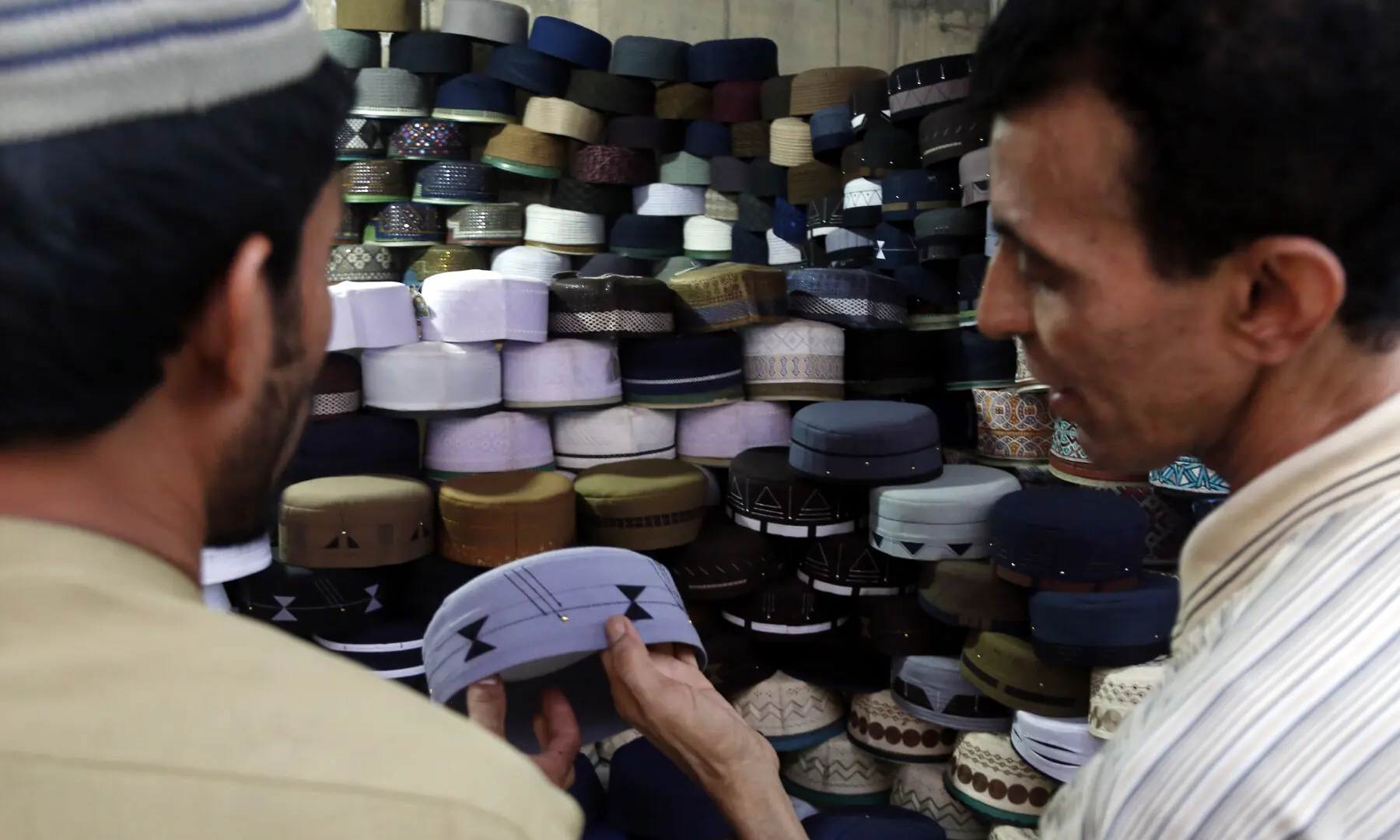
Hats, tasbeehs and ittars are being sold near Memon Mosque in Karachi in connection with Ramazan. — Shakil Adil / White Star
Hats, tasbeehs and ittars are being sold near Memon Mosque in Karachi in connection with Ramazan. — Shakil Adil / White Star
Hats, tasbeehs and ittars are being sold near Memon Mosque in Karachi in connection with Ramazan. — Shakil Adil / White Star
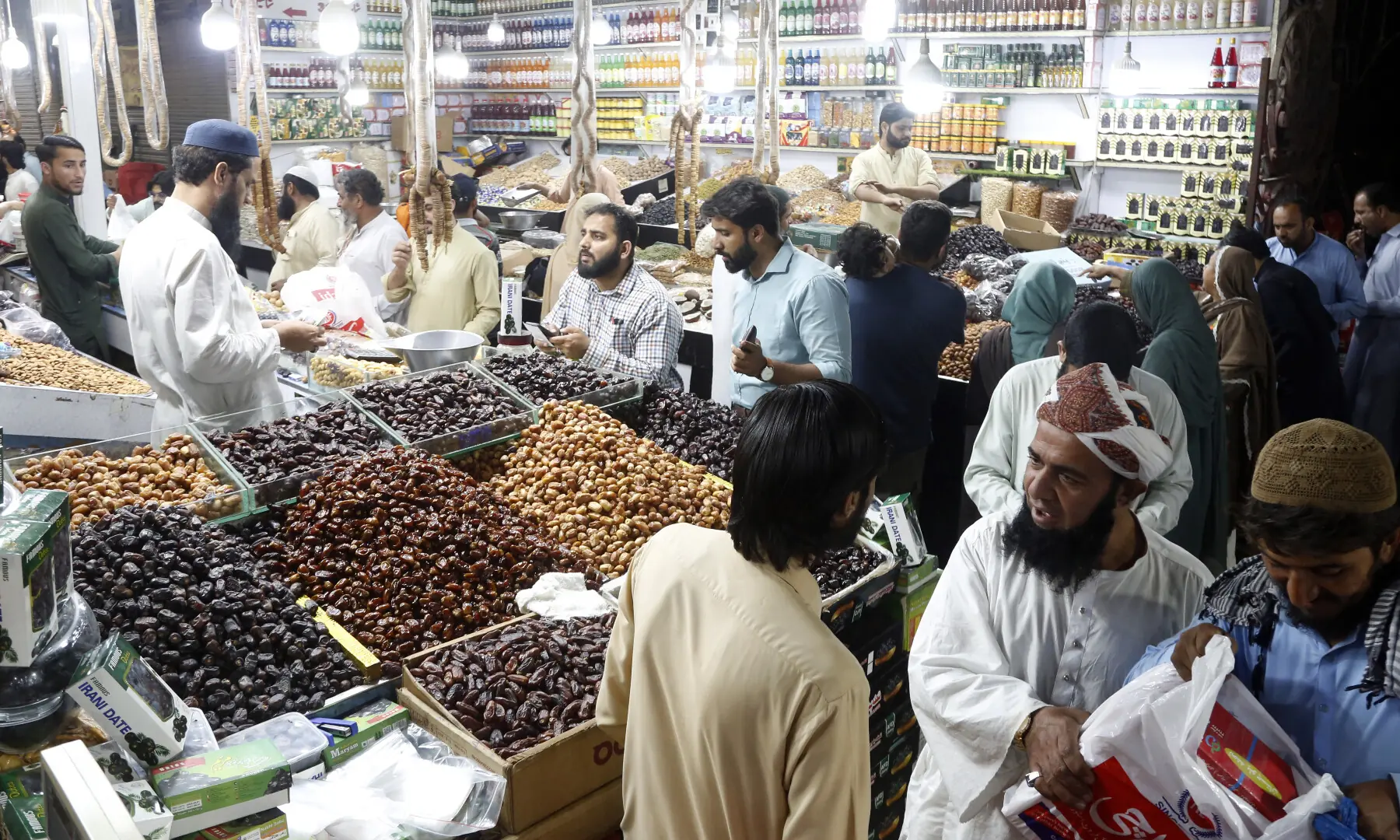
A large number of Karachi residents are buying dates for Ramazan at the Empress Market. — Shakil Adil / White Star
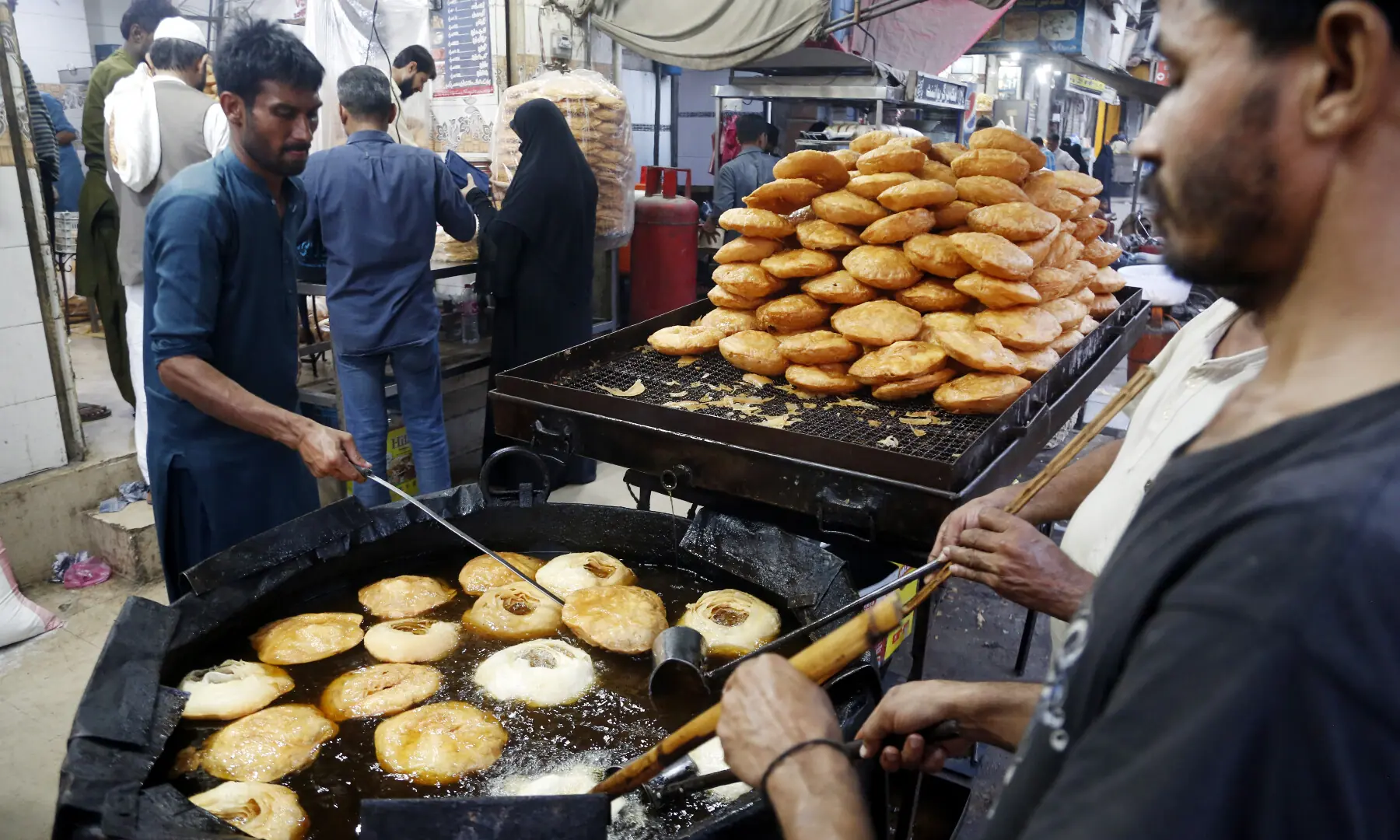
After the sighting of the moon of Ramazan in Karachi, khajla and pheni are being prepared for fasting people near Karachi’s Lighthouse market. — Shakil Adil / White Star
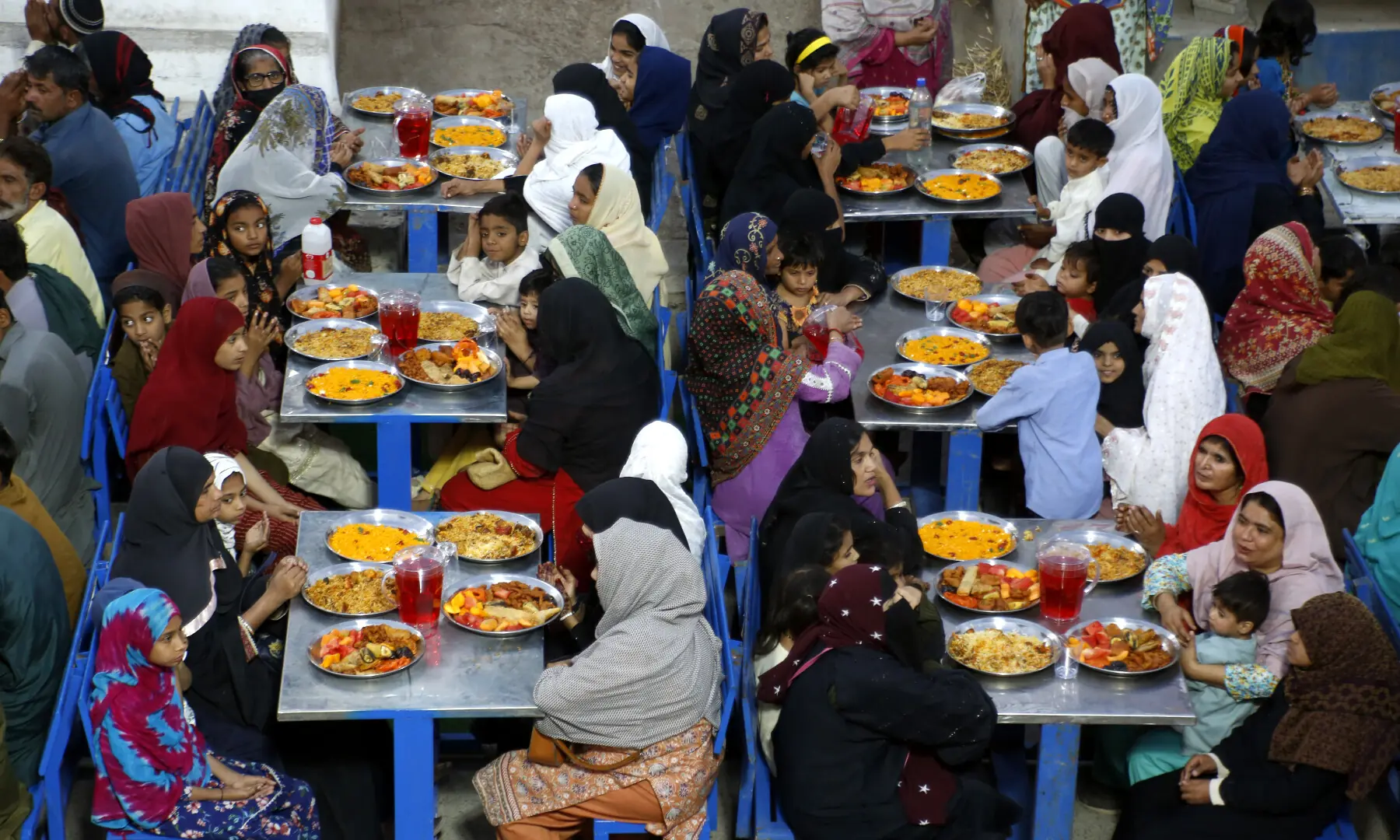
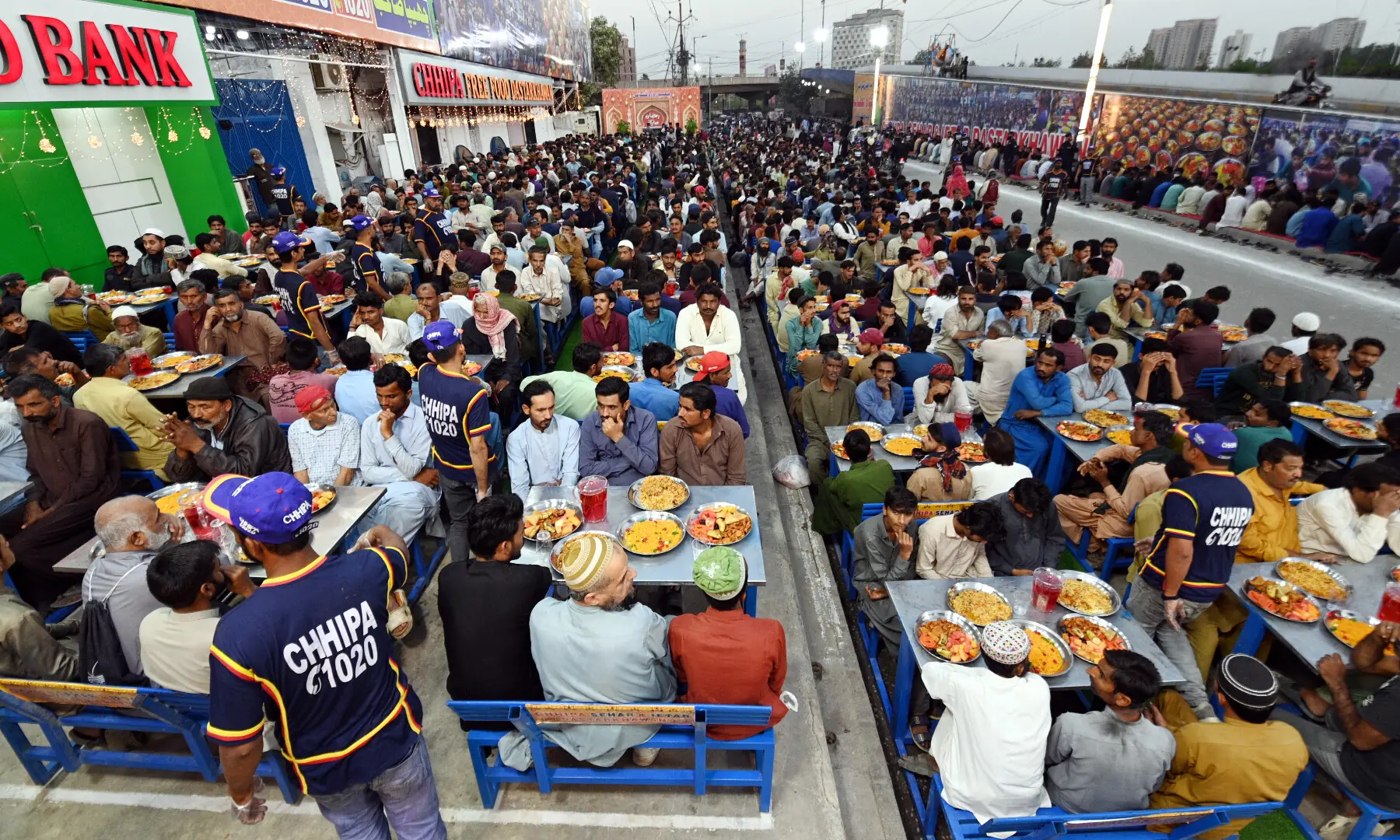
A large number of citizens, women, children and men, are breaking their fast on the first day of Ramazan at the Chhipa Welfare table near FTC Mor in Karachi. — Shakil Adil / White Star
A large number of citizens, women, children and men, are breaking their fast on the first day of Ramazan at the Chhipa Welfare table near FTC Mor in Karachi. — Shakil Adil / White Star
A large number of people are breaking their fast on the occasion of the second fast of Ramazan, organised by JDC at Karachi’s Naumaish Chowrangi. — Shakil Adil / White Star
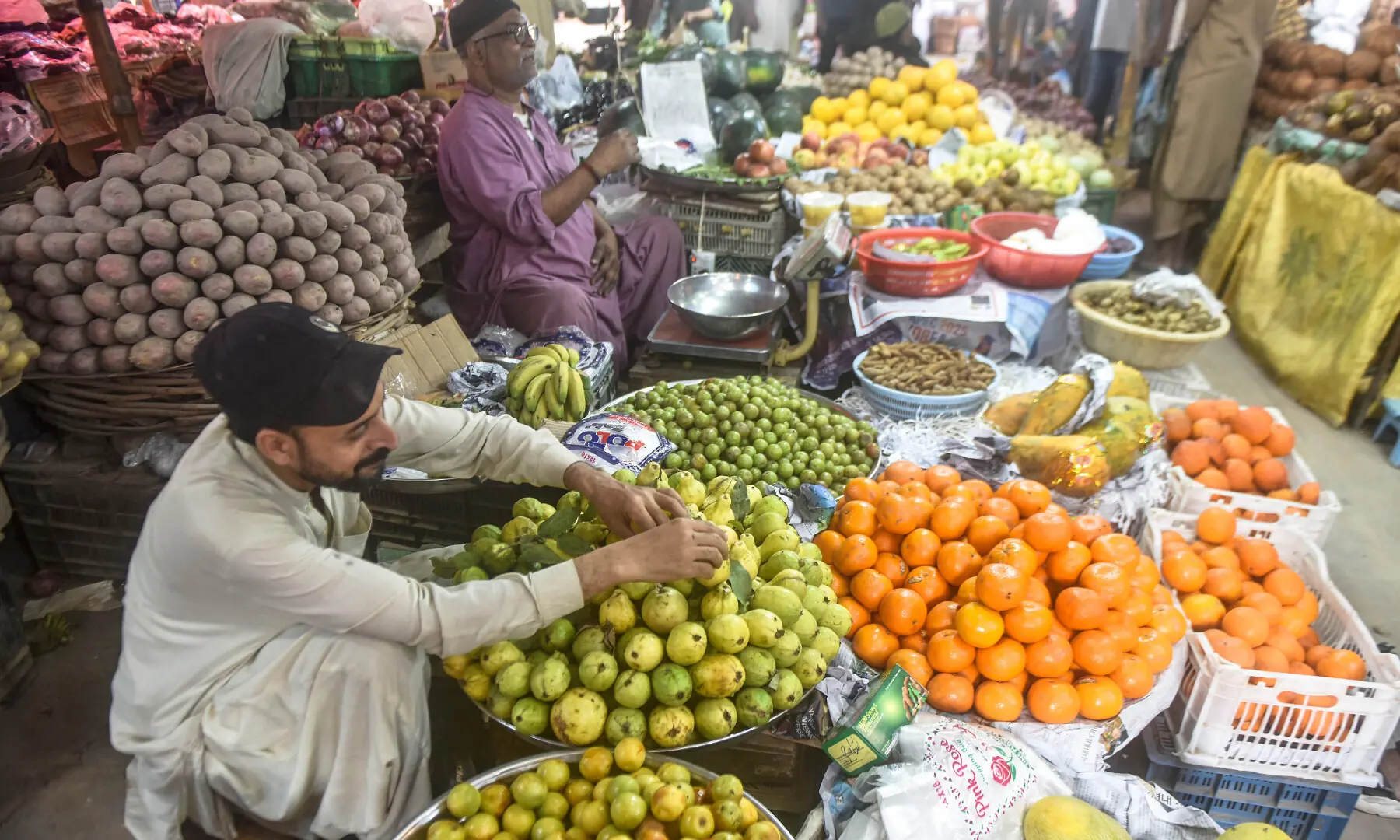
A vendor arranges fruits to attract customers in Karachi. — Fahim Siddiqui / White Star
Header image: Muslim devotees break their fast on the first day of the Islamic holy fasting month of Ramazan at Lahore’s Data Darbar. — Arif Ali / White Star
President Asif Ali Zardari’s recent visit to southern Punjab and his outburst against PTI founder Imran Khan have raised eyebrows in political circles. Some observers view the visit as a “message of displeasure” to the ruling PML-N, while others see it as preparation for early general elections.
Amid media reports suggesting the possible release of Mr Khan from jail, Mr Zardari’s aggressive tone is also being seen as an attempt to block such a move.
Although the president, as head of state, should remain apolitical, Mr Zardari has often acted otherwise. As the PPP supremo, he acts as a shield for the party against political odds and offensives.
Mr Zardari has just completed his visit to Punjab, where he stepped up his political engagements by holding several public meetings with PPP provincial leaders.
In a series of public addresses, he criticised Mr Khan, saying the jailed PTI leader should face imprisonment “like a man” and should not order his party leaders and workers to block roads. “He has served less than two years of imprisonment and is exhausted. In fact, [one realises what jail] actually is after two years of imprisonment,” he said. He added that leaders like Mr Khan had never made sacrifices and always made tall claims to [mislead] the public.
South Punjab’s visit sparks speculations of early polls
Political analysts believe these engagements are more than routine activities of a head of state and have some objectives behind them.
A senior PPP leader, who did not want to be named, said Mr Zardari’s remarks carried weight amid media reports that a deal was being struck between the PTI founder and the establishment for his early release.
However, Information Minister Attaullah Tarar rejected such reports on Thursday, stating on X that there was “neither any deal nor any leniency for Imran”.
He added that any impression of government concessions to the ex-premier was “entirely false and misleading”.
Mr Khan, imprisoned since August 2023, is serving a 14-year sentence at Rawalpindi’s Adiala jail in a £190 million corruption case. He was also convicted months ago in a case related to state gifts and faces pending trials linked to the protests of May 9, 2023.
The minister’s clarification followed remarks by Special Assistant to Prime Minister on Political Affairs Rana Sanaullah, who said efforts had been made to find a solution but Mr Khan was not ready for any “deal”.
The PPP leader suggested that Mr Zardari’s visit to Punjab and outburst against Mr Khan might have been intended to block any move for the PTI founder’s release.
“However, the remarks backfired, drawing strong criticism from the PTI’s social media brigade,” he added. He also said there was a strong possibility of early general elections and that Mr Zardari might be laying conducive groundwork for his son, Bilawal Bhutto-Zardari, for a key position in the next regime.
“Some political circles believe elections could be held by the end of this year or early next year. Mr Zardari may be trying to dent the PML-N in its Punjab stronghold.”
Pakistan Institute of Legislative Development and Transparency (Pildat) president, Ahmed Bilal Mehboob, said sadly apolitical offices in the country — the presidency and governorships — have remained political.
“Not only the president but governors often prioritise party affiliations and safeguard their parties’ interests,” he said.
Although the PPP was part of the ruling set-up holding key offices such as the presidency, governorships and Senate chairmanship, he said, Mr Zardari’s visit to Punjab, a PML-N stronghold, was significant, particularly after his recent expression of mistrust in the government and his return of several parliamentary bills without assent.
“I think the president’s visit to Punjab is a message to the PML-N that the PPP is unhappy with government decisions and policies. The PPP has already complained that it was not taken on board in decision-making,” Mr Mehboob added.
A source close to Mr Zardari said politics could not be separated from his personality, as he simultaneously held the offices of president and PPP co-chairman. The source said there was no specific agenda behind the Punjab visit, adding that Mr Zardari only sought to strengthen the party in the province.
“The president is of the view that political activities usually remain slow during Ramazan and that is why he visited Punjab to meet party leaders and workers there.” He dismissed the possibility of early elections or Mr Khan’s release, saying Mr Zardari’s outburst was a response to remarks by some PTI leaders against his daughter, First Lady Aseefa Bhutto-Zardari.
The source said the president was keen to strengthen the PPP in Punjab and reach out to other parties and groups.
“A recent statement by Jahangir Tareen (Istehkam-i-Pakistan Party leader), suggesting the PPP could be his next political destination after the [next] general elections, is ‘quite significant’,” he added.
LONDON: Prime Minister Shehbaz Sharif arrived in London in the early hours of Saturday morning after attending the inaugural meeting of the ‘Board of Peace’ in Washington, convened by US President Donald Trump.
The prime minister’s special aircraft touched down at Luton Airport, after which he travelled to his residence in the British capital.
Sources said he would remain in London for two days before leaving for Pakistan on Monday. He is accompanied on the visit by Deputy Prime Minister Ishaq Dar and Federal Information Minister Atta Tarar.
The premier had travelled to the United States at President Trump’s invitation to participate in the high-level gathering focused on Gaza and broader peace efforts. Addressing the gathering in Washington, PM Shehbaz stressed the need to end ceasefire violations in Gaza, calling it “very important” for achieving long lasting peace in the war-torn territory. “The people of Palestine have long endured illegal occupation and immense suffering,” he said, adding that protecting lives and advancing reconstruction required strict adherence to the ceasefire.
He emphasised that Palestinians must exercise full control over their land and future in line with UN Security Council resolutions, and called for a credible pathway to self-determination through the establishment of an independent, sovereign and contiguous State of Palestine.
Earlier, Mr Tarar shared a video on social media in which President Trump praised PM Shehbaz and Field Marshal Asim Munir.
Pakistan has struck seven “terrorist camps and hideouts belonging to Pakistani Taliban of [Fitna al Khwarij] and its affiliates and [the Islamic State-Khorasan Province] at the border region of Pakistan Afghan border,” the Ministry of Information and Broadcasting announced in an post early Sunday on social media platform X.
The statement asserted that “Pakistan has always strived for maintaining peace and stability in the region, but at the same time, the safety and security of our citizens remains our top priority.”
The press release stated that the action against the seven camps and hideouts was “a retributive response”, carried out based on “intelligence-based selective targeting”.
• With only one conviction in US, legislators accuse justice dept of dragging its feet
• Most Americans now find leaders ‘untrustworthy’
• Australian PM says referendums ‘hard to pass’ after Andrew’s arrest
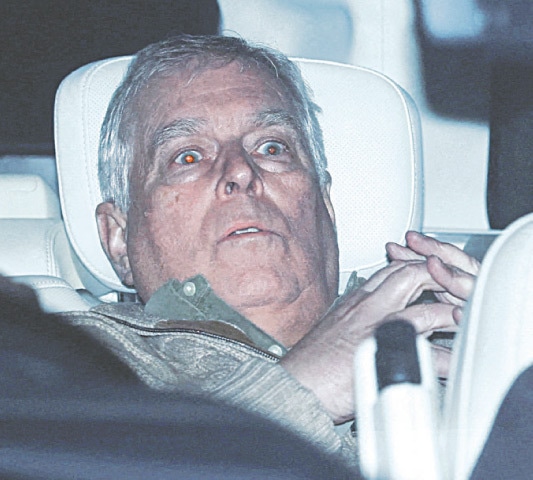
WASHINGTON: The arrest of former prince Andrew has underlined the striking contrast between Europe, where high-profile, powerful people are being held to account over their links to Jeffrey Epstein, and the United States, where the fallout has been limited.
Only one person has been arrested or convicted in the United States in connection with the activities of the late sex offender — Ghislaine Maxwell, Epstein’s ex-girlfriend and accomplice.
Epstein cultivated a global network of powerful politicians, business executives, academics and celebrities — many of whom have been tainted by their association with him.
A number of prominent Americans — from former president Bill Clinton to Microsoft co-founder Bill Gates — have had their reputations damaged by their friendships with Epstein, but no one other than Maxwell has faced legal consequences.
A top US Justice Department official suggested recently that no prosecutions may be forthcoming. “I can’t talk about any investigations, but I will say the following, which is that in July, the Department of Justice said that we had reviewed the files, the Epstein files, and there was nothing in there that allowed us to prosecute anybody,” Deputy Attorney General Todd Blanche told CNN earlier this month.
That explanation has not satisfied many US lawmakers, both Republicans and Democrats, who accuse the Trump Justice Department of dragging its feet.
“The UK has officially done more to prosecute Epstein predators than our own government. Shameful,” Representative Nancy Mace, a Republican from South Carolina, said on X.
Senator Ruben Gallego, an Arizona Democrat, blamed the lack of accountability in the US squarely on Trump, who also was a close friend of Epstein and moved in the same social circles in Florida and New York.
“Countries across the world are holding their Epstein class accountable,” Gallego said on X. “It isn’t happening in America because we have a pedo protector in the Oval Office running a government cover-up for him and his friends.”
A Reuters/Ipsos poll found 53 per cent Americans say the Epstein files “lowered their trust in the country’s political and business leaders”, while 69pc told pollsters the Epstein files “show that powerful people in the US are rarely held accountable for their actions”.
Republican lawmaker Thomas Massie welcomed prince Andrew’s arrest but said “now we need justice in the US”.
Meanwhile, Australian Prime Minister Anthony Albanese played down the chance of a vote to remove the British monarch as Australia’s head of state following the arrest of former prince Andrew.
“I’m a republican but we had a referendum during the last term. Referendums are hard to pass in Australia,” Albanese said when asked in an interview with The Guardian whether Australia should reassess its ties with the monarchy.
• President vows alternative ways to impose levies as court declared his tariff regime ‘illegal’
• Trump insists ‘India deal is on’
• Three liberal justices joined three conservatives in Friday’s ruling
• Canada hails ruling, UK, Germany cautious in their response
• Stocks rise, Treasury yields gain after the verdict
WASHINGTON: After the US Supreme Court struck down the President’s sweeping tariffs that he pursued under a law meant for use in national emergencies, Donald Trump announced on Friday he was imposing an extra global tariff of 10 per cent on US trade partners.
The conservative-majority court ruled the emergency powers law — International Emergency Economic Powers Act (IEEPA) — “does not authorise the President to impose tariffs”, marking Trump’s biggest defeat at the SC since returning to the White House last year.
While hard-hit Canada welcomed the ruling pointing out the levies were always “unjustified”, other US trading partners particularly European powers were cautious in their response, with the UK, Germany and EU stating that they were in contact with the Trump administration and analysing the court decision ‘carefully’.
Trump insisted he would impose tariffs “using alternative authorities” after rebuking certain members of the court for lacking the courage to do what’s right for the country.
He suggested that most trade deals negotiated under the threat of his tariffs remained valid, mentioning specifically India, despite the SC ruling those levies illegal. “The India deal is on,” Trump told reporters in response to a question, while suggesting tariffs under separate authorities would replace the ones overturned by the court. “All the deals — we’re just going to do it a different way.”
“In order to protect our country, a president can actually charge more tariffs than I was charging in the past,” the president asserted.
“The Supreme Court’s decision today made a president’s ability to both regulate trade and impose tariffs more powerful and more crystal clear, rather than less,” he claimed while speaking to reporters after the 6-3 ruling upheld a lower court’s decision that the Republican president’s use of the 1977 law “exceeded his authority”.
Trump has leveraged tariffs — taxes on imported goods — as a key economic and foreign policy tool. They have been central to a global trade war that Trump initiated after he began his second term as president, one that has alienated trading partners, affected financial markets and caused global economic uncertainty.
Trump’s tariffs were forecast to generate over the next decade trillions of dollars in revenue for the United States, which possesses the world’s largest economy.
However, Trump’s administration has not provided tariffs collection data since Dec 14, 2025.
Powers to issue taxes, tariffs
The Supreme Court reached its conclusion in a legal challenge by businesses affected by the tariffs and 12 US states, most of them Democratic-governed, against Trump’s unprecedented use of this law to unilaterally impose the import taxes.
The US Constitution grants Congress, not the president, the authority to issue taxes and tariffs. But Trump instead turned to a statutory authority by invoking IEEPA to impose the tariffs on nearly every US trading partner without the approval of Congress.
“Had Congress intended to convey the distinct and extraordinary power to impose tariffs” with IEEPA, “it would have done so expressly, as it consistently has in other tariff statutes,” the court noted
The SC’s three liberal justices joined three conservatives in Friday’s ruling, which upheld lower court decisions that tariffs Trump imposed under IEEPA were illegal.
Trump heaped praise on Brett Kavanaugh, the only justice he nominated who voted with him. Kavanaugh was joined in his dissent by fellow conservatives Clarence Thomas and Samuel Alito.
Chief Justice John Roberts, in delivering his opinion, said, “IEEPA contains no reference to tariffs or duties.”
Trump has imposed some additional tariffs under other laws that are not at issue in this case. Based on government data from October to mid-December, those represent about a third of the revenue from Trump-imposed tariffs.
IEEPA lets a president regulate commerce in a national emergency.
Trump became the first president to use IEEPA to impose tariffs, one of the many ways he has aggressively pushed the boundaries of executive authority since he returned to office in areas as varied as his crackdown on immigration, the firing of federal agency officials, domestic military deployments and military operations overseas.
He described the tariffs as vital for US economic security, predicting that the country would be defenseless and ruined without them.
Post-ruling strategy
In November, Trump told reporters that without his tariffs “the rest of the world would laugh at us because they’ve used tariffs against us for years and took advantage of us”. He said the United States was abused by other countries, including China, the second-largest economy.
After the SC heard arguments in the case in November, Trump said he would consider alternatives if it ruled against him on tariffs, telling reporters that “we’ll have to develop a ‘game two’ plan”.
Treasury Secretary Scott Bessent and other administration officials said the US would invoke other legal justifications to retain as many of Trump’s tariffs as possible.
Among others, these include a statutory provision that permits tariffs on imported goods that threaten US national security and another that allows retaliatory actions, including tariffs against trading partners that the Office of the US Trade Representative determines have used unfair trade practices against American exporters.
None of these alternatives offered the flexibility and blunt-force dynamics that IEEPA provided Trump, and may not be able to replicate the full scope of his tariffs in a timely fashion.
Trump’s ability to impose tariffs instantaneously on any trading partner’s goods under the aegis of some form of declared national emergency raised his leverage over other countries.
It brought world leaders scrambling to Washington to secure trade deals that often included pledges of billions of dollars in investments or other offers of enhanced market access for US companies.
But Trump’s use of tariffs as a cudgel in US foreign policy has succeeded in antagonising numerous countries, including those long considered among the closest US allies.
IEEPA historically had been used for imposing sanctions on enemies or freezing their assets, not to impose tariffs. The law does not specifically mention the word tariffs.
Estimates
Penn-Wharton Budget Model economists estimated that the amount collected in Trump’s tariffs based on the International Emergency Economic Powers Act stood at more than $175 billion. And that amount likely would need to be refunded with a Supreme Court ruling against the IEEPA-based tariffs.
The Congressional Budget Office has estimated that if all current tariffs stay in place, including the IEEPA-based duties, they would generate about $300bn annually over the next decade.
Total US net customs duty receipts reached a record $195bn in fiscal 2025, which ended on Sept 30, according to US Treasury Department data.
In February and March of 2025, Trump invoked IEEPA to impose tariffs on China, Canada and Mexico, citing the trafficking of the often-abused painkiller fentanyl and illicit drugs into the United States as a national emergency.
Trump has wielded his tariffs to extract concessions and renegotiate trade deals, and as a weapon to punish countries that draw his ire on non-trade political matters. These have ranged from Brazil’s prosecution of former president Jair Bolsonaro, India’s purchases of Russian oil that help fund Russia’s war in Ukraine, and an anti-tariffs ad by Canada’s Ontario province.
Reactions to ruling
The EU said on Friday that it was studying the US Supreme Court ruling. “We take note of the ruling … and are analysing it carefully,” EU trade spokesman Olof Gill said.
“We remain in close contact with the US Administration as we seek clarity on the steps they intend to take in response to this ruling,” he added.
“Businesses on both sides of the Atlantic depend on stability and predictability in the trading relationship”.
The British government spokesperson said Britain planned to work with the US to see how the overturning of Trump’s tariffs by the US Supreme Court would affect the trade deal between the two countries. “We will work with the administration to understand how the ruling will affect tariffs for the UK and the rest of the world,” the spokesperson said, adding that the UK expects its “privileged trading position with the US to continue”.
The Canadian minister responsible for US trade said the US Supreme Court’s ruling affirms that the levies were “unjustified”.
International Trade Minister Dominic LeBlanc noted, however, that tariffs causing the most pain in Canada — sector-specific measures affecting the steel, aluminum and auto industries — remained in force despite the ruling, promising Ottawa would work with Washington to “create growth and opportunities on both sides of the border”.
After the ruling, stock markets rose in the United States and Europe, led by shares of affected companies, including Europe’s luxury brands from LVMH to Hermes and Italian luxury outerwear group Moncler, all of which rose after the ruling.
Stocks rise
US and European stocks advanced on Friday and Treasury yields rose as investors absorbed the Supreme Court ruling, while also parsing a weak GDP report and higher-than-expected inflation data.
All three major US stock indexes moved higher immediately following the Supreme Court’s decision. The S&P 500 and the Nasdaq are on track to notch weekly gains, while the blue-chip Dow is currently flat versus last Friday’s close.
Europe’s STOXX 600 index extended gains following the ruling while gold prices came off the day’s highs in the immediate aftermath.
US Treasury yields rose following the Supreme Court’s ruling. The yield on benchmark US 10-year notes added 1.9 basis points to 4.094pc, from 4.075pc late on Thursday.
The dollar turned lower after the top US court’s tariff decision, but was still on track for its biggest weekly gain since October.