Sports and 🌎 News: March 2026

Tuesday, 31 March 2026

Lights out, bills up as summer approaches

The government is finalising a plan to curb summer electricity consumption through scheduled outages, compulsory conservation measures, and higher tariffs as cooling demand rises in the coming weeks. The move reflects a deepening fuel shortage caused by a complete disruption of LNG supplies, constrained Thar coal output, and costly alternatives like furnace oil and imported coal. With peak demand expected at 27–28 GW, officials say daily power cuts and steeper bills are unavoidable

Pakistan’s ongoing energy stress, triggered by the US-Israel war on Iran, stems primarily from two shocks: the total disruption of Qatari LNG imports — already reflected in reduced utilisation of gas-fired plants — and the escalating cost of other imported fossil fuels such as oil and coal, the full impact of which has yet to be felt by consumers and the economy.

Dr Khalid Waleed of the Sustainable Development Policy Institute (SDPI) estimates that a full summer blockade of the Strait of Hormuz could cut 8,800 GWh of RLNG-based generation. “With replacement fuel premiums costing an additional Rs100-110 billion and idle capacity charges of RLNG plants amounting to Rs35bn, tariffs will go up by Rs6–8/kWh through emergency FCA adjustments. Average residential bills may exceed Rs55–60/kWh,” he warned. He added that the foreign exchange impact would ripple across sectors, as emergency procurement of Residual Fuel Oil (RFO) and coal at war-driven premiums, along with fertiliser imports of 1.5–2 million tonnes to replace lost RLNG-based urea production, likely costing $2.5-3.5bn in a single quarter.

Peak electricity demand expected to hit 27-28GW

The key questions confronting Pakistani policymakers, therefore, are how to fill the power generation gap caused by the LNG supply disruption and how to keep electricity prices stable despite rising global fuel costs. The government’s response revolves around three measures: increasing the use of domestic gas and indigenous coal in the power generation, expanding reliance on imported coal, and, in emergencies, increase the use of oil.

“While the first step being considered by the government makes sense in the short run, the second and third steps are not viable even briefly given the rising costs of coal and oil in the international market and Pakistan’s fragile financial position to finance their import,” argued Manzoor Ahmed, a researcher at the Policy Research Institute for Equitable Development (PRIED).

“It is also clear that Pakistan cannot go back to LNG-based power generation even in the medium term because its main supplier, Qatar, will require a couple of years to resume its supplies disrupted by the war.”

Mr Ahmed noted that domestic gas could offer short-term relief but cannot fully bridge the power gap over time. Currently, it meets less than 70pc of demand, and even optimistic new discoveries are unlikely to close the deficit in the coming years.

He added that much of this gas is tied to fertiliser production, vital for agriculture. Diverting it to power generation would disrupt fertiliser supply, raise prices, and harm farm output, undermining a sector that has sustained growth as Pakistan’s manufacturing base has struggled in recent years.

Energy experts say that domestic coal also faces supply constraints due to weak investor interest, delays in construction of a railway line to transport coal and other factors from Thar to other parts of the country. The sponsors of coal mines are also finding it difficult to finalise coal purchase agreements with prospective buyers.

‘Global coal markets highly volatile’

The option of increasing coal imports from Indonesia and South Africa, relatively insulated from the Middle East conflict, to boost power generation remains less feasible. While prices remain below the 2022-23 peaks, Mr Ahmed warned that global coal markets are highly volatile. He noted prices have already risen about 30pc in the first month of the Iran conflict. With major consumers like India, Korea and Indonesia delaying coal plant retirements, demand and prices are expected to rise further.

This leaves one viable medium- to long-term solution: accelerating the ongoing shift towards solar energy and supporting it with battery storage systems.

Over the past eight years, Pakistan has seen a dramatic surge in solar adoption. A joint PRIED-TransitionZero report estimates that 51,000MW of solar capacity was imported between 2017 and 2025 at a cost of $7bn, with about 33,000MW already installed. Another study by Renewables First and the Centre for Research on Energy and Clean Air finds this boom has reshaped the energy mix, helping shield consumers from immediate LNG supply shocks and price spikes amid the war in Gulf.

Experts highlight that China has played a central Pakistan’s solar transformation, reshaping the economics of its energy transition. Its vast manufacturing scale, integrated supply chains and state-backed policies have sharply reduced global photovoltaic prices, making solar one of the cheapest power sources worldwide. This decline, reinforced by an influx of low-cost Chinese panels, enabled Pakistan – with zero-rated import taxes – to rapidly scale adoption.

The economic benefits have been compelling for households, farmers and businesses facing high tariffs and unreliable grid supply, as solar offers predictable long-term savings. Easy access to Chinese technology has removed supply bottlenecks, driving a consumer-led shift to distributed solar at an unprecedented speed. Beyond affordability, this expansion has strengthened energy security by reducing reliance on imported fuels such as LNG, partially insulating the country from external supply shocks, experts said.

However, this rapid growth has also revealed a critical structural imbalance. Solar generation, by its nature, primarily meets daytime demand. The real challenge emerges during summer nights, when air-conditioning demand peaks but solar output drops to zero due to near-zero battery adoption. As a result, even solar-equipped households remain dependent on the grid after sunset.

Dr Waleed noted that 10-18GW of distributed rooftop solar installed in recent years displaces 3,500–4,000 GWh of grid demand during daylight hours in a summer quarter, absorbing up to one-third of the shortfall. “However, output drops to zero after sunset, shifting the entire evening peak back to thermal generation. In a Hormuz blockade scenario, this would lead to severe night-time load-shedding. With no battery storage capacity, excess daytime solar cannot be utilised during peak evening hours, he explained.

Mr Ahmed emphasised that Pakistan’s subsidy-free solar boom shows strong consumer willingness to invest, provided the government avoids deterrents like taxes on panels or restrictive net-metering policies. He criticised the lack of support for low-income groups, noting that over 25pc of Pakistanis still lack electricity despite the potential of decentralised solar systems.

He argued that expanding solar access would not require major grid investments and could unlock economic opportunities. The government should remove taxes on solar equipment, offer subsidised schemes for low-income households, and support mini- and micro-grids for localised energy distribution.

Mr Ahmed also warned that rising global demand for Chinese solar panels could increase prices, making timely policy support essential. Sustaining solar growth is vital, he added, as it has already saved $5bn–$12bn in fuel imports since 2018 and can further protect foreign exchange reserves.

“Second phase”

More importantly, he stressed that the government should remove all taxes on the import of battery energy storage systems (BESS) and related equipment, he argued. This would trigger a “second phase” of Pakistan’s solar transition by improving energy independence and security. He noted that global demand for batteries is rising as countries turn to China for supply, pushing prices higher, making timely policy support essential.

Published in Dawn, April 1st, 2026


from Dawn - Home https://ift.tt/2yF9xr8

Buy jet fuel from US or get your own, Trump rails against allies

• Hegseth claims next few days to be ‘decisive’, says conflict to intensify if deal not made
• Pezeshkian says Iran wants to end war but not without guarantees; Araghchi confirms messages exchanged with US, denies talks
• Iranian missiles injure nine in Tel Aviv; US companies in region warned
• Israel claims hitting 20 weapon manufacturing sites; Iran says pharma facilities, desalination plant struck

WASHINGTON: As US Presi­dent Donald Trump singled out his allies who did not help him in the US-Israeli war against Iran, Iranian President Masoud Pezes­hkian said Tehran had the “necessary will” to end the ongoing war, but not without guarantees that the conflict would not be repeated.

In a statement posted on Truth Social, President Trump railed against the European countries, particularly the UK and France, for being unhelpful in the month-long war that has roiled global markets and led to the disruption of fuel supply via the Strait of Hormuz.

“All of those countries that can’t get jet fuel because of the Strait of Hormuz, like the United Kingdom, which refused to get involved in the decapitation of Iran, I have a suggestion for you: Number 1, buy from the U.S., we have plenty, and Number 2, build up some delayed courage, go to the Strait, and just TAKE IT,” Trump said in a Truth Social post.

“You’ll have to start learning how to fight for yourself, the U.S.A. won’t be there to help you anymore, just like you weren’t there for us. The hard part is done. Go get your own oil!” He also criticised France for not letting planes carrying military supplies to Israel fly over French territory.

‘Next few days will be decisive’

Amid reports of negotiations, US Defence Secretary Pete Hegseth said that the next few days in the war against Iran would be decisive and warned Tehran that the conflict would intensify if it did not make a deal, Reuters reported.

Iran’s Revolutionary Guards hit back with a new threat, saying that they will target US companies in the region in retaliation for attacks on Iran from Wednesday, listing 18 groups including Microsoft, Google, Apple, Intel, IBM, Tesla and Boeing.

Iran earlier set ablaze a fully loaded oil tanker off Dubai, its latest attack on merchant vessels in the Gulf or in the Strait of Hormuz since the United States and Israel attacked on Feb 28.

Mr Hegseth, who said he visited US troops in the Middle East on Saturday, said Donald Trump was willing to make a deal, and talks were ongoing and gaining strength, but that the US was prepared to continue the war if Iran did not comply.

“We have more and more options, and they have less … in only one month we set the terms, the upcoming days will be decisive,” Hegseth said in Washington. “Iran knows that, and there’s almost nothing they can militarily do about it.”

Iran, however, appeared receptive to the idea of ending the war. According to AFP, Iranian President Masoud Pezeshkian said his country had the “necessary will” to end the ongoing war with Israel and the United States, but was seeking guarantees that the conflict would not be repeated. “We possess the necessary will to end this conflict, provided that essential conditions are met — especially the guarantees required to prevent repetition of the aggression,” Mr Pezeshkian said in a phone conversation with the president of the European Council, according to a statement from his office.

Iran’s foreign minister also confirmed that messages were exchanged between the two foes. Abbas Araghchi told Qatar’s Al Jazeera that messages had been exchanged with the US either directly or through friends in the region. That did not mean Iran was in negotiations with Washington, he said. “I receive messages from Wittkov directly, as before, and this does not mean that we are in negotiations,” AJ quoted him as saying.

“There is no truth to the claim of negotiations with any party in Iran. All messages are conveyed through the foreign ministry or received by it, and there are communications between security agencies.”

The Israeli military said on Tuesday it completed a wave of strikes targeting 20 weapons manufacturing sites and a research and development site in Iran.

Iranian media said that airstrikes had put a desalination plant on Iran’s Qeshm island in the strategic Strait of Hormuz out of service, though the report did not specify when the attack took place, AFP reported.

Foreign Minister Abbas Araghchi also accused Israel of “unashamedly bombing” pharmaceutical companies in the country. “Their intentions are clear,” he said in a post on X. “What they’ve gotten wrong is that they’re not dealing with defenceless Palestinian civilians. Our powerful armed forces will severely punish aggressors.”

Areas near the World Health Organization’s Tehran office have been hit by strikes over the past two nights, WHO Director-General Tedros Adhanom Ghebreyesus said in a social media post.

Meanwhile, Iran also continued to attack targets across Israel and the Gulf. Iran’s Islamic Revolutionary Guard Corps (IRGC) Navy claimed it struck a “covert location” in the UAE, reportedly housing 200 US personnel and officers, according to the Tasnim news agency.

Multiple explosions also rattled the Saudi capital Riyadh, according to an AFP journalist, the latest apparent barrage targeting the city as Iran carries out attacks across the Gulf region. Nine people were also wounded in an Iranian attack on Tel Aviv, Al Jazeera reported.

General killed

Separately, Iran’s Revolutionary Guard confirmed the killing of a brigadier general, who was sanctioned by the US in 2025 over an international network shipping oil to China and using profits to fund Tehran-backed regional proxies, in a US-Israeli airstrike, AFP reported.

Revolutionary Guard commander-in-chief Ahmad Vahidi issued a message of condolences for Jamshid Eshaghi, the head of the budget and financial affairs at Iran’s armed forces general staff. Vahidi, whose predecessor was killed at the start of the conflict, said Eshaghi had been killed along with several members of his family in a US-Israeli strike, without giving a date or further details.

Published in Dawn, April 1st, 2026


from Dawn - Home https://ift.tt/ASUQVvz

LNG supplies under force majeure, not available for power generation, say officials

ISLAMABAD: Government officials said during a public hearing on Tuesday that liquefied natural gas (LNG) supplies were under force majeure and not available for power generation.

Force majeure is a clause included in contracts that allows a party to be excused from its obligations due to circumstances that are beyond its control. The officials’ revelation during the National Electric Power Regulatory Authority (Nepra) hearing thus means that LNG supplies were unavailable due to circumstances that were beyond the relevant parties’ control.

Responding to questions, Central Power Purchasing Agency (CCPA) Chief Executive Officer Rehan Akhtar said LNG supplies were currently under force majeure, but he assured that coal supplies — another source for power generation — through imports were not facing any problems as they mostly came from South Africa and Indonesia, and were unaffected by disruptions in the Middle East. LNG-based power plants have a generation capacity of more than 4,500 megawatts.

An almost a month-long ongoing US-Israeli war on Iran has spilled over to draw in Gulf countries and subsequently resulted in a global fuel crunch. The situation is worsened by traffic disruptions in the Strait of Hormuz — a corridor that had been the route for 20 per cent of global LNG and a quarter of seaborne oil until the war began.

The war has also led to production stoppages, notably by Qatar, which stopped all operations at its LNG facilities on March 2 and declared force majeure two days later, halting supply from a source that accounts for about 20pc of global LNG.

Officials at the Nepra hearing said consumers would be encouraged through a pricing package to better utilise cheaper electricity available during the daytime.

“The cheaper electricity available during daytime will be utilised in a better way, and measures would be taken after taking people into confidence over whatever the situation is,” said Naveed Qaiser, the chief financial officer of the Power Planning and Monitoring Company (PPMC), as he testified at the hearing.

He assured that fuel cost adjustments would not go up by Rs8-10 per unit, saying that the government was working on a daily basis and at almost every level to ensure that consumers did not face any problems.

“Things are under control at the moment, and no big shock is forseen”, he said, adding the government was also working on a tariff package to encourage better utilisation of electricity during the daytime when solar power generation was also possible.

For his part, Akhtar said LNG-based power plants, though among the most efficient, could not be run on domestic gas through diversion from older plants on dedicated gas fields.

Responding to a question, the CPPA chief said there were some problems regarding coal transportation for Sahiwal and Jamshoro power plants. He said the Power Division, CPPA and other relevant government agencies were working on a daily basis to ensure that coal inventories did not deteriorate and to run power plants at maximum capacity.

He also assured worried industrial consumers that electricity rates for April would remain unchanged as a Rs1.64 per unit positive fuel cost adjustment (FCA) for February consumption would replace an existing Rs1.63 per unit positive FCA for January consumption that was charged in March bills.

Akhtar also said that power supply from the national grid to K-Electric (KE) was beneficial for both Karachi and other consumers.

“If KE had not been provided any electricity from the national grid, an overall increase of Rs1.05/kWh in the FCA and an increase of Rs3.03/kWh in the capacity purchase price would have resulted for the consumers. Total cost would then have been Rs4.08/kWh for February”, he said. Not only this, the quarterly tariff adjustment against February consumption was expected to be Rs2.79 per unit lower, thus providing a net relief going forward.

He also said circular debt would not exceed Rs1.69tr at the close of the current fiscal year, notwithstanding seasonal fluctuations and subsidy payments from the budget.

PPPMC CFO Naveed Qaiser said that circular debt in January stood at Rs1.7tr compared to Rs2.4tr in January last year, which was a reduction of about Rs780bn.

For their part, industrial representatives asked Nepra to recommend to the government the formulation of a fixed and all inclusive industrial tariff regime for export and import substitution insutries to avoid uncertainties, and such a tariff including FCA, quarterly tariff adjustment, debt servicing surcharge and other charges be fixed within eight to nine cents per unit, with a hard ceiling of nine cents for at least five years to ensure international competitiveness.

Officials reported that the government had successfully absorbed significant cost pressures to ensure that the benefits of tariff adjustments were passed on to the public. Despite global fuel price volatility, cumulative relief amounting to Rs46.56bn had been provided to consumers during the first eight months of FY2025–26 (July–February), resulting in an overall reduction of Rs0.71/kWh at the consumer-end tariff, they said.

Industrial consumers, meanwhile, witnessed a substantial decline, with pre-tax tariffs falling from Rs49.19/unit (18 cents) in March 2024 to Rs34.75/unit (12 cents) in March 2026 — a reduction of Rs14.44/unit, it was reported.

The hearing was told that the incremental tariff package had resulted in 25 per cent growth in electricity consumption in the industrial sector and 7pc growth in the agriculture sector. More than 43pc of industrial consumers and 35pc of agriculture consumers benefited from the package, with 203,367 consumers availing the incentive package for higher consumption at lower rates.


from Dawn - Home https://ift.tt/JC74PNO

Monday, 30 March 2026

World Bank develops roadmap to modernise wheat sector in Pakistan

• Move aims to stimulate private sector investment and redirect resources
• Paper says Pakistan must close its yield gap through better seed systems, balanced fertiliser use and efficient water management
• Calls for empowering farmers with small holdings through access to finance, aggregation

ISLAMABAD: The World Bank has developed a roadmap to modernise the wheat sector in Pakistan, recommending focused interventions in five priority areas that are aimed at stimulating private sector investment and redirect resources towards core public goods for greater returns, increased farmer incomes, and job creation.

The five targeted actions highlighted in a technical paper spelt out closing the productivity gap between Pakistan and other comparable wheat producers; increased investment in agricultural research and development; empowering the farmers with small holdings so that they can reach their full potential; improving institutional coordination and transparency to ensure market stability; and managing strategic grain reserves efficiently by moving away from large, costly storage facilities.

Titled ‘Wheat Sector Moder­ni­sation Roadmap’, the WB paper has been developed in response to the recognition that traditional policies such as minimum support prices have resulted in inefficiencies, high fiscal costs, and limited incentives for diversification and private sector growth. “The goal is to create a more productive, resilient, and market-driven wheat sector that better supports rural livelihoods, nutrition, and the broader economy,” the paper says.

It says the modernisation of Pak­istan’s wheat sector requires a pivotal shift from decades of state-led interventions towards a more efficient, market-oriented system. While public procurement and fixed support prices historically achieved wheat self-sufficiency and affordable flour for consumers, these policies also distorted cropping patte­rns, discouraged diversification, and excluded farmers with small holdings.

Overemphasis on wheat has come at the expense of pulses, oilseeds, and other nutritious crops, leading to poor dietary diversity and persistent malnutrition. The discontinuation of public procurement in 2024 represents important structural reforms.

However, completing the transition to a deregulated market will require consistent policy direction, improved governance, and targeted investment in productivity-enhancing measures.

Yield gap

To achieve this, the paper says, Pakistan must close its yield gap through better seed systems, balanced fertiliser use, and efficient water management, while redirecting subsidies towards agricultural research and development as well as innovation.

“Empowering farmers with small holdings through access to finance, aggregation, and digital advisory services will be essential for inclusive growth,” it adds.

Strengthening the wheat market information system, enhancing interprovincial coordination, and maintaining strategic grain reserves only for emergency use will help stabilise prices and build market confidence.

“A modernised, transparent, and competitive wheat sector, supported by public-private partnerships in research, storage, and value chains will not only ensure food security but also drive rural incomes, job creation, and long-term agricultural transformation in Pakistan,” the paper claims.

It observes that there is overconsumption of wheat but under-consumption of other nutritious items in the diet of an average Pakistani. At the same time, limited dietary diversity contributed to persistent levels of malnutrition and stunting in the country. Wheat flour on average contributes over 40-50 per cent of the daily caloric requirement but has only 13pc share in the food expenditure basket of average household.

The report says systemic inefficiencies in seed quality and availability, fertiliser management practices and fertiliser-use efficiency and water productivity are found to be key factors contributing to productivity gap.

“While wheat productivity in the country has increased in the last decades, average wheat yield is still far below its comparable competitors,” the paper says. The average wheat yield in Pakistan is 50pc lower than Egypt, 25pc lower than Ukraine, 10pc lower than India and around 35pc lower than Indian state of Punjab.

The actual versus potential wheat yields indicate a substantial productivity gap. The average yield of 3,200kg per hectare also remains 60pc lower than the yield potential of improved varieties of around 7,500kg per hectare, which some progressive farmers have been able to achieve in selected areas.

The seed supply system is largely informal and faces several challenges. Key challenges include cumbersome certification and registration processes, strict and costly import regulations, and the widespread availability of low-quality seed. These constraints limit access to certified, high-performing varieties and slow down innovation. Only 38pc of the seed is supplied through the formal sector while remainder comes from informal sources, mainly farm-saved seed.

Published in Dawn, March 31st, 2026


from Dawn - Home https://ift.tt/7FHvzGw

Israel passes law making death penalty default sentence for Palestinians convicted of lethal attacks

Israel’s ​parliament passed ‌a law on ​Monday ​making the death ⁠penalty ​a default ​sentence for Palestinians convicted ​in ​military court of ‌deadly ⁠attacks, seeing through a ​main ​pledge ⁠by Prime ​Minister ​Benjamin ⁠Netanyahu’s far-right ⁠allies.

The legislation has been sharply criticised as discriminatory by European nations and rights groups.

The Times of Israel reported that the Knesset voted 62-48 to pass the law.

The bill was spearheaded by far-right National Security Minister Itamar Ben Gvir and his Otzma Yehudit, or Jewish Power, party.

The legislation results in the death penalty becoming the default punishment for Palestinians in the Israeli-occupied West Bank found guilty of intentionally carrying out deadly attacks deemed “acts of terrorism” by an Israeli military court.

The legislation says that the sentence may be reduced to life imprisonment under “special circumstances”.

According to The Times of Israel, the sentence handed under the law cannot be appealed.

Palestinians in the West Bank are automatically tried in Israeli military courts.

Meanwhile, under the law, in Israeli criminal courts, anyone “who intentionally causes the death of a person with the aim of harming an Israeli citizen or resident out of an intention to put an end to the existence of the state of Israel shall be sentenced to death or life imprisonment”.

Criminal courts try Israeli nationals, including Palestinian citizens of Israel.

The law sets the execution method as hanging, adding that it should be carried out within 90 days of the sentencing, with a possible postponement of up to 180 days.

Opposition lawmaker and former deputy Mossad director, Ram Ben Barak, expressed outrage at the legislation before it was passed.

“Do you understand what it means that there is one law for Arabs in Judea and Samaria, and a different law for the general public for which the state of Israel is responsible?” he asked fellow parliamentarians, using the Israeli name for the West Bank.

“I’ll tell you what it says. It says that Hamas has defeated us. It has defeated us because we have lost all our values,” he said. “It has defeated us because we are beginning to conduct ourselves like them, unfortunately. Full of hatred. And vengeance.”

‘Discriminatory application’

In February, Amnesty International urged Israeli lawmakers to reject the legislation, which it said “would allow Israeli courts to expand their use of death sentences with discriminatory application against Palestinians”.

On Sunday, Britain, France, Germany and Italy expressed “deep concern” over the legislation, which they said risked “undermining Israel’s commitments with regards to democratic principles”.

While the death penalty exists for a small number of crimes in Israel, it has become a de facto abolitionist country — the Nazi Holocaust perpetrator Adolf Eichmann was the last person to be executed in 1962.


from Dawn - Home https://ift.tt/J3zLYkU

Sunday, 29 March 2026

Global food waste crisis undermines climate and security, says UNEP official

ISLAMABAD: The world wastes food on a staggering scale, as every year over one billion tonnes of edible food — nearly one-fifth of all food available to consumers — is thrown away, impacting both people and the environment, undermining food security and climate resilience, and compromising progress towards a zero-waste, circular future.

The ‘International Day of Zero Waste’ is being observed on Monday (today), focusing on “Food – what we eat, what we waste, and how we can move towards a more circular future”. While hundreds of millions of people face hunger, 13 per cent of food is lost before it reaches retailers, the United Nations Environment Programme (UNEP) said.

In 2022, the world wasted an estimated 1.05 billion tonnes of food across the retail, food service, and household sectors combined. This amounts to 132 kg per capita per year, of which 79 kg per capita was wasted in households.

In a campaign brief, the UNEP said, “Zero waste starts on your plate”, estimating that $1 trillion was the annual cost of food loss and waste to the global economy. Up to 14pc of methane emissions come from food waste alone, largely from rotting organic waste.

Highlights over one billion tonnes of edible items thrown away every year

Speaking at the event, UNEP Executive Director Inger Andersen said the consequences were far-reaching. Food loss and waste generate 8-10pc of global greenhouse gas emissions and are a major source of methane, which is over 80 times more powerful than carbon dioxide in the short term. Reducing these emissions would slow the rate of global warming by mid-century.

According to the United Nations, around 60pc of food waste occurs at the household level, with the remainder coming mostly from food service and retail due to inefficient food systems, including production, distribution, and consumption. Tackling this issue requires redesigning these systems and transitioning towards a more sustainable, circular approach grounded in efficiency and resilience.

For this transition to succeed, the UN says governments can advance food waste prevention through climate and biodiversity plans and national policies on circularity, waste, food systems, agriculture, and urban development, while promoting effective measures and monitoring.

Businesses can set measurable food waste reduction targets, integrate them into sustainability commitments, and innovate to improve efficiency across supply chains.

‘Waste need not rot’

Speaking at the campaign brief, the UNEP executive director called for consumer behaviour change campaigns and food literacy programmes in schools, alongside retail and hospitality engagement through discounting products approaching expiry dates, improved stock management, and zero-waste dining offers.

She also highlighted the need for date-label reform to reduce confusion between “best before” and “use by” labels, as well as digital tools to help businesses forecast demand and optimise inventory.

“Organic waste represents between 30pc and 50pc of municipal waste, and in some countries up to 60pc,” Ms Andersen said.

However, she added that this waste need not rot, pointing out that it was a vital source of carbon and nutrients that fuelled microbial activity and restored soil health.

“Once treated and composted, this organic waste can be fed back into the food system, boosting degraded soils and reducing farmers’ dependency on fertilisers, the price and availability of which are affected by global shocks, as seen with disruptions around the Strait of Hormuz, through which one-third of seaborne fertiliser trade passes, threatening access for some of the most vulnerable countries,” she elaborated.

Published in Dawn, March 30th, 2026


from Dawn - Home https://ift.tt/G09Anjk

In letter to PSL CEO, police detail alleged security protocol breach by Lahore Qalandar’s Shaheen Afridi, Sikandar Raza

Lahore Deputy Inspector-General of Police (Operations) Muhammad Faisal brought to the Pakistan Super League (PSL) chief executive officer’s notice on Sunday the alleged breach of security protocols involving Lahore Qalandar players Sikandar Raza and Shaheen Shah Afridi and urged necessary action to prevent the recurrence of such violations.

The Zimbabwe all-rounder is among several overseas players who arrived in Lahore to join their franchises for the 11th edition of the PSL.

In his letter, the Lahore DIG said, “As per the contents of the report of the superintendent of police (operations), Civil Lines Division, Lahore, a serious breach of established security protocols occurred on March 28, 2026 at the PC hotel where all PSL participant teams are currently residing under strict security arrangements.”

The letter said that at approximately 10:35pm, the Lahore Qalandars liaison officer approached Pakistan Cricket Board (PCB) Security and Anti-Corruption Manager Lt Col (retd) Akhtar Hussain, seeking his permission to allow four relatives of Sikandar Raza to visit his room.

“The request was declined in accordance with the security protocols in place,” the letter said.

Subsequently, Sameen Rana, the owner of Lahore Qalandars, also approached the PSL CEO with the same request, but his request was also declined on security grounds, the letter said.

“Despite these clear instructions, at approximately 11:05pm, it was reported by PCB security staff that Lahore Qalandar’s captain Shaheen Shah Afridi and Sikandar Raza disregarded the directives and forcefully escorted” the four visitors to Sikandar’s room “despite resistance from on-duty security personnel”, the letter alleged.

“The visitors remained in the room until approximately 1:25am,” it claimed.

The letter said that this incident represented a “clear violation” of the PCB’s security protocols and code of conduct, which were designed to ensure the safety and integrity of all players, officials, and associated personnel.

“In view of the seriousness of this matter, it is requested that the incident be reviewed at the appropriate forum and necessary action be taken to prevent recurrence of such violations,” the letter said.

It emphasised that ensuring strict compliance with security protocols was essential to avoid any untoward or potentially harmful situations.


from Dawn - Home https://ift.tt/ciR81Pb

Saturday, 28 March 2026

Action plan unveiled to combat drought

ISLAMABAD: Pakistan has developed a national drought action plan in an attempt to transition from a reactive to a proactive risk-based approach for drought management, as climate change is making droughts frequent and severe, leading to water stress.

Federal Secretary for Climate Change and Environmental Coordination Aisha Humera Moriani, while speaking as a keynote speaker at a national consultative workshop on the National Drought Action Plan (NDAP) on Saturday, said drought was “no longer a distant or occasional risk” but an increasingly persistent threat driven by rising temperatures, water stress, and climate variability.

“Pakistan is already among the countries facing high water risk and drought directly affects agriculture, water resources, food security, ecosystems and livelihoods,” she said, adding that past responses had largely focused on post-impact relief rather than preparedness.

Ms Moriani highlighted the need for a coordinated institutional and policy framework to translate data into action. She acknowledged the role of the International Water Management Institute (IWMI), the Pakistan Meteorological Department (PMD) and partners in developing the Pakistan Drought Management System (PakDMS), which provides real-time monitoring and early warning capabilities.

Climate ministry official says drought ‘no longer a distant or occasional risk’, calls for ‘proactive’ approach

“This is a significant step forward. However, data alone is not enough. We need systems that ensure timely data-informed and evidence-based decisions and on-ground implementation,” she said.

The climate change ministry secretary informed participants that the ministry, with support from the United Nations Convention to Combat Desertification (UNCCD) and following extensive consultations, had developed a National Drought Action Plan. The plan was structured around key pillars, including planning and resource mobilisation, governance and policy, early warning systems, local mitigation actions and capacity building.

The workshop, attended by representatives from federal and provincial governments, development partners and organisations, including the Food and Agriculture Organisation (FAO) and the UK’s Foreign, Commonwealth and Development Office (FCDO), aimed to finalise an operational framework for implementing the plan. Partici­pants discussed identifying priority sectors, defining institutional roles and responsibilities, and developing a roadmap for short-, medium- and long-term actions.

Aisha Moriani emphasised that effective drought management required strong coordination among federal and provincial governments, technical agencies and development partners. “Drought is a cross-sectoral challenge and requires a whole-of-government and whole-of-society approach,” she stressed.

The secretary reiterated her ministry’s commitment to facilitating coordination with key stakeholders and urged participants to contribute technical inputs to finalise a practical and nationally owned action plan.

Mohammad Saleem Shaikh, a media spokesperson for the ministry, said that Pakistan continued to grapple with recurring and intensifying drought risks due to climate variability, water scarcity, heavy reliance on monsoon rainfall and growing pressure on surface and groundwater resources. The adverse impacts of drought cut across multiple sectors, including agriculture, water supply, energy production and livelihoods, he noted.

He highlighted that despite these risks, responses had largely remai­ned reactive and sector-specific. How­ever, the NDAP would provide a unified framework to shift towards proactive drought risk management by defining strategic priorities, institutional roles and coordinated actions before, during and after drought events, he claimed.

Talking about salient features of NDAP, Saleem Shaikh said it will offer operational drought monitoring and forecasting tools to support timely decision-making. How­ever, he cautioned that without a national action plan, the effective use of such data remains limited.

“Effective and well-coordinated implementation of the NDAP will help bridge existing gaps by providing a strategic roadmap to streng­then preparedness,” he added.

Published in Dawn, March 29th, 2026


from Dawn - Home https://ift.tt/NHJaGQF

DPM Dar says Iran has allowed ‘20 more ships’ under Pakistan flag to cross Strait of Hormuz

Deputy Prime Minister and Foreign Minister Ishaq Dar said late on Saturday that the government of Iran had agreed to allow “20 more ships under the Pakistani flag to pass through the Strait of Hormuz”.

In a post on X, he said two ships will cross the Strait daily.

“This is a welcome and constructive gesture by Iran and deserves appreciation. It is a harbinger of peace and will help usher stability in the region,” he said.

“This positive announcement marks a meaningful step toward peace and will strengthen our collective efforts in that direction,” he said.

“Dialogue, diplomacy, and such confidence-building measures are the only way forward,” he said. He also tagged US Vice President JD Vance, US Secretary of State Marco Rubio, Iranian Foreign Minister Abbas Araghchi and US special envoy Steve Witkoff in the post.

The world has been facing a global fuel crunch in the aftermath of a US-Israeli war on Iran, which has been going on for nearly a month. The fuel crisis has resulted from the disruption of traffic in the Strait of Hormuz — a corridor that carries 20 per cent of global liquified natural gas and a quarter of seaborne oil.

Earlier in the day, Anadolu Agency had reported that Iran had permitted two Pakistani cargo ships to transit through the Strait of Hormuz. Meanwhile, a Pakistani oil tanker had also transited through the Strait on March 16 – the first such voyage by a non-Iranian tanker since the start of the war.

The development came hours after Prime Minister Shehbaz Sharif spoke to Iranian President Masoud Pezeshkian and apprised him of Pakistan’s diplomatic outreach efforts to organise peace talks between Washington and Tehran, in a phone call that lasted over an hour.

Pakistan has taken centre-stage in a process to mediate between the US and Iran, being carried out in collaboration with Ankara and Cairo.

On Sunday, Islamabad will also be hosting the foreign ministers of Saudi Arabia, Turkiye and Egypt for “in-depth discussions” on a variety of issues, including efforts to reduce the ongoing tensions in the region amid the war on Iran.


from Dawn - Home https://ift.tt/TXueHRh

Foreign media association slams Israeli forces’ assault on CNN crew in occupied West Bank

An international media association on Saturday condemned what it described as a “violent assault” by Israeli soldiers who detained a CNN crew in the occupied West Bank this week.

A CNN team was reporting on the aftermath of an assault by Israeli settlers and the establishment of an illegal outpost near the Palestinian village of Tayasir on Thursday when Israeli soldiers detained it, the Foreign Press Association (FPA) said.

“The soldiers aggressively targeted the crew and Palestinian civilians present, pointing their rifles at them,” the FPA said, even after the journalists identified themselves.

“The soldiers repeatedly tried to infringe the CNN crew’s right to film, ordering the crew to stop filming and threatening to confiscate the camera.

“Later, an IDF (Israeli Defence Force) soldier approached CNN’s photojournalist from behind, placed him in a chokehold, slammed him to the ground, and damaged his camera,” said the association, which represents hundreds of journalists in Israel and Palestinian territories.

CNN confirmed the details in its own report on the incident, identifying the photojournalist as Cyril Theophilos.

“This was not a misunderstanding … It was a violent assault on clearly identified journalists and a direct attack on press freedom,” the FPA said.

“The use of force was excessive and dangerous. Pointing rifles at journalists and civilians, physically assaulting a cameraman, and detaining a crew are actions that cross every line.

“Such behaviour reflects a deeply alarming pattern of hostility toward the media and cannot be tolerated under any circumstances,” the FPA said, demanding an investigation into the incident.

The military said the incident will be probed.

“The soldiers’ conduct and statements in this incident do not represent the IDF, go against what is expected of IDF soldiers and will be investigated,” military spokesman Lieutenant Colonel Nadav Shoshani wrote on X.

“I apologised privately, and I will say it again — this shouldn’t have happened. Our job is to maintain law and order, among that is allowing for freedom of the press.”

The incident is the second such event involving CNN this month.

Days ago, during Ramazan, a CNN producer was left with a fractured wrist following an “unprovoked assault” by Israeli police officers.

That incident happened when journalists were documenting worshippers praying outside the walls of the Old City in East Jerusalem.

Violence in the West Bank has continued unabated even after the October 2025 ceasefire in Gaza, and since the outbreak of the current war in the Middle East, there has been a fresh spate of deadly attacks by Israeli settlers.


from Dawn - Home https://ift.tt/uSzJRLr

Friday, 27 March 2026

US can only confirm about a third of Iran’s missile arsenal destroyed, sources say

The United States can only determine with certainty that it has destroyed about a third of Iran’s vast missile arsenal as the US and Israeli war on the country ​nears its one-month mark, according to five people familiar with the US intelligence.

The status of around another third is less clear but bombings likely damaged, destroyed or buried those missiles in underground tunnels and ‌bunkers, four of the sources said. The sources spoke on condition of anonymity given the sensitive nature of the information.

One of the sources said the intelligence was similar for Iran’s drone capability, saying there was some degree of certainty about a third having been destroyed.

The assessment shows that while most of Iran’s missiles are either destroyed or inaccessible, Tehran still has a significant missile inventory and may be able to recover some buried or damaged missiles once fighting stops.

The intelligence stands in contrast to President Donald Trump’s public remarks on Thursday that Iran ​had “very few rockets left”. He also appeared to acknowledge the threat from remaining Iranian missiles and drones to any future US operations to safeguard the economically vital Strait of Hormuz.

“The problem with the straits is this: let’s say we do a great job. We say we got 99 per cent [of their ⁠missiles]. One per cent is unacceptable, because 1pc is a missile going into the hull of a ship that cost a billion dollars,” Trump said at a televised cabinet meeting on Thursday.

Asked for comment, a Pentagon official said Iranian missile and drone attacks were ​down by about 90pc since the start of the war. The US military’s Central Command “has also damaged or destroyed over 66pc of Iranian missile, drone, and naval production facilities and shipyards,” the official added.

The White House did not immediately respond to a ​request for comment.

Democratic Rep Seth Moulton, a Marine Corps veteran who served four tours in Iraq, declined to comment on Reuters’ findings but he disputed Trump’s claims about the impact of the war on Iran’s arsenal.

“If Iran is smart they’ve retained some of their capability; they’re not using everything that they have. And they’re laying in wait,” Moulton said.

Iran’s missiles are prime US targets

The Trump administration has said it aims to weaken Iran’s military by sinking its navy, destroying its missile and drone capability and ensuring that the Islamic republic never has a nuclear weapon.

Central Command has ​said its operation, known officially as “Epic Fury”, is on schedule or even ahead of plans laid out prior to the February 28 start of the US and Israeli attacks on Iran.

US says its strikes have hit more than 10,000 Iranian military targets as of ​Wednesday and, according to Central Command, have sunk 92 percent of the Iranian navy’s large vessels. The US military has published imagery showing attacks on the factories that produce Iran’s weaponry and has stressed that it is not just pursuing missile and drone stockpiles, but ‌the industry that ⁠makes them.

Still, Central Command has declined to state precisely how much of Iran’s missile or drone capability has been destroyed.

One source said part of the problem is determining how many Iranian missiles were stockpiled in underground bunkers before the war started. The US has not disclosed its estimate of the size of Iran’s pre-war missile stockpile.

Israeli military officials say Iran had 2,500 ballistic missiles capable of reaching Israel before the war. Over 335 missile launchers have been “neutralised”, representing 70pc of Iran’s launch capacity, a senior Israeli military official claimed.

Israeli officials have not publicly disclosed how many actual missiles they believe Iran still possesses. They privately acknowledge that eliminating what they estimate to be the last 30pc of Iran’s capacity will be relatively more difficult to achieve.

Iran still firing at neighbours

Despite the heavy pace of US strikes, Iran ​has demonstrated that it has not run out of weapons.

On ⁠Thursday alone, it fired 15 ballistic missiles at the United Arab Emirates, along with 11 drones, according to the UAE’s Defence Ministry.

It has also displayed new capabilities. Last week Iranian forces for the first time fired long-range missiles, targeting the US-UK military base Diego Garcia in the Indian Ocean.

Nicole Grajewski, an expert on Iran’s missile forces and the Islamic Revolutionary Guard Corps at ​Paris’ Sciences Po university, said the Trump administration may have overstated how much US strikes have degraded Iranian capabilities.

She pointed to Iran being able to continue to carry out strikes ​from Bid Kaneh military facility, which ⁠has been heavily bombed.

“The fact that they’ve managed to sustain this, I think, indicates the US was overstating the success of its operation,” Grajewski said, adding she believed that Iran still retained about 30pc of its missile capabilities.

Grajewski said Iran had more than a dozen large underground facilities where it has been able to keep launchers and missiles, adding: “The big question is: have these facilities collapsed?”

Iran’s tunnelling

One senior US official voiced skepticism about the United States’ ability to accurately assess Iran’s missile capabilities, in part because it was unclear how many ⁠were underground and ​accessible in some way. “I don’t know if we’ll ever have an accurate number,” the official said.

Defence Secretary Pete Hegseth acknowledged the challenge posed by ​Iran’s tunneling in remarks on March 19, saying: “Iran is a vast country. And just like Hamas and their tunnels (in Gaza), they’ve poured any aid, any economic development, humanitarian aid, into tunnels and rockets.”

“But we are hunting them down methodically, ruthlessly and overwhelmingly, like no other military in the world can do, and ​the results speak for themselves,” he said, without providing details on the percentage of missiles or drones destroyed.


from Dawn - Home https://ift.tt/xfItgFN

Rubio says war on Iran to last ‘weeks not months’, no US ground troops needed

The war in the Gulf is still expected to last weeks, not months, and Washington can meet all its objectives without using ground troops, US Secretary of State Marco Rubio said on Friday.

Rubio told reporters after meeting G7 counterparts in France that Washington was “on or ahead of schedule in that operation, and expect to conclude it at the appropriate time here — a matter of weeks, not months.”

While he said Washington could achieve its aims without ground troops, he acknowledged that it was deploying some to the region “to give the president maximum optionality and maximum opportunity to adjust the contingencies, should they emerge”.

Washington has dispatched two contingents of thousands of Marines to the region, the first of which is due to arrive around the end of March aboard a huge amphibious assault ship. The Pentagon is also expected to deploy thousands of elite airborne soldiers.

The deployments have raised concern that an air war that has already disrupted global energy supplies could turn into a prolonged ground battle.

But US President Donald Trump also emphasised this week what he described as “productive negotiations” aimed at a diplomatic solution to the war, despite repeated assertions from Tehran that no such talks have begun.

Rubio said Washington was still waiting for a formal response from Iran to a 15-point proposal it sent this week.

“We’ve had an exchange of messages and indications from the Iranian system, whatever’s left of it, about a willingness to talk about certain things,” Rubio said. “We’re waiting for further clarification about … who is it that we will be talking to, what will we be talking about and when will we be talking.”

For its part, Iran says it has rejected the proposal.

On Thursday, Trump extended a deadline by 10 days for Iran to reopen the blockaded Strait of Hormuz or face attacks against its civilian energy grid. He said talks were “going very well”.

A source briefed on the matter told Reuters that Trump and top White House officials had been told via interlocutors that an Iranian counter-proposal was likely to arrive later on Friday.

The US proposal is reported to include demands ranging from dismantling Iran’s nuclear and missile programmes to relinquishing control of the world’s most important trade route for energy supplies.

While Iranian officials have publicly rebuffed US diplomacy, they have said they are keeping channels open through third countries to exchange messages.

An Iranian official told Reuters on Thursday that senior officials had reviewed the US proposal and felt it served only US and Israeli interests, although diplomacy had not ended.


from Dawn - Home https://ift.tt/lrOoPnU

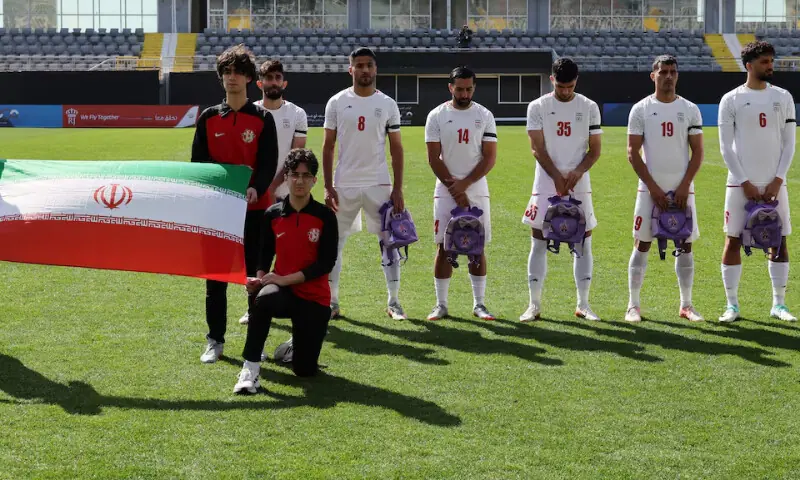
Iranian football players hold schoolbags in solidarity with girls killed in strike on Minab school

Iran’s men’s national football team wore black armbands and held schoolbags as their ‌anthem played ahead of a match in Turkey on Friday, in what a team official said was a protest over the killing of schoolgirls on the first day of the Iran war.

Iran were playing a friendly against Nigeria in the Mediterranean ​resort town of Belek ahead of the World Cup in the US, Mexico and Canada, ​at which their participation is in doubt due to the conflict.

Iran players line up before the match as school bags are laid in memory of the victims of the girls school bombing in Minab, Iran, March 27, 2026. — Reuters

The men lined up ⁠holding pink and purple bags with ribbons on them — a reference to the attack on the ​Shajareh Tayyebeh School that Tehran says killed more than 175 people, including children and teachers, on the ​first day of joint US-Israeli strikes on the country.

Mehdi Mohammad Nabi, a vice president of the Iranian football federation, told Reuters that the players had decided to stage the protest as a symbolic gesture of solidarity with the victims.

“They ​were deeply affected by the bombing of the girls’ school and wanted to express their sympathy,” ​Nabi said, speaking in Farsi through the association’s translator. “This was a collective decision by the team. We are united.”

Iran players line up before the match as school bags are laid in memory of the victims of the girls school bombing in Minab, Iran, March 27, 2026. — Reuters

US ‌military investigators ⁠believe it is likely that US forces were responsible but have not yet reached a final conclusion or completed their investigation.

The UN rights chief urged Washington on Friday to conclude its investigation into the strike at a meeting of the UN Human Rights Council.

Iran players line up before the match as school bags are laid in memory of the victims of the girls school bombing in Minab, Iran, March 27, 2026. — Reuters

Speaking in front of the stadium, Nabi said the ​team was aware of the ​discussions taking place ⁠at the rights council and hoped for a “clear and appropriate decision”.

Iran players line up before the match as school bags are laid in memory of the victims of the girls school bombing in Minab, Iran, March 27, 2026. — Reuters

US President ​Donald Trump ⁠said earlier this month that while Iran’s national team were welcome to play in the US, it might not be appropriate for their “life and safety”.

Iran’s football federation said it was in discussions with football’s world ⁠governing body ​FIFA about moving its World Cup matches to Mexico from ​the US.

The Iranian team lost 2-1 to Nigeria on Friday and will play Costa Rica on Tuesday in another friendly in ​Turkey.


from Dawn - Home https://ift.tt/0G271er

PCB issues show-cause notice to Naseem Shah for ‘violating terms of central contract, media policy’

The Pakistan Cricket Board (PCB) has issued a show-cause notice to fast bowler Naseem Shah for “violating the terms of [his] central contract as well as the media policy and regulations”, according to a press release.

The press release, issued by the PCB on Friday, said that the show-cause notice to Naseem, who also plays for the Pakistan Super League team Rawalpindiz, had been served in accordance with the board’s disciplinary framework.

“Naseem Shah is required to provide a response within the stipulated time,” the press release said, without specifying the date by when Naseem was required to submit his response.

It added that upon receipt and review of Naseem’s response, the PCB would “decide on any further action in line with the regulations”.

“The PCB remains committed to upholding professional standards, contractual obligations, and the integrity of the game,” the press release read.

While the press release did not specify the exact violations or the events that led to the issuance of a show-cause notice to Naseem, the development came a day after the opening night of the 11th season of the HBL Pakistan Super League, where Punjab CM Maryam Nawaz was also present, regarding which a post had appeared on Naseem’s X account.

The post included a video of Maryam from the event and said, “Why is she treated like a queen at Lords?”

It was later deleted and later, another post on Naseem’s account said: “This account of Naseem was recently hacked but [is] now recovered successfully.”


from Dawn - Home https://ift.tt/RZQsftm

Thursday, 26 March 2026

War Diary Day 27: Multifront escalation appears imminent as Trump’s 5-day pause expires

On 27th day of the US-Israeli war on Iran, the conflict has continued to be fully kinetic with no sign of de-escalation, even as US President Donald Trump’s five-day pause expires on Friday. Meanwhile, the overall trajectory of the conflict points towards an imminent widening of hostilities across multiple theatres.

Over the past 24 hours, direct strikes inside Iran intensified. Multiple explosions were reported across central, southern and eastern Tehran, with air defence systems activated across the capital, while additional strikes hit Khorramabad, triggering blackouts and being followed by rescue operations. Reports also indicated damage in areas where residences and infrastructure are located in Mashhad.

Iran’s response, both directly and through its regional network of allies, showed a marked escalation in tempo and scale. Missile and drone strikes continued against Israeli targets, with reports suggesting improved penetration rates against air defences and expanded targeting of defence, industrial and processing facilities, including a strike on the ICL Rotem complex in the Negev. Claims of strikes at multiple locations, including areas near Dimona and Haifa, alongside attacks on US positions in Jordan, Bahrain and Kuwait, reinforced the pattern of distributed retaliation.

The Lebanese front

The most significant escalation, however, was visible on the Lebanese front, where Hezbollah sharply increased both the intensity and effectiveness of its operations. A series of coordinated ambushes across multiple axes in southern Lebanon, including Taybeh, Markaba and Khiam, resulted in heavy Israeli armour losses, with field reports describing the destruction of a large number of Merkava tanks and supporting vehicles within a short span. This was accompanied by some of the heaviest rocket barrages reported so far, targeting not only northern Israel but extending to Tel Aviv and other strategic locations.

This combination of ground attrition and long range strikes suggests that Hezbollah is seeking to shape the battlespace ahead of any potential escalation linked to the expiry of the US pause, while reinforcing deterrence through visible battlefield successes. The messaging accompanying these operations, particularly the emphasis on reciprocal population displacement, points to an increasingly hardened posture.

Alongside Lebanon, the maritime dimension is also showing signs of activation. The Houthis have signalled readiness to resume attacks on shipping in the Bab el-Mandeb Strait, raising the prospect of a second critical chokepoint coming under pressure at a time when the Strait of Hormuz remains contested. The simultaneous choking of the two waterways, when it happens, will be part of a broader Iranian strategy of horizontal escalation.

The diplomatic front

Diplomatically, the picture remains constrained despite continued backchannel activity. Iran has formally responded to and rejected the US proposal conveyed through intermediaries, reiterating its core conditions which include an immediate end to attacks, guarantees against future aggression, compensation for damages, simultaneous cessation of hostilities across all fronts, and recognition of its position on the Strait of Hormuz. These demands underline the structural gap between Tehran and Washington, which continues to demand far reaching restrictions on nuclear and missile related matters.

Iranian officials have maintained that negotiations cannot take place under active military pressure, with Foreign Minister Abbas Araghchi publicly rejecting the idea of talks while strikes continue. Iranian state narratives have portrayed US references to diplomacy as attempts to manage perceptions and stabilise markets rather than signal genuine intent.

At the same time, internal developments within Iran point to further consolidation of a security driven approach, with figures such as Mohammad Bagher Zolghadr assuming greater influence and hardline voices gaining ground. This shift is narrowing the space for compromise and reinforcing a strategy centred on endurance and calibrated escalation.

Next phase in the offing?

On the US and Israeli side, indications of preparation for a possible next phase are becoming more visible. Political signalling in Washington has included open references to potential ground operations, while military assessments continue to focus on options such as the seizure of key islands, including Kharg, Larak, Qeshm and Kish, to alter the balance in the Strait of Hormuz.

The overall assessment at the end of day 27 is that the diplomatic window created by the US pause is closing without producing convergence, while the military dynamics across Iran, Lebanon and the maritime domain are moving in the opposite direction.

With the pause expiring, both sides appear to be positioning for a more decisive phase, raising the risk that the conflict could transition from its current attritional pattern to a broader and more intense confrontation in the coming days.


Header image: People wave national flags and hold portraits of Iran’s supreme leader Mojtaba Khamenei as they march in support of the Iranian armed forces in central Tehran on March 25, 2026. — AFP


from Dawn - Home https://ift.tt/NkMT1f0

US judge questions block on Maduro’s use of Venezuelan funds for defence

A US judge questioned on Thursday whether the US can bar Venezuela from funding Nicolas Maduro’s legal defence without violating his US constitutional rights, but stopped short of dismissing drug-trafficking charges against the ousted Venezuelan president facing trial in New York.

Maduro and his wife, Cilia Flores, wore beige prison garb to the hearing in Manhattan federal court over two months after US military forces captured them in a surprise raid on Caracas and ferried them to American soil.

Maduro, 63, and Flores, 69, have pleaded not guilty to charges including narcoterrorism conspiracy and have been jailed in Brooklyn pending trial.

They had asked US District Judge Alvin Hellerstein to dismiss the charges, saying their inability to rely on Venezuelan public funds due to US sanctions on Venezuela was interfering with their right to have a lawyer of their choosing under the Sixth Amendment of the US Constitution.

All criminal defendants in the US have constitutional rights regardless of whether they are US citizens.

Their lawyers have said Maduro and Flores cannot afford to pay their defence fees on their own.

In court, prosecutor Kyle Wirshba said the US sanctions blocking the payments were based on legitimate national security and foreign policy interests.

During his first term in the White House, Trump ramped up sanctions on Venezuela over allegations that Maduro’s government was corrupt and undermining democratic institutions. Washington called Maduro’s 2018 reelection fraudulent.

Hellerstein appeared sceptical of that argument, noting that the US had relaxed sanctions on Venezuela since Maduro’s ouster.

“The defendant is here, Flores is here. They present no further national security threat,” said Hellerstein, a judicial appointee of Democratic President Bill Clinton. “The right that’s implicated, paramount over other rights, is the right to constitutional counsel.”

Pollack, who previously represented WikiLeaks founder Julian Assange, has said he wants to withdraw from the case if Hellerstein doesn’t dismiss the charges and the Venezuelan government cannot pay his fees.

It was unclear how much Pollack is charging Maduro for his services. Pollack did not respond to a request for comment.

Earlier on Thursday, US President Donald Trump told reporters that additional cases would be brought against Maduro, without offering details.

Maduro captured by special forces

US special forces captured Maduro and Flores in a surprise January 3 raid on their Caracas residence and flew them to New York to face drug trafficking charges, an operation detailed in a Reuters examination of the covert mission and its geopolitical fallout.

Prosecutors argue that because the US has not recognised Maduro as Venezuela’s legitimate president since 2019, he and Flores should not expect the US government to allow Venezuela to pay their legal fees. The prosecutors say Maduro and Flores can be assigned public defenders if they cannot afford their own lawyers.

Wirshba said Maduro and Flores could challenge the sanctions by bringing a separate lawsuit against the Treasury Department, which enforces sanctions.

Hellerstein asked whether he could order the Treasury to modify the sanctions to allow the Venezuelan government to pay the legal fees. Wirshba said Hellerstein could not because the executive branch, not the judiciary, was in charge of foreign policy.

Narcoterrorism law has had limited trial success

Maduro faces four felony charges, including narcoterrorism conspiracy, which criminalises drug trafficking that helps to finance activities the United States considers terrorism.

The statute has rarely been tested at trial, and two of four trial convictions have been overturned over issues stemming from witness credibility, a Reuters analysis of court records found.

Maduro dismissed those accusations, along with allegations of his participation in drug trafficking, as pretextual justifications for what he called a US desire to seize control of the South American OPEC nation’s vast oil reserves.

Relations between Caracas and Washington have improved since Delcy Rodriguez, Maduro’s former vice president, became interim president after his capture.


from Dawn - Home https://ift.tt/3a01x9w

Zelensky to ink air security deal with Saudi Arabia on surprise visit, says source

Ukrainian President Volodymyr Zelensky arrived in Saudi Arabia on Thursday for an unannounced visit, as the war in Iran spurs interest among Gulf countries in Ukrainian arms technology.

The two countries are set to sign an agreement on “security cooperation — in particular, the protection of the skies”, later on Thursday, a senior official told AFP, speaking on condition of anonymity.

They did not provide further details of what was set to be in the accord.

Kyiv has sought to leverage its expertise in downing Russian drones to help Gulf nations, which are being attacked with the same Iranian-designed Shahed drones that Russia fires on Ukraine.

Zelensky has said that more than 200 Ukrainian anti-drone experts have been deployed to several countries in the Middle East, including Saudi Arabia, since the US-Israel strikes on Iran spurred retaliatory drone and missile attacks targetting US assets and bases from Tehran.

While Tehran accepts responsibility for some of the attacks, it denies having a role in others, including in Saudi Arabia.

“Arrived in Saudi Arabia. Important meetings are scheduled,” Zelensky wrote on social media, publishing a video of him meeting a regional official in Jeddah.

“We appreciate the support and support those who are ready to work with us to ensure security,” Zelensky added.

Kyiv is touting its mix of cheap drone interceptors, electronic jamming tools and anti-aircraft guns to down Russian drones as an effective air defence tool.

Ukraine has proposed swapping its interceptors for the vastly more expensive air-defence missiles that Gulf countries are currently using to down Iranian drones. Kyiv argues it needs more of them to fend off Russian missile attacks.

Last year, Saudi Arabia also hosted US officials for separate talks with Ukrainian and Russian delegations in a bid to find an end to the four-year war triggered by Moscow’s February 2022 invasion.


from Dawn - Home https://ift.tt/FNJmqfi

Wednesday, 25 March 2026

Lebanon must not become next Gaza, says UN chief

• Guterres warns war in Middle East is ‘out of control’; calls for immediate halt to hostilities between Israel, Hezbollah
• Israeli strikes kill nine more in Beirut, southern areas
• Spanish PM Pedro Sanchez condemns US-Israeli actions

UNITED NATIONS: UN Secretary-General Antonio Guterres said on Wednesday that fighting between Israel and Hezbollah must not condemn Lebanon to the same fate as Gaza, the Palestinian territory decimated by years of conflict.

“The Gaza model must not be replicated in Lebanon,” Guterres told reporters, also saying the wider war in the Middle East is “out of control”, as the United States, Israel and Iran have carried out strikes for more than three weeks.

“Across the region, and far beyond, civilians are enduring serious harm and living under profound insecurity. I witnessed some of these consequences firsthand during my recent visit to Lebanon,” he said.

“There, too, the war must stop. Hezbollah must stop launching attacks into Israel. And Israel must stop its military operations and strikes in Lebanon, which are hitting civilians the hardest.”

In early March, Israeli Finance Minister Bezalel Smotrich threatened Beirut’s southern suburbs with the same devastation that Israel has inflicted on Gaza in its war in Gaza.

Beyond Lebanon, Guterres voiced alarm at the wider regional war triggered by US-Israeli strikes on Iran in late February that killed the country’s supreme leader Ali Khamenei. “The conflict has broken past the limits even leaders thought imaginable,” he said.

“The world is staring down the barrel of a wider war, a rising tide of human suffering, and a deeper global economic shock. This has gone too far.”

The UN chief also announced the appointment of French diplomat Jean Arnault as his special envoy to lead UN efforts regarding the conflict and its consequences. UN chief says Lebanon must not become next Gaza amid fighting.

Israel broadens assault

Meanwhile, relentless Israeli aggression continued across Lebanon on Wednesday, with a new wave of strikes hitting the capital’s southern suburbs and multiple locations in the south, according to Lebanese state media.

According to the state media, Israeli strikes killed at least six people in a town and a Palestinian refugee camp in the southern Sidon area, and three more in another town.

The human cost of Israel’s campaign continues to climb. Lebanon’s health ministry reported that two paramedics were among those killed in an Israeli strike.

Hezbollah’s Deputy Secretary-General, Sheikh Naim Qassem, delivered a defiant message on Wednesday, rejecting any negotiations while Lebanon is under attack.

“When negotiations with the Israeli enemy are proposed under fire, this is an imposition of surrender,” Qassem said. He insisted that dialogue under such conditions would be tantamount to capitulation.

Spanish PM slams Israel

His words come as international alarm grows over Israel’s clear intentions. Spanish Prime Minister Pedro Sanchez warned on Wednesday that Israel aims to replicate the catastrophic destruction it inflicted on Gaza in Lebanon.

“An emboldened Israeli Prime Minister (Benjamin) Netanyahu aims to inflict on Lebanon the same destruction and suffering that was committed in Gaza,” Sanchez told lawmakers. “It’s not fair that someone sets fire to the world and the rest of us have to swallow the ashes.”

Sanchez also condemned the global economic toll of the conflict, which he blamed on “illegal US and Israeli actions,” stating that Spanish firms alone have lost 100bn euro in under a month. “Every bomb that falls in the Middle East hits the wallets of our families,” he added.

Published in Dawn, March 26th, 2026


from Dawn - Home https://ift.tt/2LGE3o7

Petroleum dealers postpone strike in light of Middle East conflict

KARACHI: Petroleum dealers announced on Wednesday that they were postponing a strike they planned to begin on March 26, keeping in view the situation resulting from the ongoing Middle East conflict, which has given rise to a global fuel crunch and supply uncertainties.

Pakistan Petroleum Dealers Association (PPDA) Chairperson Abdul Sami Khan told Dawn that “we have postponed the strike, keeping in view the hardships consumers will face if the war escalates and leads to a supply chain crisis of petroleum products”.

Asked if the PPDA would call a strike in the near future, he said, “I cannot confirm right now as the situation is highly volatile.”

The association had announced the strike on March 13 and given the government until March 26 to revise the petroleum dealers’ margin from 2.59 per cent to 8pc in the wake of a Rs55 per litre hike in diesel and petrol rates.

The decision to raise the prices was announced on March 6 as Pakistan felt the first direct economic impacts of the US-Israel war on Iran in a big way.

The PPDA chairperson said that the Economic Coordination Committee (ECC) had recommended an increase in dealers’ margin on petrol and diesel, before the Rs55 per litre hike. But, he claimed, the prime minister had suspended the implementation, and the margin remained unchanged even after the price hike.

He said thus far, there had not been a “severe crisis of petrol and diesel” as dealers were getting the required quantities from the oil marketing companies (OMCs).

On reports that the government had finalised a mobile application-based quota system for fuel for two- and three-wheelers, which may possibly include up to 800cc vehicles, to ensure a targeted subsidy to the low-income strata and to minimise oil consumption through pricing signals, he said: “The government has not taken petroleum dealers into confidence in this regard.”


from Dawn - Home https://ift.tt/yQxPH7F

Tuesday, 24 March 2026

Govt may have to ‘unfreeze’ fuel prices amid global surge

• Targeted subsidy for two-, three-wheelers on the anvil
• Jet fuel, kerosene prices rise quietly, but dramatically
• Rising jet fuel costs push up domestic, international fares by 30-40pc
• Passenger volumes on Gulf routes drop; Europe-bound travellers face limited routes, exorbitant prices
• Exporters sound alarm over rising air cargo rates

ISLAMABAD: Amid a sharp rise in jet fuel and kerosene prices, the government is considering unfreezing prices of other petroleum products to reflect global trends, while introducing targeted subsidies for two- and three-wheelers.

While petrol and high-speed diesel prices have been kept unchanged in recent weeks, the rates of jet fuel (JP-1) and kerosene have been increased without formal announcement.

Official rates seen by Dawn suggest JP-1 prices were raised by Rs84 per litre, or 21.65 per cent, to Rs472 from Rs388 per litre with effect from March 21. Since March 1, the price has surged by nearly 150pc from Rs190 per litre.

Similarly, kerosene prices increased by Rs71 per litre, or about 20pc, to Rs429 per litre from Rs358 per litre within a week. Since early March, kerosene prices have risen by 127pc, reflecting global energy market volatility following the US-Israel war on Iran.

On the other hand, the government froze petrol and diesel prices after an initial increase of Rs55 per litre each, allocating around Rs69 billion in subsidies to offset subsequent price revisions.

While the government has protected its petroleum levy targets on both products, it has diverted funds from development projects and emergency funds for natural disasters to maintain prices during Ramazan.

Officials said the government is currently absorbing about Rs175 per litre in diesel costs and around Rs75 per litre in petrol.

Officials said the freeze could not be sustained for long while the review of two IMF programmes had been held in abeyance for more than two weeks now.

“You cannot postpone inflation artificially for long; the more you delay price adjustments, the greater pain you build for the future,” an official said.

It was in this background that the government said it is “actively evaluating price divergence between international and domestic markets to support balanced and timely policy calibration”.

The statement followed a meeting of a special cabinet committee, formed by the prime minister to monitor petroleum prices and review the energy supply situation amid global volatility.

The committee also reviewed a proposal for targeted fuel subsidies for two- and three-wheelers instead of holding back general oil price adjustments.

Officials said petroleum inventories remain at comfortable levels, supported by secured imports and steady refinery output, with supply chains functioning smoothly across the country.

Cargo inflows are continuing as scheduled, with March and April fuel shipments largely secured and additional imports planned to strengthen reserves. Refineries were operating at regular production levels, with efforts underway to maintain optimal throughput and ensure efficient processing of incoming crude.

The finance minister, who chaired the meeting, directed authorities to ensure close monitoring of international markets, stock levels and supply chains.

A detailed review of national stocks and international energy market conditions was presented, highlighting notable movements in global benchmarks. The committee assessed emerging global price signals and their transmission implications, and placed particular emphasis on operational readiness across the domestic energy supply chain.

Airfares under pressure

Rising jet fuel prices are expected to further increase airfares on both domestic and international routes, with airlines already passing on increased costs to passengers.

Aviation experts said fuel, which accounts for 30-40pc of airline operating expenses, has become significantly more expensive, forcing airlines to raise fares by 20-30pc.

“Domestic ticket prices have increased by Rs10,000 to Rs15,000, while international fares have gone up by Rs30,000 to Rs40,000,” an aviation official told Dawn, adding that further increases are likely if global oil prices continue to rise.

Air travel to Europe has been particularly affected due to restricted airspace and limited routes through the Gulf region.

The owner of a travel agency told Dawn that due to the air traffic chaos over the Gulf countries, people going to Europe via Turkiye had to pay several hundred thousand more per ticket during the last couple of weeks.

“Last week, a Lahore to Denmark ticket via Dubai, which was previously available for Rs400,000, was selling for Rs1 million via Turkey last week because of the impact of the war,” he said.

Experts also warn that flying schools and training centres are also facing mounting costs. “How can Pakistani airlines avoid passing on additional costs to passengers for long?” an aviation expert said. “The training cost of pilots has significantly increased due to the surge in jet fuel prices”.

Since the start of the Middle East war, around 325 flights of Pakistani airlines — including about 200 operated by Pakistan International Airlines (PIA) — have been cancelled, according to a spokesperson for the national flag carrier.

PIA continues to operate flights to Fujairah and Al-Ain, while services to Kuwait, Qatar, Dubai and Bahrain remain suspended. Flights to Saudi Arabia are operating as scheduled.

The spokesperson said base airfares had not been increased, but fuel surcharges ranging from $10 to $100 had been introduced.

Regarding the impact on volume of passengers, he said the numbers coming from Saudi Arabia and UAE were quite high, while passenger traffic for the Gulf region from Pakistan had declined.

Flight operations to Qatar, Kuwait, and Bahrain are already suspended, but no significant impact has been seen on traffic to Europe, even though these passengers have to pay higher costs due to longer routes that avoid troubled airspace.

Meanwhile, exporters have raised concerns over rising air cargo costs. The Pakistan Fruit and Vegetable Exporters Association said ground handling companies have imposed an additional charge of Rs50 per kilogram on shipments, warning that exports could be disrupted.

“This additional burden will cause financial losses to exporters,” the association said, adding that fruit and vegetable exports via air routes have already been affected.

Mohammad Asghar in Rawalpindi and Zulqernain Tahir in Lahore also contributed to this report

Published in Dawn, March 25th, 2026


from Dawn - Home https://ift.tt/uijeD1I

LA stadium workers threaten strike ahead of FIFA World Cup

Workers at SoFi Stadium in Los Angeles have overwhelmingly voted to authorise a potential strike during the World Cup , just days before foo...