Sports and 🌎 News: November 2025

Sunday, 30 November 2025

A roadmap, not a reprimand

The International Monetary Fund’s (IMF) Governance and Corruption Diagnostic Report has, unsurprisingly, triggered a strong reaction in the media. Many commentators have rushed to frame it as a harsh judgment on the sitting government. This interpretation misrepresents the very purpose of the report.

As the document itself makes clear, the exercise was undertaken at the explicit request of the Government of Pakistan and completed with its full cooperation. It is neither an audit of the current administration nor a verdict on its performance over the past year.

Instead, the report examines governance practices that have evolved over decades, across multiple governments, and that now constrain Pakistan’s economic potential. Its purpose is to identify systemic weaknesses and recommend reforms that can help the country unlock long-delayed improvements in governance and economic management. It is meant to support reform, not to assign blame, and to guide IMF monitoring and programme execution going forward.

The report covers five broad areas: fiscal governance, market regulation, financial-sector oversight, anti-money laundering frameworks, and the rule of law. This article focuses on market regulation and, in particular, on tariff policy, which the IMF describes as a particularly important and costly example of current issues.

The IMF diagnostic report is neither an audit of the current administration nor a verdict on its performance over the past year

According to the diagnostic, reforming this area alone could “increase growth by approximately two per cent over a five-year period while having a meaningfully positive impact on reducing inequality”.

Importantly, the IMF acknowledges that Pakistan has already begun taking meaningful steps to realign tariff policy with an export-oriented growth strategy. After years where protectionist lobbies shaped tariff decisions, policy is now moving toward greater discipline and transparency.

The report highlights two reforms of particular significance. The first is the shift of tariff-setting powers away from the revenue-driven Federal Board of Revenue to the National Tariff Commission. This transition established a whole-of-government structure through the National Tariff Board and the technical Tariff Policy Centre, giving tariff policy a coherent institutional anchor.

The second is the recent approval of the National Tariff Policy 2025–2030. Building on earlier efforts, the new policy outlines a more ambitious and time-bound plan for tariff rationalisation and gradual liberalisation. If implemented faithfully, the IMF notes, these reforms could help Pakistan break from a cycle of ad hoc tariff changes and move toward a trade policy that strengthens productivity, investment, and export competitiveness.

For the IMF, the sustainability of this progress will depend on the government’s willingness to resist the pressures that have historically derailed reform. Still, the overall trajectory is unmistakably positive. A predictable, rules-based tariff regime is essential for a country that seeks export-led growth rather than reliance on protectionism and special interests. Pakistan has taken several important steps in that direction. It must now stay the course.

Looking ahead, the IMF stresses the need to strengthen the National Tariff Commission (NTC), which now has a much wider mandate of not only enforcing trade remedy measures but also tariff setting.

It remains severely understaffed and short of the specialist expertise required to carry out its mandate. Without such capacity, tariff policy remains vulnerable to ad hoc decision-making and rent-seeking pressures. The diagnostic makes clear that if Pakistan is committed to developing a credible, modern tariff regime, expanding and professionalising the NTC is indispensable.

Fortunately, the government has already launched a comprehensive review of the commission’s performance, identified key gaps, and begun evaluating options for meaningful reform. The Prime Minister’s Office is steering this effort by drawing on the experience of leading trade-remedy authorities and successful domestic institutional reforms, such as the setting up of Pakistan Single Window, a time-bound plan to restructure the NTC along similar modern lines is now in its final stages of approval.

All in all, the IMF’s diagnostic report provides a practical roadmap across five core areas that capture much of the government’s most critical work and where reform is urgently needed. What Pakistan now requires is the same disciplined and predictable approach that is beginning to take shape in tariff reforms. The IMF estimates that if these broader reforms are pursued with seriousness and continuity, Pakistan could secure a cumulative GDP gain of 5–6.5pc over five years, an opportunity the economy can ill afford to miss.

If the government follows this path with real commitment, it can significantly improve governance, rebuild confidence among domestic and foreign investors, and bring Pakistan’s economic management closer to international best practice.

Opportunities where there is clarity about the problems and broad agreement on the solutions do not come very often. This is one of those moments. Ignoring it would not only waste a valuable chance but could set the country back at a time when it cannot afford further mistakes.

The writer is a member of the Steering Committee for the Implementation of the National Tariff Policy 2025-30 and Convenor of the Committee for Modernisation of the NTC. Previously he has served as Pakistan’s ambassador to the World Trade Organisation.

Published in Dawn, The Business and Finance Weekly, December 1st, 2025


from Dawn - Home https://ift.tt/46YuJiH

KP govt to attend NFC meeting, fight case for province and its people: CM Afridi

Khyber Pakhtunkhwa Chief Minister Sohail Afridi on Sunday said that the PTI’s provincial government would attend the National Finance Commission (NFC) meeting on December 4 and “fight the case for our province and its people” in the best possible manner.

The 11th NFC was constituted on Aug 22 to finalise a new award for sharing federal divisible resources between the Centre and the provinces.

The first meeting was originally scheduled for Aug 27, then delayed to Aug 29 for unspecified reasons. This, too, was postponed on the request of the Sindh government due to flood-related engagements. The session was later rescheduled for Nov 17, then Nov 18, and again deferred at the desire of the Prime Minister’s Office.

Earlier this week, CM Afridi said that the federal government still owed Rs1.3 trillion under the NFC framework to the province.

Addressing a press conference in Peshawar today, the CM said that the erstwhile tribal areas were merged with KP administratively in 2018, but they were yet to be financially integrated. The NFC share for the merged districts had not been paid to KP since 2018, he added, deeming it “constitutional violation”.

He further said that the federal government should consider the provincial government’s suggestions for maintaining lasting peace in the province, adding that “decisions taken behind closed doors” adversely affected KP.

“If the federal government implements our suggestions, it will be our responsibility to carry out decisions and maintain the law and order situation,” CM Afridi said.

“The provincial government wants all stakeholders to be taken on board about any decision regarding peace in the province.”

The chief minister alleged that the “powers-that-be” had always conspired to push the PTI into conflict, but emphasised that the party would remain peaceful, adding that it “will, however, never hesitate to offer sacrifices”.

“Persistent efforts have been made to isolate the PTI and peaceful protesters were shot at,” CM Afridi said, claiming that founder PTI Imran Khan was being kept in isolation and all visitors, including his sisters, were being denied a meeting with the incarcerated ex-premier.

The chief minister said the PTI had decided that all parliamentarians would peacefully protest outside the Islamabad High Court (IHC) on Tuesday. They would also accompany Imran’s sisters to the Adiala jail, and the provincial government would follow directions issued by party leadership.

“All the parliamentarians, including provincial and national assembly members, along with senators, will protest outside the IHC over delayed case hearings. They will all then move towards Adiala, accompanying Imran Khan’s sisters,” CM Afridi told reporters.

The CM said that after reports by the international media about the PTI founder’s health, he went to the Adiala jail to meet Imran on November 27, but was refused an audience, even after spending the entire night outside the prison in a sit-in protest.

He said that he decided to hold a sit-in outside the Adiala jail because his party was being mistreated. He also claimed that while some chief ministers were “faciliatated and offered Pakistan Air Force jets”, his name was added to the passport control list.

Fielding questions, the chief minister said “no part of KP is under the control of the militants”. However, without naming anyone, CM Afridi alleged “the entire country is being controlled by one person”.

While responding to another question, the chief minister said his family owned property in Tirah but denied owning any himself, adding that a recent documentary against him was an attempt to divert public attention, but people never believed those who shared the documentary.

“People know everything. They know who is lying, and we want them to do their job, and only then, the country will develop,” the chief minister said.


from Dawn - Home https://ift.tt/5oiTPwp

Saturday, 29 November 2025

Political prisoner

IT seems unnecessary and ultimately counterproductive for the government to continue imposing such restrictions. Whatever it may think of Imran Khan today, the fact remains that he is a former prime minister and, as such, entitled to basic dignity during his incarceration.

Arbitrarily cutting off his access to family and lawyers appears intended to inflict psychological pressure. This is a tactic that should not be countenanced in a just society. To be fair, Mr Khan himself, while in power, demonstrated little concern for the rights of his political opponents. He repeatedly used abusive language against them and even publicly threatened to withdraw basic amenities from the jail cell of his principal rival, Nawaz Sharif.

But while there is no denying that his conduct set a poor precedent, it should not now be used as justification for the treatment he is receiving under a government led by Mr Sharif’s party. If anything, this cycle of score-settling only underscores how little separates major political parties when it comes to the misuse of state authority.

It may be noted that the courts have issued orders on several occasions allowing Mr Khan’s family and lawyers to meet the jailed leader. In most instances, however, these orders have been ignored and dismissed by the prison authorities, who, it seems, answer to some higher powers. With the courts appearing helpless in enforcing their writ, Mr Khan’s family and supporters are quite understandably growing increasingly frustrated.

Things have taken a particularly concerning turn since some publications in hostile countries recently published articles alleging that Mr Khan may have been grievously harmed in custody. Though such news appears to be fabricated and aimed at agitating Mr Khan’s supporters, it has still sparked some concern for his general well-being in his family. It is unkind of the government to not allow them to at least satisfy themselves regarding his health, even if it wants to prevent lengthy conferences.

Prisoners in Punjab, including political detainees, are generally allowed five visitors per week and 30 minutes of phone time under the jail manual. There is no defensible reason why a public figure like Mr Khan should be denied these basic privileges.

Leaving such decisions to the personal discretion of a jail superintendent reflects poorly on the current government, whose cabinet members have repeatedly tried to justify such actions, but only end up deepening the impression of vindictiveness.

Pakistan’s political class has, for decades, sent each other to jail. If they cannot break this cycle, they can at least agree on a minimal standard for how political prisoners should be treated, regardless of which party happens to be in power. Anything less will merely ensure that today’s enforcers become tomorrow’s victims, and that no one ever learns from the past.

Published in Dawn, November 30th, 2025


from Dawn - Home https://ift.tt/nvY9Iqf

‘Vast majority’ of bank accounts operational, says Shaukat Khanum trust after reports of closures

The Shaukat Khanum Memorial Trust (SKMT) said on Saturday that the “vast majority” of its bank accounts were fully operational amid reports of closure and complaints that donations were not going through.

The alleged closure of the trust’s bank account was widely discussed on social media, with some voicing concern that it could affect patients.

However, SKMT assured its donors that it was making efforts to unfreeze the bank accounts and would ensure the uninterrupted supply of medicine to its patients.

“We would like to reassure our donors and supporters that the vast majority of our bank accounts are fully operational, and we continue to receive donations without any disruption. A small number of our accounts have had restrictions placed on them, and we are working to have these lifted at the earliest. We expect that these restrictions will be removed soon.”

It further confirmed that all patient care and treatment services continued uninterrupted.

SKTM is a charitable organisation established under the Societies Registration Act XXI of 1860 of Pakistan and launched by PTI founder and former prime minister Imran Khan.

It operates the Shaukat Khanum Memorial Cancer Hospital and Research Centres in Lahore and Peshawar, with construction underway for a third location in Karachi.


from Dawn - Home https://ift.tt/udESPIh

Friday, 28 November 2025

Cybersecurity Act essential to national security, says IT minister

ISLAMABAD: Federal Minister for Information Technology (IT) and Telecom Shaza Fatima Khawaja said the Cybersecurity Act 2025 was essential for national security and reflected the government’s whole-of-nation approach to cybersecurity, marking a major reform initiative.

She noted that the Act will establish the National Cybersecurity Authority (NCA) to lead nationwide incident response and thr­eat intelligence, while exp­ansion of the Pakistan Computer Emergency Res­ponse Team (PKCERT), and the development of secure digital public infrastructure under the Digital Economy Enhancement Project (Deep) will further strengthen national cyber resilience.

Ms Khawaja was add­ressing a gathering at FAST National University, Islam­abad, on the theme ‘Securing Pakistan’s Digi­tal Frontier: CyberShield, Policy & the Future’. The event was hosted by the FAST Public Policy and Res­earch Society (FPPRS).

She added that Pakis­tan’s long-term objective is to build a cyber-resilient, innovation-driven dig­ital nation where secure infrastructure, technological excellence, and human cap­ital development adva­nce together.

The minister underscored that Pakistan’s digital transformation is accelerating at an unprecedented pace, bringing with it the critical responsibility of safeguarding national digital infrastructure and citizen data.

She highlighted Pakistan’s Tier-1 ranking in the ITU Global Cybersecurity Index as a reflection of the collective commitment of the government, academia, and youth toward building a secure digital future.

The minister said Pakistan is rapidly advancing toward AI-driven cybersecurity, dark-web moni­toring, and cloud security under the Cloud-First Policy, along with secure digital identity frameworks.

She also referred to the recent Marka-i-Haq, calling it a defining moment in which the armed forces, national institutions, and cyber experts stood united with remarkable resilience.

She emphasised that Pakistan’s effective and coordinated cyber warfare response during this period demonstrated exceptional national strength and technological capability, adding that Marka-i-Haq proved the cyber domain is the first line of defence in the modern era, and Pakistan has shown it can safeguard its digital frontiers with confidence and competence.

The minister also toured FAST-NU Islamabad’s IC Design Lab along with Director Dr Waseem Shahzad, Dean Dr Sadia Nadeem, and Fast Public Policy and Research Society (FPPRS) President Zainab Inam Cheema, and met scholars enrolled in Ignite’s flagship training initiative, “Training in IC Design & Verification.”

Under this Ignite-funded programme, 30 young engineers — including seven female participants — are undergoing a rigorous 10-month training course covering IC design, verification, and fabrication processes.

Implemented by FAST-NU, the programme offers hands-on training aligned with global semiconductor industry standards.

Published in Dawn, November 29th, 2025


from Dawn - Home https://ift.tt/djC3Gvp

Afghan suspect in US National Guard shooting to be charged with murder

An Afghan national accused of shooting two National Guard members will be charged with first-degree murder, a US official said Friday, after one of the soldiers died of her wounds as Donald Trump pledged to suspend migration from “third-world countries.”

The announcement marks an escalation in charges facing the assailant, identified as 29-year-old Rahmanullah Lakanwal, who the US media said was part of the “Zero Units” — a CIA-backed Afghan paramilitary force.

“There are certainly many more charges to come, but we are upgrading the initial charges of assault to murder in the first degree,” Jeanine Pirro, the attorney for Washington, DC, told the Fox News programme ‘Fox & Friends’.

“It is a premeditated murder. There was an ambush with a gun toward people who didn’t know what was coming.”

Pirro’s announcement comes after Attorney General Pam Bondi pledged on Thursday to “seek the death penalty” against Lakanwal, describing him as a “monster.”

Pirro said Lakanwal opened fire with a .357 Smith and Wesson revolver on a group of guardsmen on patrol just a few blocks from the White House on Wednesday, the eve of the Thanksgiving holiday.

Sarah Beckstrom, a 20-year-old West Virginia National Guard member deployed in the US capital as part of Trump’s crackdown on crime, died from her wounds, the president said on Thursday. He said the other soldier wounded in the attack, 24-year-old Andrew Wolfe, was “fighting for his life”.

“We still have hope,” Pirro said of Wolfe. “He’s still in critical condition. We are doing everything we can to assist his family.”

The shooting has brought together three politically explosive issues: Trump’s controversial use of the military on American soil, immigration, and the lingering legacy of the 20-year conflict in Afghanistan — America’s longest war.

‘Rigorous reexamination’

Late on Thursday, Trump pledged on Truth Social to “permanently pause” migration from “all Third World Countries” and threatened to reverse “millions” of admissions granted under his predecessor Joe Biden, in a new escalation in his anti-immigration stance.

When asked which specific nationalities would be affected, the US Department of Homeland Security pointed AFP to a list of 19 countries — including Afghanistan, Cuba, Haiti, Iran and Myanmar — facing US travel restrictions under a previous order from Trump in June.

Separately, Joseph Edlow, Trump’s director of US Citizenship and Immigration Services (USCIS), said on Thursday he had ordered a “full-scale, rigorous reexamination of every Green Card for every alien from every country of concern.” When asked to specify the countries, the USCIS referred AFP to the same list of 19 countries.

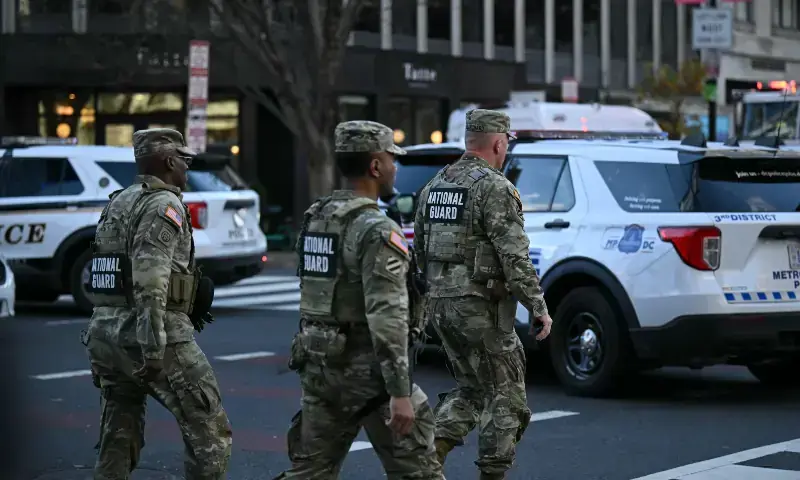
US National Guard soldiers gather near a crime scene after a shooting in downtown Washington, DC, the US on November 26. — AFP

More than 1.6 million US green card holders, roughly 12 per cent of the total permanent resident population, were born in the countries listed, according to the latest immigration data available on the agency’s ‘Eligible to Naturalise Dashboard’ analysed by AFP.

Afghanistan, which has over 116,000 green card holders, is also affected by a total halt of immigration application processing, ordered by the Trump administration after the shooting.

CIA director John Ratcliffe said the suspect, Lakanwal, had been part of a CIA-backed “partner force” fighting the Taliban in Afghanistan.

He added that he had been brought to the United States as part of a program to evacuate Afghans who had worked with the agency after the Taliban toppled the American-backed government in 2021.

Lakanwal had been living in the western state of Washington with his family and had driven across the country to the capital, officials said.

The heads of the FBI, CIA and Homeland Security and other senior Trump appointees all insisted that Lakanwal had been granted unvetted access to the US because of lax asylum policies in the wake of the chaotic final US withdrawal from Afghanistan under former president Biden.

However, AfghanEvac, a group that helped resettle Afghans in the US after the military withdrawal, said they had undergone “some of the most extensive security vetting” of any migrants.


from Dawn - Home https://ift.tt/PXybkcS

Lesco restores power to Lahore’s Bahria Town after payment of dues

The Lahore Electric Supply Company (Lesco) restored power supply to four housing projects in Bahria Town Lahore after the society’s administration paid outstanding bills amounting to Rs682 million.

“The power supply has been restored to four Bahria town projects, including main Bahria Town near Mohlanwal,” a Lesco spokesperson told Dawn.

The power supply was suspended yesterday, inviting criticism from the residents, who also announced holding a protest demonstration in front of the Bahria Town offices after Friday prayers on this issue.

According to Lesco CEO Mr Ramzan Butt, the last date for bill payment was November 21, which was extended to November 23 on the request of the housing society’s officials.

After failing to pay, the officials had requested another day’s extension and continued securing more until Wednesday.

“Since the final and last date was November 27 (yesterday), they, instead of paying bills, approached the court, reportedly. But before they could get the court decision, we disconnected the power supply to four projects, including the main Bahria town (near Mohlanwal) that alone has dues of over Rs530m,” Butt explained to Dawn.

In 2024, Lesco had disconnected the power supply to Bahria Town over the non-payment of more than Rs762m in electricity bills.

The real estate company has come under scrutiny before as well for power issues. In June last year, scores of residents in Bahria Town’s operations in Islamabad petitioned against overbilling and deductions by the management on electricity generated through solar power.


from Dawn - Home https://ift.tt/I2GB5Xe

Thursday, 27 November 2025

Govt & PTI men assure ‘all well with Imran’

 Khyber Pakhtunkhwa Chief Minister Sohail Afridi arrives at Adiala jail in Rawalpindi.—Reuters
Khyber Pakhtunkhwa Chief Minister Sohail Afridi arrives at Adiala jail in Rawalpindi.—Reuters

• Clarification follows concerns expressed by Imran’s son Kasim; Rana Sanaullah also dismisses reports of ex-PM’s transfer to another prison
• KP CM Afridi stages sit-in outside jail after eighth snub at Adiala

ISLAMABAD: As reports about PTI chief Imran Khan’s ill health swirled on social and foreign media, both government and PTI figures dismissed such speculation on Thursday, saying the former prime minister — currently held in isolation — was doing well.

The clarification came when PTI activists staged a sit-in outside Adiala jail after authorities did not allow Khyber Pakhtunkhwa Chief Minister Sohail Afridi to meet the incarcerated party leader for the eighth time since he assumed office. His sisters and legal team were not allowed to meet Imran, either.

The lack of access to Mr Khan also gave rise to unconfirmed reports about his ill health and transfer to a high-security prison — which were picked up by a Japanese newspaper and the BBC.

‘Where is Imran Khan?’ also trended on X on Thursday morning.

In a statement shared by the PTI, Imran’s son Kasim Khan also called on the international community and global human rights organisations to intervene and “demand proof of life, enforce court-ordered access, end this inhumane isolation” faced by his father.

Against this backdrop, Rana Sanaullah, who advises the PM on political affairs, told ARY News that Mr Khan was fine and his health was being taken care of. “There is a team of doctors that checks him on a weekly and daily basis [and looks after his] medicine, diet, facilities [and] exercises.” He said Mr Khan was getting everything befitting his position and status, adding that the PTI chief was still present in Adiala jail.

PTI leader Ali Zafar also dismissed reports about Imran Khan’s health in a DawnNewsTV show. “Thank God, the news is baseless, but it is even more important after this report that the government immediately allow us the opportunity of a meeting so we can go and see ourselves,” said the PTI leader, adding that once a meeting was held, they could come out and tell everyone that everything was fine. “We think it is very necessary that a meeting is facilitated with Imran; it’s been a month,” he added.

“There were news reports about Imran Khan, news from India and Afghanistan, attempts were made to spread discord; these reports have been denied. The government cannot harm Imran Khan,” said PTI Central Information Secretary Waqas Akram while talking to Dawn.

Minister of State for Interior Tallal Chaudhry, in an appearance on Geo News, stated that jail officials had already provided information on Imran’s health.

Senate protest

On the other hand, the PTI staged a noisy protest against the alleged mistreatment meted out to the former prime minister. The issue was raised in the House by PTI lawmaker Faisal Javed soon after the question hour. He claimed that Mr Khan had been kept in solitary confinement and regretted that nobody, including his family members, lawyers and doctors, was allowed to see him. “This is against basic human rights, court orders, the jail manual and prison rules,” he remarked.

Minister of State for Interior Talal Cha­udhry, in his response, described Imran Khan as a VIP prisoner enjoying the facilities of exercise machines and a personal cook. He said meetings with a prisoner are regulated under the jail manual.

CM stages sit-in

Meanwhile, a sit-in led by KP CM Afridi continued outside Adiala jail. Pashtunkhwa Milli Awami Party (PkMAP) Mehmood Khan Achakzai also joined the protest on Thursday night to show solidarity with the CM.

Mr Achakzai said more sit-ins would be held across the country and “after that people will govern the country”. “It is unfortunate that the CM of a province is sitting outside the jail. MNAs and senators were not being allowed to meet Imran Khan,” he said.

The KP chief minister, who replaced Ali Amin Gandapur last month, had arrived in Rawalpindi in the morning to meet Imran Khan, but the jail administration did not allow him to proceed. The CM and party supporters originally intended to march to the prison, where Imran Khan is incarcerated, but were stopped by a heavy contingent of police officials at the ‘factory naaka’.

The CM asked the officials to inform him in writing regarding the decision to bar him from meeting the incarcerated former premier despite the court orders, but his request was declined.

Amid uncertainty surrounding the health of Mr Khan, CM Afridi later told reporters that he wanted to meet Mr Khan to get “actual information” from him and share it with the nation. He said he had exhausted all legal and political avenues in his attempts to gain access to the PTI leader.

Published in Dawn, November 28th, 2025


from Dawn - Home https://ift.tt/30tOshZ

Indian delegation pulls out of Oxford Union debate in ‘collective retreat’, Pakistan’s UK mission says

A high-profile debate at the Oxford Union that was scheduled to feature senior figures from Pakistan and India was cancelled after the Indian delegation withdrew at the last minute, prompting strong reactions from Pakistan’s High Commission in London and triggering speculations about why India pulled out last minute.

According to statements issued by the High Commission, the debate centred on the motion “This House Believes India’s Policy Towards Pakistan is a Populist Strategy Sold as Security Policy” had been confirmed weeks in advance. It is scheduled for 12:30am PKT.

Pakistan’s delegation, comprising former Joint Chiefs of Staff Committee chairman Lt Gen (R) Zubair Mahmood Hayat, former foreign minister Hina Rabbani Khar and former diplomat Dr Mohammad Faisal, was already in London for the event.

The High Commission claimed that India’s originally announced speakers, General M.M. Naravane, Dr Subramanian Swamy and politician Sachin Pilot, “withdrew at the eleventh hour”, leaving the event without its opposing panel.

It further alleged that India later proposed “obscure and low-profile replacements” that did not match the level of the Pakistani delegation and “undermined the credibility and balance of the debate.”

“The collective retreat of the Indian delegation amounted to an unchallenged victory for Pakistan,” the High Commission stated, adding that India’s withdrawal “exposed the weakness of its narrative on a neutral academic platform”.

Sources familiar with the matter told Dawn that the last-minute shift was “very bizarre”, noting that such debates were typically finalised far in advance and that delegations typically agreed knowing who they were debating.

While the High Commission criticised what it described as India’s reluctance to face open questioning, many on social media questioned the reason behind India’s withdrawal, speculating that it may have been pressure from the Indian government on the panellists.


from Dawn - Home https://ift.tt/qndCLoE

Wednesday, 26 November 2025

Travel restrictions on ‘Kaghan to GB’ route

MANSEHRA: The district administration of Mansehra has imposed a complete ban on travelling between Khyber Pakhtunkhwa and Gilgit-Baltistan via the Kaghan Valley until next summer.

“We have now completely restricted passenger vehicles, motorists and tourists from travelling to neighbouring GB for their safety,” Assistant Commissioner Balakot Hasrat Khan told reporters on Wednesday. He said the decision to impose a travel ban between KP and GB was taken in a meeting attended by the heads of all relevant departments.

The AC said that the Chilas (GB) district administration and police were in contact with Mansehra’s administration, and they too had imposed a ban on travel along Mansehra-Naran-Jalkhad road. “

We have decided to allow tourists to travel only up to Battakundi and Saiful Muluk between 11am and 3pm, and only with chained tyres, as vehicles cannot move safely on icy roads before or after the four-hour period,” Mr Khan said.

He clarified that no restrictions had been placed on travel up to Naran until the next spell of snowfall. The official said most of the indigenous community settled in Barawai, Battakundi, and other areas beyond Naran had already migrated, while the remaining people were expected to leave within a week or after the second snowfall in Kaghan valley.

He stated that police posts in the upper reaches of the valley had also been closed for the winter. “We expect the Kaghan–Babusar Top section of the MNJ road to reopen in early May next year, and until then the valley will remain completely closed to movement,” he said.

Published in Dawn, November 27th, 2025


from Dawn - Home https://ift.tt/oVNAHKE

Jurist bodies slam ‘ongoing judicial harassment’ of Imaan Mazari, Hadi Ali Chatta

Jurist’s body Lawyers for Lawyers published an open letter on Wednesday condemning the “ongoing judicial harassment” of lawyers Imaan Zainab Mazari-Hazir and Hadi Ali Chatta and urging the government to drop the cases against them.

The National Cybercrime Investigation Agency (NCIA) had registered a case against Mazari and Chattha, accusing the two of attempting to incite divisions on linguistic grounds through social media posts and of creating the impression that the armed forces were engaged in terrorism within the country.

Their lawyer, appointed by the court, refused to cross-examine the prosecution’s witnesses during the most recent hearing on Tuesday, saying that he could not “ask questions dictated” to him.

In a press release, Lawyers for Lawyers, the International Bar Association’s Human Rights Institute, the Law Society of England and Wales, the International Commission of Jurists and the International Observatory of Lawyers at Risk expressed concern over the case.

“We have received credible information indicating that the recent indictment and criminal proceedings against the couple, marred by serious irregularities and the denial of due process guarantees, are intended to obstruct their legitimate legal work and retaliate against them for exercising their right to freedom of expression,” it read.

Lawyers for Lawyers noted tweets made by the couple criticising the armed forces and that the trial progressed rapidly but was “marred by procedural irregularities and apparent judicial bias, raising serious concerns about [its] fairness and legitimacy”.

“The ongoing trial is part of a broader troubling trend of judicial harassment aimed at exhausting the lawyers’ time and resources, discrediting their work, and obstructing their ability to represent victims of state violence,” Lawyers for Lawyers said.

The body urged the authorities to:

  • Immediately drop all charges and end criminal proceedings against Imaan Zainab Mazari-Hazir and Hadi Ali Chattha related to their legitimate professional activities and exercise of freedom of expression;
  • Immediately cease all acts of harassment, intimidation, and improper interference in their legitimate professional work;
  • Ensure that all lawyers in Pakistan can perform their professional duties without fear of reprisals and free of all undue restrictions in accordance with international standards.


from Dawn - Home https://ift.tt/e9xlsWv

Tuesday, 25 November 2025

‘One eye on the barrel, the other on the sky’: How police in Bannu are dealing with evolving militant tactics

PTI to release white paper over alleged election rigging, corruption

The PTI has decided to release a white paper which will “disclose” evidence of the government’s alleged role in rigging the recent by-elections, corruption, the poor law and order situation in the country, malintent in recent legislation and the economic meltdown in Pakistan.

Party stalwart and former National Assembly speaker Asad Qaiser told Dawn he was hopeful that the white paper would be released next month, as different teams would be working on it and all the findings would be compiled.

He alleged that the recent rigging in the by-elections, especially in Haripur, once again proved that the incumbent government had failed and become unpopular.

“The white paper will cover all issues, including economic conditions, corruption, election rigging, law and order situation, etc,” Qaiser said. “Moreover, we will also give the comparison of the performance of the incumbent government with the tenure of PTI.”

Replying to a question, Qaiser said that the legal team headed by PTI Secretary General Salman Akram Raja will look into issues related to law, election rigging and legislation passed by the government as part of the white paper.

“It is a fact that the incumbent government has passed a number of bills and has done legislation, but not a single legislation was done to address the issues of the masses,” he added.

Regarding the section of the white paper dealing with economic downturn and corruption, Qaiser said that party leaders, including Taimur Khan Jhagra, Muhammad Zubair and Muzzammil Aslam, would work on it.

“Similarly, other teams will work on different issues and in the end all will be compiled in the white paper, which will be released next month,” he said.

While talking to media persons earlier, Raja also announced that the white paper would be released, but said that “the law will also be followed”.

He said that during the hearing in the Election Commission of Pakistan (ECP), Ali Bukhari demanded that all party members should receive the same treatment, as leaders from Punjab travelled to Khyber Pakhtunkhwa and made statements, but the ECP did not take the issue up seriously.

“The KP chief minister has directed that the bureaucracy must implement the law and there should not be rigging,” Raja said. “It is the duty of the CM to ensure that the laws are implemented and followed.”

KP CM Sohail Afridi said that he has informed the ECP that, in case of rigging, legal action would be taken against the officials.

“In Haripur, presiding officers were KP government servants, but the returning officer was from the ECP and his office employees were from the federal government, so they issued Form 45 despite ‘pressure’,” he said.

Replying to a question, the CM said that the PTI would continue criticising policies that violate the law and claimed that Form 45 has signatures of polling agents from both sides, but the tickers shared from the RO office were different.

CM Afridi also said that the federal government should pay Rs3 trillion to the KP government so that development work could get started.

“The movement for the release of Imran Khan is ongoing and will continue,” he added.


from Dawn - Home https://ift.tt/QuLpEUG

Barrick committed to Reko Diq copper project, says interim CEO

Barrick Mining Corp remains committed to its Reko Diq copper mine in Pakistan, one of the world’s largest undeveloped deposits of the metal, its interim CEO said on Tuesday after reports of a possible withdrawal.

The $7 billion project in Balochistan is held in an equal partnership between the company and the government and is expected to start production by the end of 2028.

Barrick’s board had raised the possibility of splitting the company’s assets, which could include an outright sale of the Reko Diq mine and the company’s African assets, Reuters reported this month, citing sources familiar with the company’s thinking.

“Barrick remains committed to the Reko Diq project and to Pakistan,” Mark Hill told Reuters.

Security, scale, stake

Balochistan suffers frequent attacks by terrorists, making security a major concern for the mine. The project also requires a railway line upgrade to transport copper concentrate to Karachi for processing abroad.

Lenders, including the International Finance Corporation and the Asian Development Bank, among others, are assembling a financing package exceeding $2.6bn.

The Reko Diq project added 13 million ounces to Barrick’s gold reserves in 2024 and is expected to produce 200,000 metric tonnes of copper a year in its first phase, doubling after expansion, with projected free cash flow of more than $70bn over 37 years.

Pakistan’s mineral play

The remarks from Barrick underscore Reko Diq’s importance to both Pakistan and the company, with Islamabad counting on the mine to anchor its minerals strategy while the Canadian miner advances one of its largest long-term projects.

Sources familiar with the company’s thinking told Reuters this month that board members and some shareholders worry that exposure to riskier assets in Pakistan and Africa may be weighing on Barrick’s valuation compared with its safer North American operations, particularly in the context of any potential takeover interest.

Barrick returned to Pakistan in 2022 after a years-long legal dispute was settled, and the mine has since become a flagship investment for the country as it seeks to draw more capital into its minerals sector.


from Dawn - Home https://ift.tt/1kJ5U0r

Monday, 24 November 2025

‘Tweaks bar FCC from hearing pleas against SC decrees’

ISLAMABAD: The Federal Constitu­tional Court’s (FCC) jurisdiction to hear intra-court appeals (ICAs) came under question on Monday when a senior counsel objected to the court taking up appeals that had earlier been filed under the Supreme Court (Practice and Procedure) Act, 2023.

“If the FCC hears and decides ICAs that were moved against decisions of the Supreme Court, it will create the impression that the court is sitting as an appellate forum over Supreme Court judgements, whereas the 27th Constitutional Amend­ment contains no such provision,” argued senior counsel Ibad-ur-Rehman Lodhi.

Consequently, Chief Justice Aminuddin Khan, who was heading a six-member FCC bench, adjourned the proceedings to allow the counsel to file an appropriate petition on the matter. The counsel later told Dawn that he would file a miscellaneous application within the present ICA instead of submitting a separate petition.

The issue arose when the FCC bench, also comprising Justices Syed Hasan Azhar Rizvi, Ali Baqar Najafi, Muhammad Karim Khan Agha, Rozi Khan Barrech and Arshad Hussain Shah, took up a set of ICAs concerning the All Public Universities BPS Teachers Association (APUBTA), an organisation that had earlier highlighted vacant positions across public-sector universities, including vice-chancellors, presidents, vice presidents, registrars, faculty heads, department heads, controllers of examination, and directors of finance.

Question of jurisdiction surfaces when court takes up varsity teachers’ appeals

When the case was taken up, Advocate Lodhi representing one of the petitioners, vice chancellor Dr Akhtar Ali Kalhoro of the NFC Institute of Engineering, Multan, argued that the FCC could not hear the matter because the appeal had been filed under Section 5 of the SC (Practice and Procedure) Act, 2023.

He contended that the matter should instead be referred back to the SC, which had issued adverse remarks against the petitioner. However, the CJ reminded him that the SC could no longer hear petitions filed under Article 184(3), which relates to the enforcement of fundamental rights, now omitted under the 27th Constitutional Amendment. “Where is Article 184(3) in the Constitution as it stands today?” Justice K.K. Agha asked.

The counsel responded that at the time the appeal was filed before the SC, Article 184(3) was still in effect, even though Article 175(E) now vests original jurisdiction in the FCC to hear such matters. He noted that no appeal or petition under Article 175(E) was pending before the SC that would require transferring cases to the FCC; rather, the appeals had been filed under Article 185 of the Constitution. Justice Najafi observed that the amendment had broadened the scope and concept of the Article, bringing such matters within the FCC’s domain.

“Confusion inevitably arises when matters are left to assumption,” the counsel argued, adding that lawmakers did not address this anomaly. He reiterated that the SC was not seized of any petition under Article 175(E) that would warrant transferring cases to the FCC after its creation.

“Why don’t you file a separate petition on this point?” Justice Najafi suggested.

The counsel replied that if the FCC proceeded with the appeal, it would give the impression that the court was acting as an appellate body over SC decisions. He added that Article 175(F) of the 27th Ame­ndment clearly states that the FCC may hear and determine appeals arising from judgements of a high court made under Article 199 — and not those of the SC.

During the hearing, the FCC also appeared constrained by the lack of readily available copies of the Pakistan Legal Decisions or the Supreme Court Monthly Review for quick reference to prior decisions. The bench had to rely on books provided by the counsel, with two judges sharing a single copy at a time.

Published in Dawn, November 25th, 2025


from Dawn - Home https://ift.tt/bOPvGfQ

UN experts sound alarm on rights violations in occupied Kashmir after Pahalgam attack

United Nations experts on Monday sounded the alarm over “serious human rights violations” in Indian-occupied Kashmir by the Indian government, issuing the warning in the aftermath of the Pahalgam attack.

Pahalgam is the site where gunmen on April 22 killed 26 mostly Hindu tourists. New Delhi blamed the attack on Pakistan, which strongly denied the allegations while calling for a neutral investigation, triggering a series of tit-for-tat diplomatic measures that escalated into a four-day conflict.

In the aftermath of the Pahalgam attack, Indian forces arrested more than 2,000 Kashmiris and demolished several homes in a sweeping crackdown.

The arrests were carried out across multiple districts, including Srinagar, Ganderbal, Bandipora, Kupwara, Baramulla, Budgam, Islamabad, Pulwama, Shopian and Kulgam.

“We unequivocally condemn the brutal terrorist attack on a tourist area and extend our condolences to the victims, their families, and the Government of India. However, all governments must respect international human rights law while combating terrorism,” the experts said in a press release issued today on India’s response to the attack.

They noted that Indian authorities launched sweeping operations across the territory in the attack’s wake, resulting in the arrest and detention of around 2,800 individuals, including journalists and human rights defenders.

They pointed out that some were detained and charged under the Public Safety Act or the Unlawful Activities (Prevention) Act, which permitted prolonged detention without charge or trial and contained “vague and overbroad definitions of terrorism”.

The experts noted that some detainees were allegedly tortured, held incommunicado, and denied access to lawyers and family members.

“We condemn reports of arbitrary arrests and detentions, suspicious deaths in custody, torture and other ill-treatment, lynchings, and discriminatory treatment of Kashmiri and Muslim communities,” the experts said.

They further highlighted reports of punitive house demolitions and forced evictions and arbitrary displacement, targeting families of individuals perceived as supporting freedom fighters, and carried out without court orders or due process.

“Such actions constitute collective punishment and defy the 2024 ruling by India’s Supreme Court, which found that such demolitions are unconstitutional and violate the rights to life and human dignity, which includes the right to protection against arbitrary displacement,” the experts said.

They also expressed concern at communication blackouts and restrictions on press freedom, saying that authorities reportedly suspended mobile internet services and blocked around 8,000 social media accounts, including those of journalists and independent media outlets.

“These measures are disproportionate restrictions on freedoms of expression, association and peaceful assembly,” the experts noted.

They remarked that India’s response to the attacks was “also felt elsewhere in India”, with Kashmiri students subjected to surveillance and harassment, following government directives requiring universities to collect their personal data.

“Hate speech and incitement to violence increased against Muslims, inflamed by political figures in the ruling party. Demolitions were reported in Gujarat and Assam, where thousands of Muslim homes, mosques, and businesses were destroyed.”

“Nearly 1,900 Muslims and Rohingya refugees were also expelled to Bangladesh and Myanmar, often without due process,” the press release said.

The experts stressed that such expulsions violated the international obligation of non-refoulement, which prohibited returning individuals to countries where they risked persecution, arbitrary deprivation of life, torture, or other serious harm.

They further highlighted what they said was the “persistent nature of violations” in the territory with several human rights defenders, including Irfan Mehraj and Khurram Parvez, being arbitrarily detained for years under draconian security laws.

“We urge the immediate unconditional release of all individuals arbitrarily detained in Jammu and Kashmir.”

The experts also urged India to bring its counter-terrorism laws and practices “in line with international human rights obligations and independently investigate all alleged violations” and ensure accountability, including through prosecutions.

“Excessive counter-terrorism measures not only violate human dignity, the Indian constitution and international law but counter-productively fuel social division and grievances that can spiral into further violence,” the experts warned.

They lastly asked Pakistan and India to peacefully resolve the Kashmir dispute, which they said had “fuelled human rights violations and the destructive cycle of cross-border violence”.


from Dawn - Home https://ift.tt/hLUTjA5

PTI slams govt for ‘1971-style power grab’ in by-elections, urges course correction

The PTI lashed out on Monday at the incumbent government for the turnout of the recent by-elections, alleging that it resurrected the 1971 blueprint of taking the people’s mandate away to sustain its own rule.

According to provisional results, the PML-N won all six National Assembly (NA) seats and six of seven Punjab Assembly seats up for grabs. One provincial seat was won by the PPP, which fielded its candidates in only three of the 13 constituencies.

Most of these seats were vacated following the disqualification of PTI members due to their convictions in May 9 cases.

Reacting to the results, PTI Central Information Secretary Sheikh Waqas Akram slammed the authorities for repeating history’s “gravest mistakes”.

He insisted that the country was on the verge of security, economic, political and social collapse, and urged the authorities to learn from past mistakes by taking corrective and remedial measures instead of repeating old blunders while expecting different results.

Akram recalled that, just like the Awami League, the PTI secured a landslide victory in the February 8, 2024, general election, only to be “robbed” of its mandate, with a subsequent spree of disqualifications against PTI candidates under flimsy excuses and the denial of reserved seats.

He pointed out that in the 1970 election, the Awami League, led by Sheikh Mujibur Rahman, won a clear majority, but the party was deliberately cut down by declaring around 183 seats vacant, depriving it of the ability to form a government both at the federal level and in East Pakistan.

The PTI spokesperson expressed surprise at why the government was so adamant on replicating the same disastrous model of 1971, noting that those who repeated a calamitous model while expecting different results were “living in a fool’s paradise”.

He stated that instead of recognising the gravity of the situation and taking remedial measures to pull the country out of a deep abyss, the rulers were busy taking steps to perpetuate their rule, caring for nothing but retaining power.

Akram emphasised that such “controlled and rigged” polls could never serve as a true measure of PTI or former prime minister Imran Khan’s popularity.

He recalled that Imran had repeatedly demonstrated the overwhelming public support for him in the past.

The PTI spokesperson warned that even the PPP had not learned from past mistakes, as it allowed itself to be exploited for petty political gains and expediencies, ultimately paying a heavy price.

“Now, after securing a simple majority, PML-N could reveal its true colours and give the party a cold shoulder,“ he noted.

He challenged the government to announce fresh elections and dared all political forces to unite under one election symbol against the PTI. He vowed that the PTI would not just defeat, but obliterate all rival parties from the political landscape.


from Dawn - Home https://ift.tt/CaTHIAw

Sunday, 23 November 2025

‘Hum gunahgar aurtain’: Female rage takes centre stage at Adab Festival

Written several decades ago in a time much different from today, Kishwar Naheed’s feminist poem ‘Hum gunahgar aurtain’ (We sinful women) still rang true at the 10th edition of the Adab Festival held in Karachi, where conversation at a panel discussion centred around the rage, anger, and hope that fuels Pakistani women in their personal and professional lives.

Opening the conversation at the panel titled ‘Power women of Pakistan: her story, our future’, classical dancer, social activist and founder of the cultural action group Tehrik-i-Niswan, Sheema Kermani read out loud a poem by famed feminist poet Fahmida Riaz, ‘Ek ladki se’, which recounts the tale of a “captive princess”.

The panel also included MNA Sharmila Faruqui, TCS Group President Saira Awan Malik and was moderated by journalist Zarrar Khuhro.

Female rage

As Kermani finished reciting Riaz’s work, Khuhro asked, “There is as much hope in these words as there is anger. Would you be here today if you did not have this rage?”

Kermani responded that she would not be here if it were not for the rage she felt against the world.

“We women have a lot of rage, but we also have the desire to change that rage into positive action,” she said. For Kermani, the rage, she believed, was a driving factor in her work and activism.

“One can only take action when they are enraged,” she said. However, Kermani went on to add that, “women are also full of love, and it manifests itself in everything we do”.

Kermani, referencing Naheed’s poem, which the poet watched herself from the audience, recalled that, “’Hum gunahghar aurtain’ was an expression of anger as well —  how dare you call us sinful? Who are you to say what we do is sinful?”

Awan, however, offered a different perspective on the driving force behind her work and life. For her, empowerment came not from a place of anger, but from ambition and encouragement.

“My internal ingredient has always been a deep sense of purpose and focus,” she said, crediting her role models and the familial support she received growing up.

Echoing Kermani’s words, Faruqui recounted how she has always turned her rage into fuel, as she talked about the struggles she faced as a female politician and the recent bill she introduced in the National Assembly against domestic violence, which was passed on November 13.

Faruqui began by describing the ordeal of being a woman in politics, calling it “brutal and beautiful.”

“You are judged, underestimated, harassed, you are either too loud or too ambitious,” she lamented.

Shifting her attention back to the bill, she described her work as a part of her personal journey and hoped that people would acknowledge the “effort and long struggle that goes into working towards such legislation”.

Faruqui characterised the experience of getting the bill passed as “demeaning, humiliating, and yet somehow uplifting”. She recalled that the men in the assembly had told her that she was trying to break up marriages.

“The bill was returned to me at least six times, there were provisions removed, it was ridiculed, and made fun of, and there were moments where I felt completely alone,” she said, recalling the resistance she faced from both men and women alike. 

At this point, Kermani interjected and asked: “How many women are there in the assembly?”

Thirty replied Faruqui. When asked how many men there were, she said 300.

“There you go,” Kermani said, matter-of-factly, as she called for increased female participation in politics.

On corporate success

On being asked if women in workplaces should have to check their womanhood at the door, Awan said that women had innate characteristics which work well in corporate settings.

“They are natural problem solvers, more empathetic, not ego-driven. They are always looking to build organisational culture,” she explained.

Citing her experiences, Awan said, “Women in leadership often bring care, longevity in their roles.”

Khuhro chimed in, adding, “So inclusivity is not a buzzword; it is also good for business.”

Speaking about women’s participation in the workforce, Awan noted that in Pakistan, the number for female participation stood at 23 per cent.

She acknowledged that while there were societal barriers, there was also a greater need to address universal barriers that stopped women from entering the workforce.

“We need to put in place protective measures for women entering the corporate sector,” she said.


from Dawn - Home https://ift.tt/QuHq98g

Alarmed by weakness of audit mechanism, IMF calls for independent AGP office

• Warns of fiduciary risks to Rs40tr in public funds
• Questions why auditor general’s office remains attached to federal secretariat
• Audit process bogged down by over 6,000 reports a year, minimal PAC follow-up

ISLAMABAD: The Inter­national Monetary Fund (IMF) has expressed serious concern over the absence of an internal audit mechanism and weak constitutional and parliamentary audit supervision in Pakistan, warning that these gaps pose major fiduciary risks to public funds estimated at about Rs40 trillion at the federal level and even higher in the provinces.

It has called for a fully independent Office of the Auditor Gen­eral of Pakistan (AGP) to ensure better value for taxpayers’ money.

In a detailed section in its Governance & Corruption Diagnosis Assessment (GCDA), the IMF has identified a series of weaknesses in Pakistan’s internal financial controls, internal and external audit systems and practical subservience of the AGP to the executive despite its constitutional autonomy, besides insufficient capacity and role of the parliamentary oversight through the Public Accounts Committee (PAC).

It is therefore unsurprising that cases of financial irregularities, embezzlement and corruption running into trillions of rupees continue to surface year after year.

The Fund said an effective internal control system was essential for creating an environment that ensured appropriate decision-making regarding the use of public resources, with clear accountability for such decisions, including via administrative structures, as well as external oversight by a supreme audit institution and the legislature.

“Both internal and external audits are vital in maintaining the integrity of an organisation’s operations and financial reporting, thereby reducing the risk of corruption,” the Fund observed and highlighted a series of weaknesses and vulnerabilities.

Saying that internal audit was weak in Pakistan, the report noted that the Public Finance Management (PFM) Act 2019 required the creation of a Chief Internal Auditor (CIA) in each division to work directly with principal accounting officers no later than 2020.

“Despite this provision, there has been no implementation and appointment of CIAs,” the IMF said.

It said that 25 chief finance and accounts officers (CFAOs) were working in ministries for financial management — a distinct role — but CIAs have not been posted in all ministries and divisions and CFAOs are also missing in 15 ministries and divisions. The full implementation of the PFM Act 2019 still remains a dream after six years.

“In addition, ministries and divisions with CFAOs lack consistency, interest, and follow-up on the findings of internal audit reports,” it said. The Fund also questioned why the Office of the Auditor General (OAG) was still operating as an attached institution of the Federal Secretariat, which resulted in a lack of full independence.

According to Article 171 of the Constitution and Article 7 of the Pakistan Audit Ordinance, 2001, the AGP has to attest the Appropriation accounts and financial statements of federal, provincial and local governments’ entities and the certified accounts and financial statements of the federal and provincial/local governments are submitted to the president and the governors of provinces, respectively.

“Due to its status as an attached institution, the Auditor General does not report directly to the parliament but instead through the Federal Secretariat, the prime minister, and the president. This indirect reporting structure can potentially compromise the independence and objectivity of the audit process,” it said.

In addition, as an attached institution, the OAG has to obtain approval from the federal Public Service Commission to hire auditors. The OAG complained to the IMF that they faced a significant staffing shortage — a deficit of 1,500 staff members — mainly due to fiscal constraints preventing necessary government approvals for hiring.

Despite the fact that the budget of the Auditor General is classified as charged expenditure, which means it is not subject to a parliamentary vote, the OAG still needs to adhere to budget execution rules. Consequently, they are subject to budget releases by the Finance Division, subject to cash availability.

“This dependency on the Federal Secretariat for budget releases further limits the OAG’s operational independence”, critically important for Supreme Audit Institutions to perform their tasks as needed and required, it said.

As if that was not enough, the effectiveness of the audit process was further being undermined by the excessively long reports that contain repetitive recommendations and the lack of timely review by the PAC.

The Office of the Auditor General produced over 6,000 reports each year, but there was minimal or no follow-up from the Public Account Committee and the ministries and divisions. “As a result, 75 per cent of the 34,000 recommendations made by the Supreme Audit Institution are still pending discussion in the PAC.

Moreover, it pointed out that the audit reports were often too lengthy, with some reaching up to thousands of pages that included repetitive recommendations for years since these irregularities identified in the reports are not addressed by the executive agencies. For instance, the Federal Government Compliance Audit Report for FY2023-24 is 4,000 pages long.

On top of that, there are no systems in place for monitoring the response to or compliance with audit findings and recommendations, which further diminishes the impact and effectiveness of the audit process.

The IMF demanded the development of a system that could make executive authority responsible and accountable in case of non-compliance with audit recommendations as well as PAC directions.

For this, the lender suggested making appropriate amendments to the PAC regulations and AGP Act to empower these institutions to ensure compliance with their directives.

Going forward, the IMF also demanded streamlining audit reports by including concise recommendations for the most critical issues and organising findings by their impact and urgency, using visual tools like traffic light systems to indicate the severity of issues.

In addition, the Fund also demanded strengthening of the parliamentary oversight by mandating the PAC to review audit reports promptly, supported by a tracking system on implementation progress through a centralised secretariat for monitoring and improved transparency and accountability.

Published in Dawn, November 24th, 2025


from Dawn - Home https://ift.tt/VfhRpTD

Pakistan Shaheens retain Asia Cup Rising Stars title after Super Over thriller against Bangladesh ‘A’

Pakistan Shaheens defended a modest 125 to beat Bangladesh ‘A’ in a nerve-shredding Super Over thriller and successfully defend their Asia Cup Rising Stars title at the West End Park International Cricket Stadium in Doha on Sunday night.

In a final that swung wildly in the space of 40 minutes, Pakistan were bowled out for 125 after yet another top-order meltdown, only for their spinners to rip through Bangladesh ‘A’ and leave them reeling at 53 for 7.

A gritty 43-run eighth-wicket stand between Rakibul Hasan and SM Meherob threatened the unthinkable, before three huge sixes in the 19th over from Abdul Gaffar Saqlain took the game to a Super Over.

Ahmed Daniyal lean-bowled both batters in the first four balls of the Super Over to restrict Bangladesh to just six.

Ripon Mondol, Bangladesh’s hero with the ball in the main game, started superbly with two yorkers but Saad Masood’s flicked four off the third legitimate delivery sealed a famous victory for Pakistan Shaheens.

Earlier, Shaheens’ batting woes resurfaced on a tricky two-paced surface. They lost Yasir Khan to a run-out off the very first ball when Gaffar’s brilliant direct hit caught the opener short.

Two balls later, Mohammad Faiq was castled by left-arm spinner Meherob and when Ghazi Ghori played down the wrong line to Rakibul, Pakistan were 25 for 3 in the powerplay.

Maaz Sadaqat counter-attacked briefly with a 23-ball 23, but once he chopped on against part-time off-spinner Jishan Alam, the innings fell away.

Only Arafat Minhas (25) and a fighting 38 from 26 balls by Saad — the only batter to strike at above 100 after the powerplay — offered resistance.

Bangladesh’s spinners strangled the middle overs, Rakibul finishing with 2-16 and Mahfuzur Rahman Rabby a miserly 0-17 from his four.

Mondol then blew away the lower order with a devastating 19th over that yielded three wickets for just two runs, including two pinpoint yorkers.

Chasing 126, Bangladesh looked well set at 36 for 1 after four overs, Habibur Rahman Sohan having launched Ubaid Shah for a huge six. But the introduction of spin turned the game on its head.

Arafat Minhas struck with his third ball, trapping Jishan lbw, and in his next over removed Mahidul Islam Ankon in identical fashion.

Saad then produced a rank long-hop that Sohan spooned to midwicket, and when Sufiyan Muqeem skidded one through Akbar Ali’s gate, Bangladesh had lost four wickets for eight runs.

Sufiyan, the outstanding bowler of the tournament, was unplayable at times, finishing with 3-11 from four overs including two googlies that crashed into the stumps.

At 53 for 7, Pakistan appeared home and dry, only for Rakibul (24) and Meherob (19) to add 37 crucial runs and keep Bangladesh hopes flickering.

The drama peaked in the final two overs; Shahid Aziz was hammered for three sixes in the 19th as Saqlain took 20 runs off it.

Needing seven off the last over, Daniyal kept his nerve, conceding just three runs and two byes off the first five balls before a leg-bye off the final delivery forced the tie.


from Dawn - Home https://ift.tt/GbfozeT

FO denounces Indian defence minister’s ‘delusional, dangerously revisionist’ remarks about Sindh

The Foreign Office (FO) issued a strong condemnation on Sunday, denouncing Indian Defence Minister Rajnath Singh’s “delusional and dangerously revisionist remarks” about Sindh.

The FO’s rebuke came after the Indian media quoted Singh as saying: “Today, the land of Sindh may not be a part of India, but civilisationally, Sindh will always be a part of India. And as far as land is concerned, borders can change. Who knows, tomorrow Sindh may return to India again.”

According to Indian media outlets, Singh maintained that Sindhi Hindus from his generation never fully accepted the accession of the province to Pakistan.

The FO said in its response that such statements revealed an “expansionist Hindutva mindset that seeks to challenge established realities and stands in clear violation of international law, the inviolability of recognised borders, and the sovereignty of states”.

“We urge Mr Rajnath Singh and other Indian leaders to refrain from provocative rhetoric that threatens regional peace and stability. It would be far more constructive for the Government of India to focus on ensuring the security of its own citizens, particularly vulnerable minority communities.

“It should hold accountable those who incite or perpetrate violence against them and address discrimination rooted in faith-based prejudice and historical distortions,” the FO statement read.

It added that India would also “do well to address the persistent grievances of the peoples in its northeast, many of whom continue to face systematic marginalisation, identity-based persecution, and cycles of state-enabled violence”.

“We call on India to take credible steps toward the genuine resolution of the Jammu and Kashmir dispute in accordance with UN Security Council resolutions and the aspirations of the Kashmiri people under occupation.

“Pakistan remains committed to [a] peaceful resolution of all disputes with India on the basis of justice, equity and established international legal norms. At the same time, as in the past, Pakistan is firmly resolved to safeguard its security, national independence and sovereignty,” the FO statement said.

Ties between Pakistan and India have worsened since a four-day military conflict between the two neighbours in May.

The conflict, the worst between the old foes in decades, was sparked by an attack on Hindu tourists in occupied Kashmir, which New Delhi, without evidence, said was backed by Pakistan. Pakistan has denied involvement, with the foreign ministry having questioned the credibility of India’s account of the events, saying it was “replete with fabrications”.

Both sides used fighter jets, missiles, artillery and drones during the four-day conflict, killing dozens of people, before agreeing to a ceasefire. Pakistan initially said it took down six Indian fighter jets during the conflict, including the French-made Rafale, and later increased the count to seven.

New Delhi acknowledged “some losses” during the conflict but denied losing six jets.

Since then, military and political leaders on both sides have issued strongly worded statements and warnings.

In early October, the Pakistani military had warned that any future conflict with India could lead to “cataclysmic devastation” and Islamabad would respond “resolutely, without any qualms or restraints”.

The statement by the Inter-Services Public Relations (ISPR) had come in the wake of provocative remarks by the top Indian civil-military leadership.

“In the face of highly provocative statements of the Indian defence minister and its army and air chiefs, we caution that a future conflict might lead to cataclysmic devastation. In case a fresh round of hostilities is triggered, Pakistan shall not hold back. We shall resolutely respond, without any qualms or restraint,” it said.

In his remarks, Indian Army Chief General Upendra Dwivedi had warned Pakistan that it must “stop state-sponsored terrorism if it wants to retain its place on the map”.

Meanwhile, Indian Air Force Chief Amar Preet Singh claimed without evidence that his country had “downed five Pakistani fighter jets of the F-16 and JF-17 class” during the intense fighting between the nuclear-armed neighbours in May.

For his part, Singh said during a speech: “Our soldiers have both weapons and high morale. No challenge can stand before us. Whether it is terrorism or any other kind of problem, we have the capability to deal with and defeat them all.”


More to follow


from Dawn - Home https://ift.tt/iaOvtE6

Saturday, 22 November 2025

Why do companies delist in Pakistan?

KARACHI: Shield’s baby feeders are a common household essential for many families. Considering Pakistan’s high population growth rate, one might expect the business to be thriving. However, recently, Shield Corporation has decided to delist, joining the ranks of companies like Gillette and Philip Morris.

In the 1980s, Pakistan offered a 5 per cent tax advantage to firms that listed on the stock exchange, explains Ali Farid Khwaja, CEO of Oxford Frontier Capital and Co-founder and Chairman of KTrade. That incentive drew dozens of family-owned textile mills and others to the PSX.

That incentive no longer exists. Once the tax break went away, many firms had little interest in public shareholders. They quietly bought back shares, shrank the free float, and continued operating like private family businesses. This explains why many listed companies today have negligible trading volumes.

Some delist simply because public ownership is insignificant. Philip Morris fits partly into this category: its free float was 5pc, small enough to make the listing meaningless while still inviting regulatory scrutiny.

“When you’re listed, you become transparent. If you delist, these requirements go away,” says Asad Ali Shah, former managing partner of Deloitte. Being listed increases visibility, reporting obligations, and tax scrutiny. It also limits the ability to operate in the “grey zones” common in Pakistan’s largely undocumented economy and can make competition harder when non-listed peers are less constrained.

Multinationals often prefer to book profits in lower-tax jurisdictions. Listing complicates this because shareholders can question intercompany transactions, import pricing, margins, and royalties. Pakistan’s regulatory apparatus does not meaningfully oversee transfer pricing. “Not a single transfer pricing case has been pursued to conclusion,” notes Mr Shah. Through transfer pricing, profits can be kept in low-tax jurisdictions while the local listed entity shows thin margins or even losses, he explains. Those losses can then be carried forward for years as tax shields. Once listed, all this becomes visible.

Listing also helps families manage inheritance across generations. “For large family groups with multiple sub-families, a listed structure makes it easier to distribute wealth while keeping the business intact,” notes Mr Khwaja.

Sayyid Babar Ali writes about this in his autobiography, Mr Khwaja points out. In family-driven businesses, listing provides liquidity, inheritance planning, and the ability to monetise a small portion of shares without giving up control.

Being part of a family business holding shares in a listed company can also generate windfalls. Even selling a tiny fraction of shares at a high price brings cash, and when prices fall, you can buy back. Notices on the PSX often show independent directors, family members, mothers, sisters, and aunts selling small percentages and buying them back. Some families also strategically let prices fall and rise again to maximise returns.

Delisting is expensive. Public shareholders must be bought out at a premium, sometimes many multiples of the share price. Pak Suzuki Motors’ stock illustrates this: from around Rs100 before its delisting notice in April 2023, it shot to Rs900 on January 11 2025. Eventually, Suzuki Japan set a minimum share price at Rs406, but the PSX ultimately fixed the buyback at Rs609. Similarly, when Gillette’s delisting news broke, the stock climbed from Rs212 on October 1 to Rs605 by October 16, before settling at Rs340 by last Friday’s close.

M. Farid Alam of AKD Securities adds that delisting also affects price discovery and competitive pressures. In Pakistan, most listed companies are tightly held, with sponsors owning 90-95 per cent of shares, unlike global markets where 10-20pc is often sufficient.If tax rates remain high, more large companies may eventually consider leaving the stock market. Yet delisting is complex and costly, so many companies remain listed by default, even if it is no longer their preference.

Published in Dawn, November 23rd, 2025


from Dawn - Home https://ift.tt/UDZ1S8O

Karachi police initiate preliminary investigation after journalist receives alleged threats

The Karachi police launched a preliminary investigation on Saturday after reports surfaced of two individuals allegedly threatening a journalist at his residence.

A statement from the Crime Reporters Association (CRA) condemned what it said were “threatening activities of two suspicious persons” at the house of senior journalist Faraz Khan, associated with The News International, in Federal B Industrial Area.

Referring to a video of the alleged incident making the rounds on social media, the CRA said: “The two persons can be clearly seen in the CCTV footage, who knocked on the door of the house and threatened the family of serious consequences, which caused panic and fear among the family.”

It said the incident had caused “serious concern” among the affected family and wider journalist community, adding that it had immediately informed the police and high-ranking officials.

“Taking immediate action, Federal B Industrial Area station house officer has reached the house … where the police authorities have taken evidence in their custody and the statements of the affected family are also being recorded.”

“The association demands that the strictest action be taken against such elements in accordance with the law so that the threats to journalists and their families can be addressed,” added the CRA statement.

Central Senior Superintendent of Police Zeeshan Shafiq Siddiqi similarly told Dawn that police officers visited the residence and took the CCTV footage for investigation purposes.

He said investigators were waiting for the journalist to lodge a case to initiate legal proceedings about the alleged threats.

Last month, the attempted target killing of a DawnNewsTV journalist was foiled following the arrest of the suspects by the Rawalpindi police.

Journ­alists and media professionals have faced a tightening landscape in 2025 for free expression, according to a report by the Pakistan Press Foundation.

Reporters Without Borders has ranked Pakistan as one of the world’s deadliest countries for journalists owing to its high rate of impunity for the killers of journalists.

According to a report by the Commonwealth Human Rights Initiative, 87 journalists were killed in Pakistan between 2006 and 2023, with only two of those cases “resolved”.


from Dawn - Home https://ift.tt/5JFeyEl

Friday, 21 November 2025

Trump lavishes praise on New York Mayor-elect Mamdani at warm White House meeting

After months of trading insults, US President Donald Trump and incoming New York City Mayor Zohran Mamdani smiled at each other, swapped compliments and pledged to collaborate on tackling crime and affordability in the nation’s biggest city at an unexpectedly friendly meeting at the White House on Friday.

The political opposites, a Republican billionaire and a young democratic socialist, have clashed over everything from immigration to economic policy.

But it was clear the two forged a rapport in their first encounter.

Mamdani, a 34-year-old state lawmaker, stood by Trump’s desk as the 79-year-old president smiled up at him and patted him warmly on the arm, having only recently falsely caricatured Mamdani as an anti-Semitic communist, among other jibes.


“We agree on a lot more than I would have thought,” Trump said after letting journalists and cameras into the Oval Office at the end of a private meeting with the mayor-elect.

“We have one thing in common: We want this city of ours that we love to do very well.”

The meeting in the Oval Office, where Trump has sometimes embarrassed or chastised visiting heads of state, far exceeded Trump’s prediction earlier on Friday that it would be “quite cordial”.

The men, two different generations of New Yorkers, announced nothing new on policy except what seemed to be the launch of an unexpected, politics-shifting professional friendship.

“What I really appreciate about the president is that the meeting that we had focused not on places of disagreement, which there are many, and also focused on the shared purpose that we have in serving New Yorkers,” Mamdani said.

Just 26 per cent of Americans say Trump is doing a good job at managing the cost of living, according to a Reuters/Ipsos poll.

Meanwhile, Mamdani, promising a freeze on rents and free buses and childcare, was one of a slew of Democratic victors around the country in elections earlier this month.

It was among the most deflating nights endured by Republicans this year, and Trump had not been expected to enjoy the reminder through a visit by one of the most prominent Democratic winners.

Yet the president, who found his fame as a New York real estate developer, brightened at Mamdani’s call for more housing in the city he will lead from January 1.

Trump was cheered to hear a chunk of New Yorkers who voted for him in last year’s presidential election had gone on to vote for Mamdani.

“When we spoke to those voters who voted for President Trump, we heard them speak of the cost of living,” Mamdani said.

Trump, who says he is paying increasing attention to affordability and inflation, said this made sense to him.

“Some of his ideas are the same ideas I have,” Trump explained. “The better he does, the happier I am.”

Mamdani, Trump laugh off past insults

As Mamdani surged in the polls to victory on November 4, Trump issued threats to strip federal funding from New York City. Mamdani has regularly criticised Trump’s promise to ramp up federal immigration enforcement efforts in a city where four in 10 residents are foreign-born.

In the weeks before they met, Trump had labeled Mamdani a “radical left lunatic,” a communist and a “Jew hater”.

Mamdani has espoused Nordic-style democratic socialism, not communism.

While a staunch critic of Israel, he was endorsed by prominent Jewish politicians, is bringing Jewish staff into his new administration, notably New York Police Commissioner Jessica Tisch, and has repeatedly condemned anti-Semitism.


And yet, less than an hour after first meeting each other in person, Trump was repeatedly coming to Mamdani's aid to fend off pointed questions from the press.

The pair laughed away some of their spicier insults as reporters reminded them of what they had said about each other.


“I've been called much worse than a despot,” Trump said with a smile. “So it's not that insulting, but I think he'll change his mind after we get to working together.”

Mamdani was asked if he still considered Trump a fascist. “That’s OK, you can just say ‘yes’,” Trump interjected, swapping grins with Mamdani and patting his arm twice. “It’s easier than explaining it.”

Trump defends Mamdani as ‘very rational person’

Trump also defended the Uganda-born Mamdani, who will be New York City’s first Muslim mayor, from some of the Islamophobic slurs he has faced.

One reporter asked Trump if he believed he had “a jihadist” standing by him.

“No, I don’t,” Trump said as Mamdani looked on. “I met with a man who’s a very rational person.”

Some politicians and commentators were discombobulated by the televised friendliness. At least a couple Republicans said they still did not trust Mamdani, Trump’s new approval notwithstanding.

“What the heck just happened?” U.S. Representative Rashida Tlaib, a Democrat from Michigan, wrote on social media, sharing a clip of one of the meeting’s Trump-Mamdani buddy moments.


Trump had [repeatedly ](https://ift.tt/rzhOwJK New Yorkers not to vote for Mamdani, warning it would be a disaster for a city that is already portrayed as a crime-ridden hellscape by conservative media, despite being among the safest big cities in the country.

After his first term as president, Trump decamped from Manhattan to become a Florida resident.

A reporter asked Trump if he would consider moving back to the city of his birth with Mamdani running it.


“Yeah, I would,” Trump said, “especially after the meeting.”

from Dawn - Home https://ift.tt/1BMCqNp

LA stadium workers threaten strike ahead of FIFA World Cup

Workers at SoFi Stadium in Los Angeles have overwhelmingly voted to authorise a potential strike during the World Cup , just days before foo...