Sports News Onli brings the latest sports news, live match updates, scores, and highlights from cricket, football, hockey, and other international sports.
UNITED NATIONS: The escalating crisis in the Strait of Hormuz could push tens of millions into poverty, trigger a surge in global hunger and even tip the world toward recession, United Nations Secretary General Antonio Guterres warned on Thursday.
The closure of the vital waterway is “strangling the global economy,” the secretary general said in remarks to the press.
Guterres decried the restrictions on free passage through the strait, a crucial chokepoint, which he said is impeding the delivery of oil, gas, fertiliser and other critical commodities.
Even if restrictions on shipping and trade were lifted immediately, “supply chains will take months to recover, prolonging lower economic output and higher prices,” he said.
Setting out three possible trajectories for a world still reeling from the shocks of a pandemic and the war in Ukraine, Guterres said the best-case scenario would see global growth fall from 3.4 per cent to 3.1pc, with inflation rising to 4.4pc and trade slowing sharply.
If disruptions arising from Iranian attacks and threats and the US blockade of Iranian ports continue through midyear, the consequences would deepen significantly, he added.
Under that scenario, 32 million people would be pushed into poverty, 45 million more would face extreme hunger as fertiliser runs low and crop yields fall, and “hard-won development gains” could be reversed overnight.
In a worst-case scenario, where severe disruptions persist through the end of the year, “we confront the spectre of a global recession with dramatic impacts on people, on the economy, and on political and social stability,” he warned.
“These consequences are not cumulative. They are exponential,” Guterres stressed, cautioning that the longer the vital artery is choked, the harder it will be to reverse the damage.
Guterres highlighted diplomatic efforts underway to break the deadlock in the US-Iran talks.
“My message to all parties is clear: Navigational rights and freedoms must be restored immediately,” Guterres said. “Open the Strait. Let all ships pass. Let the global economy breathe again.”
ON paper, the Judicial Commission of Pakistan (JCP) meeting convened for April 28 was about a routine administrative matter: the transfer of a few high court judges under Article 200 of the Constitution.
In reality, however, the proceedings evolved into a foundational clash over judicial accountability, the limits of administrative authority, and whether the Constitution permits a quiet correction of conduct without invoking formal removal mechanisms.
The extraordinary pre-meeting documentation — including recorded objections by Chief Justice of Pakistan Yahya Afridi and a detailed report from the Islamabad High Court (IHC) — had already brought into the open a conversation that the superior judiciary usually handles behind closed doors: how to respond when a judge is perceived as professionally difficult, administratively overbearing or institutionally reluctant to hear certain cases.
The short answer, according to the report, is that Article 200 does not require reasons for a transfer. The more complex question now being weighed is whether a transfer can serve as a proportionate administrative response to conduct that falls short of impeachable misconduct under Article 209.
With IHC judges being transferred without formal proceedings or their consent, questions arise over judicial accountability and the limits of administrative authority
At the heart of the controversy lies a constitutional grey area. Article 200 empowers the president, on the recommendation of the JCP, to transfer a judge from one high court to another without requiring a formal inquiry. In contrast, Article 209 establishes the Supreme Judicial Council as a quasi-disciplinary forum for investigating incapacity or misconduct through a structured process.
The chief justice’s recorded objections — that the proposed transfers appeared “penal” in nature, deviated from a 2025 precedent based on federal representation, and could create administrative vacancies — were an attempt to introduce procedural safeguards.
The IHC report dismantles each ground with surgical precision, but in doing so, it raises a far more delicate question: if transfers are not penal, why was it necessary to record specific allegations of judicial reluctance, administrative interference and even a threat of imprisonment against a court officer?
That is the central tension. The report insists that Article 200 requires no reasons, yet it provides voluminous reasons — naming judges, including Justice Mohsin Akhtar Kayani and Justice Babar Sattar, and detailing their alleged conduct.
For the careful observer, this is not a contradiction. It is a signal. The mover of the requisition is not hiding behind constitutional ambiguity; they are building a public record that the transfers are neither whimsical nor retaliatory but rooted in documented institutional dysfunction.
The report states that Justice Kayani, along with two other named judges, has “on various occasions, shown reluctance in hearing and finally adjudicating matters pertaining to taxation, fiscal liabilities and allied revenue disputes”.
Tax litigation, the document notes, frequently involves “substantial questions relating to public revenue, statutory interpretation, commercial obligations and fiscal governance, often concerning liabilities amounting to billions of rupees”.
No allegation in the response document carries more weight than the episode attributed to Justice Babar Sattar. To threaten a Deputy Registrar (Judicial) with imprisonment and lock-up “solely on account of the number of cases marked before the Bench” is not, by any measure, routine judicial demeanour. It touches the raw nerve of judicial administration, particularly the relationship between a judge and the court’s administrative machinery.
‘Victims of their own behaviour’
Legal experts note that such conduct, if proven, exists in a constitutional penumbra. It is unlikely to meet the high threshold of “misconduct” under Article 209, which has historically required evidence of corruption, moral turpitude or persistent disregard of judicial standards.
Yet, it is also not conduct that a chief justice or the JCP can comfortably ignore. The report’s solution is to treat it as a legitimate consideration for administrative reassignment — a transfer away from a court where that judge’s relationship with registry officers has, allegedly, become dysfunctional.
This is precisely what worries senior lawyers and bar associations. The Islamabad Bar Council’s statement, demanding a “structured, periodic and across-the-board rotation policy”, is not a naive call for bureaucracy.
It is an attempt to pre-empt exactly what is unfolding: case-specific, judge-specific transfers that, however well-intentioned, will inevitably be perceived as punitive by the judge in question and his supporters.
Perhaps the most revealing subtext of the current crisis is the absence of unanimity among the bar. The Islamabad Bar Council’s vice chairman and executive committee chairman issued a strong statement against the transfers, invoking “mala fide intent”.
But the council’s own chairman of the disciplinary committee, Hafeezullah Yaqoob, broke ranks spectacularly, stating that the transferred judges “became victims of their own behaviour” and that lawyers only require “patient hearing and respect”.
That public fracture within the bar is significant. For years, superior court judges have relied on an almost reflexive bar support whenever executive or judicial leadership moved against a colleague.
Yaqoob’s intervention suggests that a segment of the legal community, particularly practitioners who appear before the IHC on a daily basis, has grown weary of judicial conduct that makes their work harder: reluctance to hear tax or property matters, restrictive listing directions limiting benches to five or six cases a day, and open-court roster interventions that bypass institutional channels.
The response document explicitly cites these very issues: “directions…limiting matters to be fixed before certain Benches to only five or six cases per day” and “encroachment upon the administrative authority vested in the office of the Chief Justice”.
For the working lawyer facing backlogs measured in years, a judge who will not hear property disputes or criminal appeals is not a hero of judicial independence. He is a bottleneck.
The Islamabad High Court Bar Association adopted a more measured position, calling for transparency, uniformity and principled consistency without explicitly opposing the transfers.
Barrister Qasim Nawaz Abbasi, secretary of the IHCBA, said transfers should not be used as a tool for victimisation.
He added that if high court judges could be transferred on such grounds, then similar accountability standards should apply to the district judiciary, where complaints are often more serious.
Oil prices shot higher Wednesday on concerns of an extended blockade of the Strait of Hormuz, while Wall Street stocks mostly slid as investors awaited a US Fed rate decision and a slew of tech firm earnings.
Both main oil contracts jumped nearly six per cent after President Donald Trump warned Tehran on Wednesday that it should “get smart soon” and capitulate to Washington’s demands for tight controls on its nuclear programme, as a US naval blockade turned the screws on Iran’s economy.
Meanwhile, the United States could extend its naval blockade of Iran for months more, oil executives were told in a meeting with Trump, an administration official said.
Analysts warned that such a move would prompt Iran to maintain its own blockade of the Strait of Hormuz, leaving the vital oil shipping route at a near standstill.
The US Federal Reserve is widely expected to keep interest rates unchanged later in the day, with markets closely watching its guidance on inflation as energy costs soar.
The dollar drifted higher against its main peers.
“The longer the conflict persists and the Strait of Hormuz remains disrupted, the more pronounced the inflationary pressures are likely to become,” said Anna Macdonald, investment strategy director at Hargreaves Lansdown.
International benchmark oil contract Brent crude for June delivery rose to $117.81 a barrel, its highest level since the fragile ceasefire between the US and Iran came into effect.
“The market is increasingly shifting towards a view that no longer expects a quick and lasting peace, nor an immediate reopening of the Strait of Hormuz,” said Arne Lohmann Rasmussen, chief analyst at Global Risk Management.
Kathleen Brooks, research director at trading platform XTB, warned: “This is a new phase of the war in Iran, and we could now see oil prices go back to the March highs around $120 per barrel for Brent.”
With talks to end the Middle East war appearing to be at a standstill, investors’ attention turned to earnings updates.
Wall Street’s main stock indices were mostly lower in late morning trade.
“As with other financial markets, investors appear to be happy to sit on their hands ahead of tonight’s monetary policy announcement from the Federal Reserve’s FOMC, and as four constituents of the ‘Magnificent Seven’ prepare to release their latest earnings updates after the close,” said David Morrison, senior market analyst at Trade Nation.
Investors will be paying particular attention to spending on artificial intelligence by Amazon, Google, Meta and Microsoft — and whether it is translating into revenue.
“Given the outsized weighting of these companies in the index, and the enormous capital expenditure they have announced to build AI capabilities, these results will be closely watched by investors,” Hargreaves Lansdown’s Macdonald added.
Tech stocks took a hit on Tuesday following a report in the Wall Street Journal that ChatGPT-maker OpenAI had missed targets on user numbers and revenue.
Stock markets in London, Paris and Frankfurt finished in the red, despite some major companies spiking on strong earnings reports.
Shares in Swiss banking giant UBS jumped more than three percent as its net profit rose 80pc in the first quarter, beating expectations.
Strong quarterly profit growth led shares in German sportswear giant Adidas to jump more than eight percent in Frankfurt.
After a weak lead from Wall Street, Asian stock markets mostly rose Wednesday, with Hong Kong up more than one percent.
SOUTH WAZIRISTAN LOWER: Mortar shells fired from across the Pak-Afghan border injured five people — four children and a woman — in the Angoor Adda village of Khyber Pakhtunkhwa’s South Waziristan district on Wednesday, according to security sources.
The sources said that the shells struck the homes of two residents of the village and that the injured children were between the ages of three and 13.
All the injured were take to the district headquarters hospital in Wana, they added.
They said that the Afghan Taliban and affiliated elements had repeatedly targeted civilians across the border, adding that after Wednesday’s attack, the Pakistan Army promptly retaliated by targeting their firing positions along the border.
As a result, the Afghan Taliban abandoned their posts and fled, the sources said.
The attack came three days after the Afghan Taliban opened unprovoked firing at civilians in South Waziristan, leaving three injured.
Security sources said at the time that the Afghan Taliban’s posts were destroyed in retaliatory action.
The sources said that Afghan Taliban had been making attempts to help a group of Fitna-Al-Khawarij — a term used by the state for the banned Tehreek-i-Taliban Pakistan — cross into Pakistan. However, due to the prompt action by the military, the infiltration attempt was thwarted, they added.
“Out of frustration, following several failed attempts to infiltrate into Pakistan, [the] Afghan Taliban targeted civilian population in Angoor Adda today,” they said.
They had added that previously, the Afghan Taliban repeatedly targeted Pakistani civilians in Dir, Bajaur, Orakzai, Torkham and North Waziristan districts.
The attacks have taken place as Pakistan continues to carry out Operation Ghazab lil-Haq against the Afghan Taliban and terrorists operating from its soil. It was launched on the night of Feb 26, following unprovoked cross-border attacks by the Afghan Taliban.
LONDON: British lawmakers voted on Tuesday against launching an inquiry into whether Prime Minister Keir Starmer misled parliament in statements about his decision to appoint Peter Mandelson as ambassador to the US.
Starmer appointed Mandelson in Dec 2024, and the ex-ambassador was sacked last September when his ties to the late US sex offender Jeffrey Epstein were found to have been deeper than previously known. Police arrested Mandelson in February on suspicion of misconduct in public office, but did not charge him.
The prime minister has resisted pressure to quit over the matter, saying Mandelson lied about his relationship with Epstein. Starmer also said officials had kept information from him about the vetting process that would have stopped him making the appointment.
On Tuesday, lawmakers voted 335 to 223 against asking the Committee of Privileges to investigate whether Starmer had misled the House of Commons on several matters, including by saying “full due process” had been followed around the appointment.
If the committee had found Starmer deliberately misled parliament, he would have been expected to resign.
Starmer had criticised the attempt, led by the opposition Conservative Party chief Kemi Badenoch, to launch an investigation, calling it a political stunt timed to sway voters before local and regional elections.
He ordered lawmakers in his centre-left Labour Party to oppose an investigation, resulting in the overwhelming rejection. Badenoch said it was a sign of Starmer’s weakness that he had to use such an order.
US intelligence agencies are studying how Iran would respond if President Donald Trump were to declare a unilateral victory in the two-month-old war that has killed thousands and become a political liability for the White House, two US officials and a person familiar with the matter said.
The intelligence community is analysing the question along with others at the request of senior administration officials. The goal is to understand the implications of Trump potentially pulling back from a conflict that some officials and advisers worry could contribute to deep Republican losses at the midterm elections later this year, according to the sources.
While no decision has been made, and Trump could easily ramp back up military operations, a quick de-escalation could ease political pressure on the president, even as it could leave behind an emboldened Iran.
The sources spoke on the condition of anonymity in order to discuss sensitive intelligence matters.
It is not clear when the intelligence community would complete its work, but it has previously analysed the likely reaction of Iran’s leaders to a US declaration of victory.
In the days following US-Israeli strikes in Iran in late February, intelligence agencies assessed that if Trump were to declare victory and the US drew down its forces in the region, Iran would likely view it as a win, one of the sources said.
If Trump instead said the US had won but maintained a heavy troop presence, Iran would likely see it as a negotiating tactic, but not one that would necessarily lead to the end of the war, the source said.
The CIA and the Office of the Director of National Intelligence declined to comment.
White House spokeswoman Anna Kelly said the US is still engaging with the Iranians on negotiations and would “not be rushed into making a bad deal”.
“The president will only enter into an agreement that puts U.S. national security first, and he has been clear that Iran can never possess a nuclear weapon,” she said.
High political costs
Opinion polls show the war is overwhelmingly unpopular with Americans. Only 26 per cent of respondents in a Reuters/Ipsos poll released last week said the military campaign has been worth the costs, and only 25pc said it has made the US safer.
Three people familiar with White House discussions in recent days have described Trump as keenly aware of the political price being paid by him and his party.
Twenty days after Trump declared a ceasefire, a flurry of diplomacy has failed to fully open the economically vital Strait of Hormuz, which Tehran closed by attacking ships and laying mines in the narrow waterway.
Choking off the shipping that carries about 20pc of the world’s crude oil has driven up energy costs worldwide and the price at US gasoline pumps. Iran’s ability to disrupt commerce gives it powerful leverage against the United States and its allies.
A decision to scale back the US military presence in the region, paired with a mutual lifting of the blockade, would eventually bring down gasoline prices.
So far, however, the two sides appear far from any agreement.
Last weekend, Trump cancelled a trip by his special envoy Steve Witkoff and son-in-law Jared Kushner to meet Iranian officials in Pakistan, telling reporters on Saturday that it would take “too much time” and that if Iran wanted to talk “all they had to do was call.”
Military options remain on table
Various military options remain formally on the table, with renewed airstrikes on Iran’s military and political leaders among them, according to a separate person familiar with administration dynamics.
One of the US officials and another person familiar with the discussions said, however, that the most ambitious of those options, such as a ground invasion of the Iranian mainland, appear less likely than they did a few weeks ago.
A White House official described the domestic pressure on the president to wrap up the war as “enormous.”
ISLAMABAD: Energy prices are projected to surge by 24 per cent this year to their highest level since Russia’s invasion of Ukraine in 2022, as the war in the Middle East sends a severe shock through global commodity markets, the World Bank Group said in its latest Commodity Markets Outlook.
Overall, commodity prices are forecast to rise 16pc in 2026, driven by soaring energy and fertiliser prices and record-high prices for several key metals, according to the assessment.
“The shock will have serious implications for job creation and development,” the analysis indicates.
The World Bank noted: “Attacks on energy infrastructure and shipping disruptions in the Strait of Hormuz, which handles about 35pc of global seaborne crude oil trade, have triggered the largest oil supply shock on record, with an initial reduction in global oil supply of about 10 million barrels per day.
“Even after moderating from their recent peak, Brent oil prices remained more than 50pc higher in mid-April than they were at the start of the year. Brent oil is forecast to average $86 a barrel in 2026, up sharply from $69 a barrel in 2025.”
These forecasts assume that the most acute disruptions end in May and that shipping through the Strait of Hormuz gradually returns to pre-war levels by late 2026, the analysis concludes.
On this, the group’s Chief Economist Indermit Gill said, “The war is hitting the global economy in cumulative waves: first through higher energy prices, then higher food prices, and finally, higher inflation, which will push up interest rates and make debt even more expensive.
“The poorest people, who spend the highest share of their income on food and fuels, will be hit the hardest, as will developing economies already struggling under heavy debt burdens. All of this is a reminder of a stark truth: war is development in reverse.”
Fertiliser prices are projected to increase by 31pc in 2026, driven by a 60pc jump in urea prices, according to the analysis.
“Fertiliser affordability will fall to its worst level since 2022, eroding farmers’ incomes and threatening future crop yields. If the conflict proves more prolonged, these pressures on food supply and affordability could push up to 45m more people into acute food insecurity this year, according to the World Food Programme.”
Moreover, prices for base metals, including aluminum, copper, and tin, are also expected to reach all-time highs, reflecting strong demand related to industries including data centres, electric vehicles, and renewable energy.
Precious metals continue to break price and volatility records, with average prices forecast to increase 42pc in 2026, as geopolitical uncertainty fuels demand for safe-haven assets, the assessment says.
It further states that rising commodity prices caused by these shocks will increase inflation and dampen growth worldwide.
“In developing economies, inflation is now projected to average 5.1pc in 2026 under the baseline assumptions — a full percentage point higher than was expected before the war and an increase from 4.7pc last year. Growth in developing economies will also deteriorate as higher prices for essentials weigh on incomes and exports from the Middle East face sharp curbs.
“Developing economies are expected to grow by 3.6pc in 2026, a downward revision of 0.4 percentage point since January. Economies directly impacted by conflict will be hardest hit, and 70pc of commodity importers and more than 60pc of commodity exporters worldwide could see weaker growth than was projected in January.”
According to the analysis, commodity prices could rise even higher if hostilities escalate or supply disruptions from the war last longer than projected.
Brent oil prices could average as high as $115 a barrel in 2026 in a scenario where critical oil and gas facilities suffer more damage and export volumes are slow to recover, it says, adding that this, in turn, would have ripple effects on prices for fertiliser and alternative energy sources such as biofuels.
“Under this scenario, inflation in developing economies could rise to 5.8pc this year, a level exceeded only in 2022 over the past decade.”
World Bank’s Deputy Chief Economist Ayhan Kose says, “The succession of shocks over the decade has sharply reduced the fiscal space available to respond to the current historic energy supply crisis. Governments must resist the temptation of broad, untargeted fiscal support measures that could distort markets and erode fiscal buffers. Instead, they should focus on rapid, temporary support targeted to the most vulnerable households.”
The report finds that oil-price volatility during periods of rising geopolitical risk is roughly twice as high as during calmer periods, with a geopolitically driven 1pc decline in oil production pushing prices up by an average of 11.5pc.
“Critically, these effects spill over into other key commodity markets, with an impact roughly 50pc larger than under normal market conditions … A 10pc oil price increase triggered by a geopolitical supply shock leads to natural gas price increases peaking at about 7pc and fertiliser price increases peaking at over 5pc. These peaks typically occur about a year after the initial oil price shock, with adverse consequences for food security and poverty reduction,” it states.
SpaceX’s board approved a compensation plan for founder Elon Musk with goals as futuristic and celestial as the company’s ambitions: colonising Mars and running data centres in outer space.
The details of Musk’s sweeping pay package were revealed in the company’s confidential registration statement filed in recent weeks with the Securities and Exchange Commission and have been reviewed by Reuters.
The lofty rewards dangled for Musk by SpaceX show the challenge of holding the attention of the serial entrepreneur as he prepared to take the rocket maker public. They also potentially set up SpaceX investors for tensions with shareholders of Tesla, where Musk is chief executive officer (CEO), said corporate governance experts.
Connecting science-fiction visions with accounting commitments, the SpaceX board in January approved a pay package for the world’s richest man that would award 200 million in super-voting restricted shares if the company hit a market value of $7.5 trillion and established a permanent human colony on Mars with at least one million people, according to excerpts from the company’s registration statement reviewed by Reuters.
His Mars-shot performance package also gave him as many as 60.4m in restricted shares awarded on March 23, if SpaceX met separate valuation goals and operated data centres in space that provided at least 100 terawatts of compute capacity — a colossal amount of power equal to 100,000 gigawatts — or about 100,000 one-gigawatt nuclear reactors running all at once.
Both awards came with super-voting Class B restricted stock, which carried 10 votes to every one Class A share, and vested in tranches as the company’s value rose.
Conditional rewards, stock options
However, he would not receive a single share if the company failed to reach the board’s lofty valuation targets, which were not tied to a specific timeline other than his continued employment.
He received a nominal salary from SpaceX of $54,080 per year since 2019. The value of the pay package could not be determined since SpaceX is privately held.
SpaceX is targeting an initial public offering around the time of Musk’s birthday on June 28, which could value the company at some $1.75 trillion.
As of December 31, he held 68.8m in previously awarded Class B stock options with a strike price of about $42 that expires in 2031, allowing Musk to pocket any profit above that amount if he exercises the options before that date.
Musk is already worth $776 billion by Forbes’ estimate. SpaceX aside, he could more than double that if he achieves separate, ambitious performance goals at Tesla — the EV automaker he also runs. He owned about 20 per cent of that company’s stock as of November, according to the registration statement.
SpaceX and Tesla did not respond to requests for comment.
TheInformation and Reuters previously reported SpaceX paid targets for Musk linked to a Mars colony and to space data centres.
Executive compensation expert Eric Hoffmann, who is chief data officer for corporate governance consulting firm Farient Advisers, said he knew of nothing remotely comparable in compensation packages at other companies.
Space targets stand alone
“I am not a physicist or astronomer, and I wouldn’t know where to start,” he said.
“The measuring stick is: has it been done in human history? These haven’t. So that’s hard. Now, SpaceX and Tesla are effectively competing over Musk,” Hoffmann added.
He noted how just last autumn, Tesla’s board argued it needed to pay Musk generously to keep him focused on the automaker. Musk, in fact, threatened to leave Tesla if shareholders failed to approve the plan, Tesla previously disclosed.
“What’s interesting about this situation is now, SpaceX and Tesla — both effectively controlled by Elon Musk — are now bidding against each other for his attention,” Hoffmann said.
Equilar Director of Research Courtney Yu also said the goals of colonising Mars and building space data centres stood out because he could not remember any other company aside from Tesla using metrics beyond standard financial ones, like measures of earnings or revenue to set CEO pay.
It is up to the boards of the respective companies — SpaceX and Tesla — to determine how best to structure Musk’s time, Yu said.
While a $7.5 trillion market capitalisation for SpaceX may seem extraordinary, Yu said in a telephone interview, “it does help with setting expectations for investors as to what the goals of the company really are”.
LONDON: Britain’s parliament will vote on Tuesday on launching an inquiry into Prime Minister Keir Starmer to determine whether he misled the House of Commons over the appointment of former US ambassador Peter Mandelson.
Any such inquiry could have serious implications for Starmer’s future. If the prime minister is found to have knowingly misled parliament, his position would likely become untenable.
House of Commons Speaker Lindsay Hoyle said he approved a request from opposition Conservative Party leader Kemi Badenoch for a debate and vote on whether the Committee of Privileges should investigate the matter.
The controversy stems from Starmer’s decision to hire Mandelson, who was fired last September after his relationship with the late US sex offender Jeffrey Epstein was found to be deeper than previously known.
The incident has raised doubts about Starmer’s judgement, particularly after it was revealed a security vetting body was leaning against granting clearance for the appointment — a decision foreign ministry officials overruled without telling the prime minister.
A spokesperson from Starmer’s office described the push for a vote as a “desperate political stunt” ahead of local elections on May 7.
The government also published a letter from a former senior civil servant saying he concluded “that appropriate processes were followed”. If approved, the inquiry would focus on Starmer’s statements that due process was followed when hiring Mandelson.
The same committee found that former prime minister Boris Johnson had knowingly misled parliament over parties held during Covid, a report that preceded his resignation.
MUZAFFARABAD: The Azad Jammu and Kashmir (AJK) government has promulgated the AJK Elections (Amendment) Ordinance, 2026, introducing changes to the electoral law aimed at facilitating refugee voters and extending the scope of political party restrictions in line with laws applicable in Pakistan.
According to the ordinance, which surfaced on Sunday, after approval by acting president Chaudhry Latif Akbar, amendments have been made to the AJK Elections Act, 2020.
Under the amendment to Section 24, the post-1989 refugees from occupied Jammu and Kashmir who have shifted between refugee camps or changed their place of residence within AJK will now be entitled to enrol at their new place of residence and cast their vote accordingly.
Move extends scope of party restrictions in line with laws applicable in Pakistan
The ordinance also empowers the AJK Election Commission to issue necessary directions, prescribe procedures, prepare supplementary electoral rolls, and take any other steps deemed appropriate to implement the provision.
In a separate amendment to Section 126, the ordinance provides that if a political party is banned, dissolved or prohibited under the laws of Pakistan, then such a party, along with its branches, organisational extensions, affiliated entities or regional units acting on its behalf, shall also stand prohibited in AJK.
Deputy Prime Minister and Foreign Minister Ishaq Dar said on Sunday that traffic restrictions around Islamabad’s Red Zone and Serena Hotel, which was expected to be the venue for the now cancelled US-Iran talks, had been lifted.
“Traffic restrictions around the Serena Hotel and the Red Zone in Islamabad have been lifted today. I extend my heartfelt thanks to the people of Pakistan — especially the residents of Islamabad and Rawalpindi — for their patience and cooperation.
“Your support enables us to ensure the safety of our guests and to continue our efforts for peace in the region. We remain committed to these goals and are grateful for, and in need of, your prayers and wishes,” Dar posted on X.
The restrictions were placed on April 19, with Red Zone being closed to the public as the federal capital braced to welcome foreign delegations for expected talks between the US and Iran.
Entry of heavy transport had also been suspended in Islamabad, but authorities later relaxed the restriction for vehicles carrying petroleum products, food items and medicines.
Reports from the ground on Sunday said several areas in Rawalpindi and Islamabad had reopened. However, residential and commercial areas around Nur Khan Airbase were reported to have remained closed.
The Metro Bus Service between Rawalpindi and Islamabad also resumed operations; however, its route was limited from Saddar to the Shaheed-i-Millat bus stop.
Electric buses in the twin cities were also plying on their routes on Sunday.
“We started running the metro bus service between Rawalpindi and Islamabad on Sunday morning and electric buses on different routes,” Punjab Mass Transit Authority Operations Manager Wajid Saleem told Dawn.
Meanwhile, streets, link roads, markets and banks around the old airport in Rawalpindi remained closed, causing inconvenience for the residents of Shah Faisal Colony, Khalid Colony, Gulzar-i-Quaid, Fazal Town and other areas.
Imtiaz Ahmed, a resident of Faisal Colony, said localities around Nur Khan Airbase were still closed and there was a shortage of water and food items in his area. “I got drinking water from nearby localities, while there is a dire need for water tankers, as there is no water supply from the Water and Sanitation Agency (Wasa). Wasa is charging monthly bills but fails to supply water to the colony,” he said.
Mohammad Umer, a resident of Gulzar-i-Quaid, said, “Saturday and Sunday were weekly shopping days for families … but they could not go out because of the blockades.”
A senior official of the district administration told Dawn that areas that were still closed were likely to reopen by Monday.
US President Donald Trump reiterated on Sunday that talks with Iran would be held remotely and commended Pakistan, which has been playing a mediatory role between Washington and Tehran, saying that Islamabad would “stay involved” in the process.
The US president’s remarks came during a phone interview with Fox News, where he said: “If they (Iran) want to talk, they can come to us, or they can call us; you know, there is a telephone … If they want they can talk, but we are not sending people to travel 18 hours to meet.”
His remarks come a day after he called off a planned visit of US Special Envoy Steve Witkoff and adviser Jared Kushner to travel to Islamabad for a second round of talks with Iran.
The first round of historic direct US-Iran talks was held in Islamabad on April 11 and 12, following a Pakistan-brokered ceasefire on April 8. It had ended without an agreement, but also without a breakdown.
Acknowledging Pakistan’s role in the process, Trump said, “Great respect for Pakistan because they have been terrific, they have really tried. So we are going to do it by telephone. If they (Iran) want, they can call us. But again, they know what has to be in the agreement; very simple, they cannot have a nuclear weapon. Otherwise, there’s no reason to meet.”
Pakistan’s civil and military leadership has been engaged in feverish diplomacy, seeking to bring the US and Iran back to the negotiating table after the first round of talks in Islamabad yielded no result.
The talks had taken place as a Pakistan-brokered ceasefire remained in place. It has now been extended by Trump until Tehran submits a “unified proposal” and “discussions are concluded, one way or the other”.
Meanwhile, the expected second round of negotiations witnessed a delay due to continued friction between the US and Iran, particularly regarding Iran’s closure of the Strait of Hormuz and the US blockade of Iran’s ports.
Unrestricted navigation through the Strait of Hormuz has emerged as one of the issues at the core of the impasse between the US and Iran. Another point of contention is Washington’s demand for long-term commitments on Iran’s nuclear programme, including constraints on enrichment and safeguards against weaponisation.
US President Donald Trump’s decision to abruptly cancel a previously confirmed visit by his envoys to Islamabad underscores a defining feature of the current crisis: diplomacy that advances and retreats at the speed of presidential messaging.
Until this latest move, Washington had been sending mixed but cautiously constructive signals. Backchannel contacts and Pakistan’s mediation had raised the possibility of direct engagement in Islamabad, potentially involving Iranian Foreign Minister Abbas Araghchi.
Mr Trump’s decision to cancel the trip does not formally end the diplomatic track, but it significantly alters its momentum. Instead of actively pursuing negotiations, the burden now shifts to Tehran, effectively placing the onus on Iran to initiate contact on US terms.
US president’s decision to cancel envoys’ trip does not formally end diplomatic track, but it significantly alters its momentum
For mediators like Pakistan, this is a notable setback. Diplomacy thrives on continuity; abrupt reversals complicate both timing and trust.
‘Erratic and provocative’
Iranian officials have long argued that Mr Trump’s public messaging disrupts diplomacy, a concern reflected in Western media coverage.
The Guardian has described Mr Trump’s “erratic and provocative commentary” as “a major obstacle” to diplomacy, noting that such statements can undermine ongoing engagement. The publication has also warned of a broader “lack of a clear exit strategy”, highlighting uncertainty in US policy direction.
The New York Times has frequently noted that President Trump uses social media as an instrument of policymaking, often announcing or shaping decisions in real time.
The Washington Post has reported that his messaging has at times complicated or contradicted official diplomatic positions, while the BBC has highlighted how such statements can move markets and influence global diplomacy.
Analysts across the Western world have pointed to the growing role of presidential messaging in shaping events in real time, where public statements can advance, complicate, or abruptly halt diplomatic efforts. In this conflict, communication is not commentary. It is action.
Mr Trump’s approach has followed a recurring pattern: escalation, pause, outreach, and sudden withdrawal.
The conflict began with what analysts described as a “shock-and-awe” phase, followed by a shift towards economic pressure and conditional diplomacy. Yet even within short timeframes, the president has moved between optimism and coercion, welcoming diplomatic openings while maintaining military pressure.
The cancellation of the Islamabad trip now reinforces this cycle.
The impact extends beyond diplomacy. Energy markets, highly sensitive to geopolitical signals, have reacted sharply throughout the crisis. Oil prices have surged, rising more than 50 per cent since the conflict began, and remain volatile amid mixed signals about war and peace.
More recently, renewed uncertainty following the cancellation of talks is likely to reinforce market instability, as traders respond not only to developments on the ground but also to shifts in tone.
Across Europe, unease is also expected to deepen. Allies already grappling with disruptions linked to tensions in the Strait of Hormuz have expressed concern about the absence of a predictable US strategy.
Islamabad talks on hold, not over
Despite the setback, diplomacy is not dead. Pakistan’s effort to convene talks remains relevant, and both Washington and Tehran retain incentives to avoid a prolonged conflict. However, the dynamics have shifted.
Any future engagement is now more likely to depend on whether Iran chooses to initiate contact — and whether Washington maintains a consistent position long enough to sustain negotiations.
The core issues remain unchanged: US demands for verifiable limits on Iran’s nuclear programme, and Iran’s insistence on sanctions relief and an end to military pressure. Mr Trump’s assertion that “we have all the cards” reflects Washington’s attempt to frame the situation as leverage-driven diplomacy.
Tehran, however, is likely to interpret the cancellation differently — as inconsistency or even hesitation.
Both sides are shaping narratives for domestic and international audiences. In that contest, Mr Trump’s communication style remains both a tool and a risk: it enables rapid pressure, but complicates the credibility of long-term commitments.
What lies ahead
The immediate future is more uncertain than it was just days ago.
The Islamabad talks, once appearing within reach, are now effectively on hold. Whether they are revived will depend on Tehran’s response — and whether Washington sustains a coherent approach.
A narrow path to de-escalation still exists: a limited agreement offering phased concessions on both sides. But that path now appears more fragile.
For now, the conflict remains suspended — between diplomacy and escalation — shaped as much by sudden statements as by deliberate strategy.
US President Donald Trump and first lady Melania Trump were rushed out of the White House Correspondents’ Association dinner by Secret Service agents on Saturday night after a man armed with a shotgun tried to breach security, officials said.
A man armed with a shotgun fired at a Secret Service agent, an FBI official told Reuters. The agent was hit in an area covered by protective gear and not harmed, the official said.
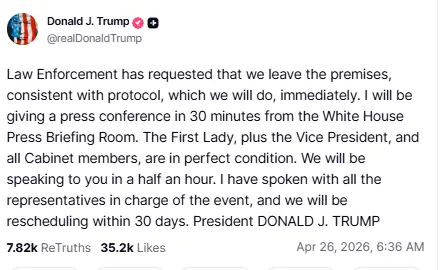
All federal officials, including Trump, were safe. About an hour after Trump was rushed from the event, he posted on Truth Social that a “shooter had been apprehended.” “Quite an evening in DC, Secret Service and Law Enforcement did a fantastic job,” Trump added.
— Screengrab via TruthSocial
Shortly afterwards, he posted, “The First Lady, plus the Vice President, and all Cabinet members, are in perfect condition.” He said he would be holding a White House press conference on Saturday night.
Anthony Guglielmi, a Secret Service spokesman, said the service was investigating a shooting near the main screening area at the entrance to the event.
After the sound of shots, dinner attendees immediately stopped talking, and people started screaming Get down, get down!” Hundreds of guests dove under the tables as Secret Service officers in combat gear ran into the dining room. Trump and the first lady had bent down behind the dais before being hustled out by Secret Service officers.
Many of the 2,600 attendees took cover while waiters fled to the front of the dining hall.
Hours after an Iranian delegation departed Islamabad, Prime Minister Shehbaz Sharif on Saturday spoke with Iranian President Masoud Pezeshkian and said that Pakistan was committed to serving as an “honest and sincere facilitator”.
In a post on the social media platform X, PM Shehbaz said that he had a “warm and constructive” call with the Iranian president on the evolving regional situation.
“I appreciated Iran’s continued engagement, including the high-level delegation to Islamabad led by Foreign Minister Abbas Araghchi, whom I had the pleasure of meeting earlier today,” he said.
“I reaffirmed that, with the support of friends and partners, Pakistan remains committed to [serving] as an honest and sincere facilitator — working tirelessly to advance durable peace and lasting stability in the region,” he said.
According to the Prime Minister’s Office (PMO), the phone call lasted 50 minutes, with the two leaders exchanging views on the “current regional situation and ongoing efforts to promote peace and stability in the region”.
Further, the prime minister also welcomed Iran’s decision to send a delegation led by FM Araghchi to Islamabad.
“While sharing with the Iranian president an overview of his recent diplomatic outreach to a number of world leaders, the prime minister emphasised that these interactions had been helpful in building broader consensus in support of sustained dialogue and diplomacy aimed at achieving lasting peace in the war-affected region,” the PMO said.
It further said that the prime minister expressed appreciation for the fruitful discussions by the Iranian leadership with Chief of Defence Forces and Chief of Army Staff Field Marshal Munir during his recent visit to Tehran.
“While reassuring the Iranian president of Pakistan’s firm commitment to regional peace, the prime minister said that Pakistan would continue its sincere and honest endeavours to promote regional peace and security,” the statement said.
It added that Pezeshkian thanked the prime minister, CDF Munir and Deputy Prime Minister and Foreign Minister Ishaq Dar for their “significant contribution to the peace efforts”.
“While expressing Iran’s desire for peace, he also expressed confidence that the fraternal ties between Iran and Pakistan will continue to strengthen and expand in the future,” the statement said.
It added that the prime minister also conveyed his greetings and regards to Iranian Supreme Leader Ayatollah Mojtaba Khamenei.
“Both leaders agreed to continue their close coordination,” the statement concluded.
The first round of direct talks between the US and Iran was held in Islamabad on April 11 and 12, which ended after more than 20 hours without agreement but kept the diplomatic channel open.
Since then, exchanges have continued indirectly through Pakistan, with both sides calibrating positions while avoiding a formal breakdown.
The ceasefire, originally brokered around April 7 and 8, has been extended without a defined timeline, creating space for diplomacy but also prolonging uncertainty.
OVER most of the past year, Pakistan’s role in US-Iran diplomacy remained quiet, familiar and carefully limited; functioning as a channel passing messages and keeping lines of open when direct contact between two global adversaries was politically difficult.
For the larger part, Islamabad was not setting the agenda, only facilitating communication. That changed at the end of February, when the outbreak of all-out war altered ground realities.
What started as discreet facilitation quickly levelled up into something more ambitious, with Pakistan hosting delegations and publicly positioning itself as a bridge between Washington and Tehran.
On March 24, Prime Minister Shehbaz Sharif said Pakistan would “facilitate” dialogue, a formulation that Deputy Prime Minister and Foreign Minister Ishaq Dar echoed a week later at the end of a quadrilateral meeting, when he said Pakistan would “host and facilitate meaningful talks”.
From the UN chief to the Kremlin, Islamabad’s efforts to mediate between the US and Iran have won it universal acclaim. Although experts agree Pakistan is best-positioned for this role, lasting outcomes are not reached overnight and require structured engagement
After the first round in Islamabad earlier this month, that description was altered once again, when Dar said on April 12 that he, along with Chief of Defence Forces Field Marshal Asim Munir, had “helped mediate several rounds of intense and constructive negotiations”.
The change in language was not incidental, rather, it signalled a willingness to place national credibility behind a process whose outcome remains uncertain, at least for the time being.
Why Islamabad?
Part of the explanation for this lies in geography. Pakistan sits next to Iran and within strategic reach of the Gulf, while maintaining longstanding security ties with the US.
But geography alone does not create a mediator. The shift, in fact, reflects a search for enhanced relevance on the external front, with Islamabad seizing the opportunity to act as a major diplomatic player, rather than a security concern. This is especially prescient given the current global context; where influence is increasingly seen as being tied to crisis management, a la the Board of Peace. Additionally, the move to mediation is also about containing the spill-over of conflict into Pakistan’s own sphere, whether through economic disruption, regional instability or security pressures.
There is also a sense among diplomatic practitioners that Pakistan’s past experience gives it the impetus to attempt such a role.
“We played [in the past] an important role in the release of US hostages from Iran,” former foreign secretary Jalil Abbas Jilani recalls.
Pakistan “at the highest level played an active and positive role in bringing about a ceasefire (during the 2026 war) and bringing the two conflicting parties to the negotiating table”, he adds, arguing that the present effort had already averted wider economic losses.
He also notes that Pakistan has looked after ‘Iranian interests’ in Washington for decades — the Pakistan embassy houses Tehran’s consular presence in the American capital — which, in his view, places it in a better position than many others.
That reading is shared by others. Ambassador Ali Sarwar Naqvi recalls that “Pakistan mediated between Iran and Iraq during Saddam’s time in the 1980s. It didn’t stop the war but the effort was made.”
The former diplomat, who is also executive director of the Centre for International Strategic Studies (CISS) think tank, also cited Pakistan’s role in facilitating contacts between Iran and Saudi Arabia in the context of Yemen, not too long ago. “This history qualified Pakistan to be a mediator.”
The emphasis, however, is on effort rather than outcome.
Others underscore how effective mediation depends less on history and more on credibility in the here and now. Former envoy to UN, US and UK, Maleeha Lodhi, observes that “a decisive factor is the mediator’s neutrality and credibility so that the two parties can have trust in the mediating country”.
That requirement becomes more demanding in an asymmetric conflict, where one side holds significantly greater leverage.
‘Historic baggage’
Experience suggests that mediation works under certain conditions: in the existence of a mutually painful stalemate, a mediator possessing both legitimacy and some degree of leverage, and the process being tightly managed. Where any of these elements are weak, the process tends to drift, and positions of the parties involved in the conflict harden.
The experience of Camp David illustrates this. The US did not simply bring Egypt and Israel together, rather it provided inducements and guarantees that made compromise politically defensible. It must be remembered that agreements have to be sold at home, not just accepted across the table; without that political cover, leaders have little room to manoeuvre.
The same constraint applies to the current US-Iran conflict, where Washington is seeking tangible progress on maritime access and nuclear limits, while Tehran needs relief from pressure and recognition of its security concerns. Therefore, any framework for dialogue that does not address both sets of requirements will not do.
Process management is equally important. The Dayton Accords of 1995 — which ended the Bosnian War — showed how controlling the environment in terms of limiting external influence and forcing sustained engagement can shape outcomes, while at the same time allowing the mediator to reduce space for backtracking.
But that model is harder to replicate today, when negotiators are able to remain in constant contact with their capitals through far more sophisticated communications channels.
During the Islamabad talks, there were real-time consultations by the US delegation, which potentially caused positions to shift. The Iranians would have probably loved to do the same, but they were constrained by concerns over the security of their leadership back home.
Striking a balance
Pakistan’s decision to host the talks reflects an awareness that the venue matters. A controlled setting can reduce public posturing and allow space for exploring options, but the limits are also evident.
While Islamabad could host the talks and probably keep the media at bay, it could not fully insulate them from outside influence. This is where the question of leverage becomes central. Pakistan has access to both sides, which few countries do. But access is not the same as influence.
The US retains global options and coercive tools, while Iran is operating under sanctions and sustained pressure. In such conditions, the risk is that mediation begins to reflect the priorities of the stronger side, and that very perception can in itself erode trust.
One should not forget that in January 1966, Soviet Premier Alexei Kosygin hosted the Tashkent talks that ended the 1965 India-Pakistan war, acting as a neutral broker despite Moscow’s clear tilt toward India. That agreement focused on withdrawal to pre-war positions and a mutual ceasefire, reflecting a priority on regional stability rather than a preference for one side over the other.
Ambassador Masood Khan argues that Pakistan is not constrained by history, saying: “Thankfully, Pakistan does not carry any baggage from its previous mediatory roles”.
He described the current effort as “a new chapter in the history of diplomacy”, noting that Islamabad had built regional and international support for its role. He also pointed to the framework of Article 33 of the UN Charter as the appropriate basis for mediation.
Structure is key
Yet even with wider support, the structure of the process remains critical.
The Oslo experience is a reminder that momentum without a framework is fragile and negotiations that defer core disputes without enforcement mechanisms tend to unravel over time. The US-Iran dispute is not limited to a ceasefire and involves sanctions, nuclear limits, maritime access and regional security arrangements. Therefore, without sequencing, verification and guarantees, any pause in fighting risks being temporary.
Pakistan’s own diplomatic record reflects these limits. It has often played a role in opening channels, rather than shaping final outcomes. Its contribution to the US-China thaw in 1971 was facilitative, while in the Geneva process on Afghanistan, it was a stakeholder. In Doha, it influenced access rather than the terms of agreement.
Interestingly, most of the foreign policy experts Dawn spoke to mentioned these examples as instances of mediation, even though they were not, in the strictest sense of the term.
These precedents, nevertheless, help unravel what is at stake in the current effort. Pakistan is experienced in enabling dialogue, but its prowess when it comes in sustaining a structured negotiation over time may be found wanting.
Despite this, Islamabad has won acclaim for its efforts — everyone from the UN chief to the Kremlin and Beijing, as well as regional heads of state and even the leaders of the two warring sides have only praised Pakistan’s role.
Whether the current effort succeeds will depend on how the process is managed. Careful messaging, balanced engagement, and a framework that would allow both sides equal grounds to defend a compromise at home is essential to lasting deal. Without these, it is feared that even sustained dialogue may not produce durable outcomes.
ISLAMABAD: In a surprise move, the Shehbaz Sharif government on Friday increased the prices of both petrol and diesel by Rs26.77 per litre with immediate effect for the week ending May 1, passing on the impact of global prices during the last fortnight while also seeking to raise revenues in the final months of the fiscal year under commitments with the International Monetary Fund (IMF).
The IMF’s executive board is expected to approve in the first half of May the disbursement of more than $1.2 billion under two ongoing programmes.
As of April 23, diesel prices were estimated to go down by around Rs25 per litre and petrol by Rs6 per litre. However, the government partially restored the petroleum levy on diesel and increased petrol prices to meet overall fiscal targets.
Unlike the prime minister’s announcements of price cuts, the increase this time was quietly announced by the petroleum division on the day Iran and the United States dispatched their negotiators to Islamabad for the second round of talks.
Petrol, diesel prices raised by Rs27 per litre
As such, the ex-depot price of high-speed diesel (HSD) was fixed at Rs380.19 against Rs353.42 per litre at present, up by 7.6pc or Rs26.77 per litre.
The diesel price has come down from a peak of Rs520.35 on April 10 as the prime minister removed the petroleum levy for two weeks but then allowed partial recovery, sources said. HSD is considered the most inflationary item due to its widespread use in freight transportation.
Likewise, the ex-depot rate of petrol was set at Rs393.35 per litre for the coming week, up from Rs366.58 per litre, an increase of Rs26.77 or 7.3pc.
With the latest revision, the government is now charging around Rs135 per litre in taxes on petrol and Rs65 per litre on diesel, including petroleum levy, customs duty and the climate support levy.
On Friday, the government increased the petroleum levy on petrol by about Rs27, raising it from Rs80 to Rs107.38 per litre, while the levy on high-speed diesel was kept at zero at the retail level under the latest notification.
In a written statement, Petroleum Minister Ali Pervez Malik said oil prices were again rising due to regional tensions and the government had to take measures to pass on the additional burden to consumers in view of agreements with international stakeholders.
He said the government absorbed the increase in international prices for as long as possible with its limited resources and provided “historic relief” to the people.
Petrol and diesel rates have gone up from Rs266 and Rs281 per litre, respectively, after the US-Israel attacked Iran on Feb 28, sending shockwaves to the global energy markets.
The two fuels remain the government’s key revenue generators, with combined monthly sales of around 700,000 to 800,000 tonnes compared to about 10,000 tonnes for kerosene.
• In letter to commission, Justice Afridi warns move will set ‘undesirable and potentially far-reaching precedent’
• Fears it will ‘erode public confidence’ in judiciary’s independence and stability
• Last year, he described transfer of three judges to IHC from different provinces under Article 200 as something to be ‘rejoiced’
ISLAMABAD: Chief Justice of Pakistan (CJP) Yahya Afridi has opposed the scheduled meeting of the Judicial Commission of Pakistan (JCP) being called to consider the transfer of five judges of the Islamabad High Court (IHC) to different high courts of the country.
Although the CJP had earlier declined to call the meeting of the JCP, he eventually scheduled the session after it was requisitioned by a two-thirds majority of the commission’s members, an informed source privy to the development confided.
The commission is scheduled to meet at 1pm on April 28, during which it may consider the contents of the CJP’s letter to the JCP in which he expressed his reservations as well as deliberate upon the transfer of five serving IHC judges to different provincial high courts.
In his letter, the CJP expressed concern that allowing transfers of sitting IHC judges would set an “undesirable and potentially far-reaching precedent, effectively normalising the treatment of judges as administratively interchangeable or disposable”.
Such an approach, the source stated while citing the CJP’s letter, would “carry serious implications for the institutional integrity of the judiciary”, thus “eroding public confidence” in its independence and stability.
Article 200 of the Constitution empowers the JCP to recommend transfers without the consent of the judges concerned. However, the consent of judges was mandatory before the 27th Constitution Amendment. The amended provision has now vested this authority in the JCP, where decisions are taken by majority vote, whether the CJP agrees or not.
It is believed that the judges under consideration for transfer include IHC’s senior puisne judge Justice Mohsin Akhtar Kayani, Justice Babar Sattar, Justice Arbab Muhammad Tahir, Justice Saman Rafat Imtiaz and Justice Khadim Hussain Soomro.
‘Rejoiced’
In one of his interactions with the media on Feb 3, 2025, the CJP had supported the idea of transferring judges to the IHC, even though he acknowledged reservations regarding the seniority principle.
At the time, the CJP described the transfer of three judges to the IHC from different provinces under Article 200 as something to be “rejoiced”, setting a precedent that should be followed in the future. “The IHC is the symbol of four federating units and not merely a white marble building,” the CJP had observed while sharing his reason why he agreed with the proposal to transfer three judges to the high court. He had also read out a summary stating that the transfer of the judges from different federating units was fully “synchronised with the spirit of federalism as enshrined in the Constitution”.
“It is also in conformity with Section 3 of the Islamabad High Court (IHC) Act 2010… [there is] thoughtful consideration behind the proposal, [which] illustrates the resolve and equitable share to the linguistic diversity of our country and [a] fair chance of representation to all the federating units in the high court of the common capital of the federation i.e. [the] IHC,” the summary stated.
“Rejoice the fact that the IHC now has judges who are Balochi-speaking or Sindhi-speaking,” the CJP had emphasised, adding: “Had we had a judge from the tribal area in Peshawar, I would have asked to bring him to the IHC too.”
In his current letter to the JCP, the CJP is said to have stated that the proposed transfer of sitting judges out of the IHC would “in substance assume a punitive character” [and pave the way for] “an outcome that finds no sanction anywhere in the constitutional scheme governing the superior judiciary”.
“Besides, such transfer is entirely alien to the purpose of Article 200 of the Constitution and runs contrary to the foundational principles of judicial independence and security of tenure,” the CJP stated.
The CJP observed, the requisition for convening the JCP meeting for the purpose of transferring the IHC judges “could not be acceded to by the undersigned”. On June 19 last year, the SC’s Constitutional Bench, constituted under the 26th Constitutional Amendment, had, by a 3-2 majority, ruled that the transfer of three judges from provincial high courts to the IHC was in line with the Constitution.
Five IHC judges, the Karachi Bar Association, the IHC Bar Association and others had challenged the transfer of Chief Justice Sardar Mohammad Sarfraz Dogar, Khadim Hussain Soomro and Muhammad Asif from the Lahore, Sindh and Balochistan high courts, respectively, before the SC.
The controversy revolved around the alteration of the IHC judges’ seniority list after these transfers, as Justice Dogar was made the senior puisne judge, paving the way for his appointment as IHC chief justice after Justice Aamer Farooq’s elevation to the SC.
The foreign ministers of Pakistan and seven other Muslim-majority countries issued a joint statement on Thursday, rejecting any attempts to alter the historic and legal status quo in Jerusalem and its Islamic and Christian holy sites.
The foreign ministers condemned the “repeated violations of the historic and legal status quo at Jerusalem’s Islamic and Christian holy sites by Israeli occupation authorities”.
They particularly deplored the continued incursions by Israeli settlers and “extremist ministers into Al Aqsa Mosque/Al Haram Al Sharif under Israeli police protection, as well as the raising of the Israeli flag within its courtyards”, the joint statement citing the foreign ministers of Pakistan, Egypt, Turkiye, Indonesia, Jordan, Qatar, Saudi Arabia and the United Arab Emirates said.
“The ministers reiterated that these provocative actions at Al Aqsa Mosque/Al Haram Al Sharif, constitute a flagrant violation of international law and international humanitarian law, and represent an unacceptable provocation to Muslims around the world, and a flagrant violation to the sanctity of the holy city,” the statement read.
It added that the foreign ministers reaffirmed their “categorical rejection of any attempts to alter the historic and legal status quo in Jerusalem and its Islamic and Christian holy sites, and stressed on its preservation while recognising the special role of the historic Hashemite custodianship in this regard”.
They reiterated that the “entire area of Al Aqsa Mosque/Al Haram Sharif, which amounts to 144 dunams, is a place of worship exclusively for Muslims, and that the Jerusalem Endowments and Al Aqsa Mosque Affairs Department, affiliated with the Jordanian Ministry of Awqaf and Islamic Affairs, is the legal entity with exclusive jurisdiction to administer the affairs of the blessed Al Aqsa Mosque/Al Haram Al Sharif and to regulate entry thereto”.
The ministers further condemned the “accelerating illegal settlement activity, including Israel’s decision to approve over 30 new settlements, which constitutes a flagrant violation of international law, including United Nations Security Council resolutions and the 2024 advisory opinion of the International Court of Justice”.
They also condemned the continued and escalating settler violence against Palestinians in the occupied West Bank, including recent attacks on Palestinian schools and children, and called for those responsible to be held accountable, the statement said.
It added that the ministers emphasised that Israel had “no sovereignty over the Occupied Palestinian Territory”.
“They categorically rejected any attempts to annex the occupied Palestinian territory or to displace the Palestinian people.
“The Ministers stressed that such actions constitute a deliberate and direct attack on the viability of the Palestinian state and on the implementation of the two-state solution, increase tensions, undermine peace efforts, and hinder ongoing initiatives aimed at de escalation and the restoration of stability,” the statement read.
It said the foreign ministers reiterated their call for the the international community to uphold its legal and moral responsibilities and compel Israel to halt its “dangerous escalation” in the occupied West Bank, and to put an end to its illegal practices.
“The ministers called upon the international community to assume its responsibilities and take clear and decisive steps to halt these violations. They also called on the international community to intensify all regional and international efforts to advance a political solution that achieves a comprehensive peace based on the two-state solution.”
The statement said they further reiterated their “unwavering support” for the legitimate rights of the Palestinian people, particularly their right to self-determination and to realise the independent Palestinian state along the June 4, 1967 lines, with East Jerusalem as its capital.
The statement came two days after the latest storming at Al Aqsa Mosque by Israeli settlers. The settlers forced their way into the site through the mosque’s Mughrabi Gate, under heavy police protection, according to an Anadolu reporter.
Videos circulating on social media showed occupiers performing Talmudic rituals and prayers aloud, including what is referred to as “epic prostration”, particularly in the eastern area of the compound.
Photos shared online also showed two occupiers raising the Israeli flag inside the compound, with the Dome of the Rock mosque visible behind them.
On April 6, far-right Israeli National Security Minister Itamar Ben-Gvir had also stormed the Al Aqsa Mosque compound.
Palestinian news agency Wafaquoted the Islamic Waqf Department in Jerusalem as saying that the minister toured the mosque’s courtyards, entering through the Mughrabi Gate and proceeding to the Chain Gate before returning via the same route, amidst a heavy deployment of occupation police.
“He has stormed the mosque approximately 14 times since assuming his position in 2023, as part of an escalating policy towards the mosque,” the report said at the time.
Later, he again stormed the mosque on April 13 under heavy police deployment.
In March, Israeli police had prevented the Latin Patriarch of Jerusalem, Cardinal Pierbattista Pizzaballa, from entering the Church of the Holy Sepulchre in Jerusalem to celebrate Palm Sunday mass. Later, after widespread backlash, Israel said the Latin Patriarch of Jerusalem would regain access to Christianity’s holiest site.
Navy Secretary John Phelan has been fired, a US official and a person familiar with the matter said on Wednesday, in another wartime shakeup at the Pentagon coming just weeks after Defence Secretary Pete Hegseth ousted the Army’s top general.
The Pentagon announced his departure in a brief statement, saying he was leaving the administration “effective immediately.” But it did not provide a reason or say whether it was his decision to go.
The sources, who spoke on condition of anonymity, said Phelan was dismissed in part because he was moving too slow to implement reforms to speed shipbuilding and because he had fallen out with key Pentagon leadership.
One source cited bad relationships with Hegseth, Hegseth’s deputy, Steve Feinberg, as well as the Navy’s No 2 civilian, Hung Cao, who the Pentagon said will now take over as acting Navy secretary.
The source also cited an ethics investigation into Phelan’s office.
A billionaire seen as having close ties to President Donald Trump, Phelan is the first administration-picked service secretary to be fired since Trump came back into office last year.
His departure fits within a broader context of upheaval at all levels of leadership at the Pentagon under Hegseth’s watch, including the firing last year of the chairman of the Joint Chiefs of Staff, Air Force General C Q Brown, as well as the chief of naval operations and Air Force vice chief of staff.
On April 2, Hegseth fired Army Chief of Staff Randy George without citing a reason. Two US officials said the decision was tied to tensions between Hegseth and Army Secretary Daniel Driscoll.
Senator Jack Reed, the top Democrat on the Senate Armed Services Committee, called Phelan’s dismissal “troubling”.
“I am concerned it is yet another example of the instability and dysfunction that have come to define the Department of Defence under President Trump and Secretary Hegseth,” Reed said.
The latest departure comes during a tense ceasefire with Iran, as the US flows more naval assets into the Middle East.
The US military is relying on naval assets to carry out a blockade of Iran, which President Donald Trump is hoping will pressure Tehran to negotiate an end to the conflict on his terms.
The Navy is under intense pressure to expand its fleet. China’s shipbuilding industry now dwarfs the US, which was once a global powerhouse.
Trump’s $1.5 trillion defence budget request for fiscal year 2027 includes over $65 billion to procure 18 warships and 16 support ships made by General Dynamics and Huntington Ingalls Industries.
It is part of what the Pentagon is calling the “Golden Fleet” initiative, which officials say is the largest shipbuilding request since 1962.
LONDON: British Prime Minister Keir Starmer insisted on Wednesday that he would not resign, claiming allegations of misleading MPs over his appointment of a party loyalist as UK envoy to Washington had been “put to bed”.
Starmer, facing pressure to resign, addressed MPs after firing the Foreign Ministry’s most senior official, Olly Robbins, blaming him for failing to disclose Mandelson’s clearance problems.
The premier spoke to lawmakers a day after the foreign ministry’s most senior official, Olly Robbins, gave evidence to a parliamentary committee, having been fired by Starmer over the affair last week. Starmer has accused Robbins of failing to tell him about problems that emerged during Mandelson’s security clearance.
He has repeatedly insisted that, despite previously stating that “all due process” had been followed, he would not have allowed the appointment to proceed if he had known that independent vetting officials had recommended security clearance be denied.
Starmer told MPs that Robbins clearly answered “no” when asked if he had shared the recommendation “with me, number 10 or any other ministers”.
He said this clears all allegations of dishonesty against him, adding that although the opposition claimed it was shared with him, it was not. Mandelson was appointed to the top diplomatic post in December 2024.
The specific risks identified by vetting officials are unknown, but Robbins clarified they are unrelated to Mandelson’s ties with Jeffrey Epstein.
He alleged Downing Street pressured officials to approve the appointment, seemingly ignoring security concerns, with a demanding tone of “get it done”.
Conservative leader Kemi Badenoch questioned Starmer’s decision not to retract the appointment, despite other controversies.
Morgan McSweeney, Starmer’s former top aide who resigned over his role in the crisis, is to appear before lawmakers on Tuesday.
Manchester City ended Arsenal’s six-month stay on the Premier League summit and condemned Burnley to relegation with a laboured 1-0 victory at Turf Moor on Wednesday.
Erling Haaland’s clinical finish after five minutes could have paved the way for a boost to City’s goal difference but they lacked a cutting edge as Burnley dug deep.
Haaland hit the post and had other chances as City tried to give themselves a safety margin but Pep Guardiola’s side had to make do with a surprisingly narrow victory.
After reeling Arsenal in they now lead the table on goals scored with both sides on 70 points from 33 games and with an identical goal difference of plus 37.
For Scott Parker’s Burnley the inevitable has now become a reality as they are stuck on 20 points, 13 points behind the safety zone with only four games remaining.
“We played a really good game, unfortunately we missed a lot of chances. We defended better in the second half. Second half we had less problems,” Guardiola, whose side face Southampton in the FA Cup semi-final on Saturday, told Sky Sports.
“It was such a demanding game on Sunday. It is not easy after three days but in the Premier League you have to adjust. We are used to doing it. We competed really well, we made a really good game but it’s a pity the chances we had.”
Burnley produce spirited play
City’s fans sang “we are top of the league” at the final whistle as their team hit the top but it was with a mixture of relief as they could never truly relax as Burnley betrayed their lowly status with a spirited display.
Arsenal have led the race since early October but have stalled in April and Haaland’s winner in a 2-1 victory against them at the Etihad Stadium on Sunday has given City the edge.
With the race so tight, however, they would have expected to sweep Burnley aside by a wider margin on Wednesday and given themselves the edge on goal difference.
It certainly looked that way at the start as Burnley keeper Martin Dubravka made a great save from Rayan Cherki before Haaland was played through and the Norwegian advanced before dinking a subtle left-footed finish past the keeper.
City had 10 goal attempts before the break although Burnley were a threat with Jaidon Anthony having an early shot saved by Gianluigi Donnarumma while Zian Flemming shot wide.
Antoine Semenyo poked a chance over the bar early in the second half and Haaland drifted a shot against the post as City strained for a second goal.
In the end it was a nervous finale as Burnley won a corner deep in stoppage time with Dubravka sent forward, but City avoided any stumble to take the points.
While they may have hit the top after stretching their unbeaten league run to 11, City will need to play better in a relatively tough run-in to win a fifth title in six seasons.
They also are at a disadvantage with Arsenal playing twice in the league before City’s next league game away at Everton.
For Burnley it is a second relegation in three seasons, having come up from the Championship with 100 points.
“I came here with a dream to keep this club up,” Burnley captain Kyle Walker, a multiple title winner with City, said. “Hopefully we can do the fans proud next season.”
KARACHI: Interpol has issued a red notice for a fugitive Lyari gangster, Wasiullah Lakho, who is reportedly hiding abroad and wanted by Karachi police, South Deputy Inspector General (DIG) Syed Asad Raza told Dawn on Wednesday.
A red notice is a request to law enforcement agencies by Interpol to locate and provisionally arrest a person pending extradition, surrender, or similar legal action.
DIG Raza said the Interpol secretariat in Lyon, France had issued the notice against Lakho on the request of Pakistani authorities.
According to the notice, seen by Dawn, Lakho had been involved in murders, extortion and assault on police in Karachi.
It said Lakho was wanted for prosecution in more than 60 cases of “heinous nature”. Among them, Interpol issued a red notice for his arrest in a 2014 case registered at Karachi’s Kalri police station under Sections 353 (assault or criminal force to deter public servant from discharge of their duty), 324 (attempt to murder) and 34 (acts done by several persons in furtherance of a common intention) of the Pakistan Penal Code.
Elaborating on the case, the notice said a police party had reached Karachi’s Daryabad area upon receiving information that Lakho was present there along with his accomplices, who were associated with Lyari gang war, with the intention to commit a “heinous crime”.
Police cordoned off the area after reaching the site, the notice said, adding that Lakho and his accomplices opened fire on law enforcers with the intention to kill upon seeing them.
“Police also started firing in self-defence. Resultantly, one accused person, Abdul Jabbar, fell down … due to a bullet injury while other accused persons succeeded in escaping,” it read.
The notice said police arrested the injured suspect and found a TT pistol and ammunition in his possession.
It said that during interrogation, arrested suspect Abdul Jabbar named one of the suspects who had fled as Wasiullah Lakho.
Lakho “has fled to avoid arrest. Competent court of law has declared him a proclaimed offender and issued a perpetual warrant of arrest for him. The accused is wanted for prosecution”, the notice read.
GILGIT: Over 650 candidates have filed their nomination papers for the Gilgit-Baltistan Assembly elections scheduled for June 7 in 24 constituencies.
A total of 666 candidates have submitted their nomination papers; however, no woman candidate has filed nomination papers for the assembly elections.
According to a press release issued by the GB Election Commission Secretariat, polling for the general election will be held on June 7, while the election process is underway in all 24 constituencies.
The secretariat has convened a multi-party conference on Thursday (tomorrow) at the Election Commission Secretariat in Gilgit. The aim of the conference is to consult political parties to advance the election process in a fair, transparent and coordinated manner.
Nawaz says if elected, PML-N will focus on region’s development
The conference will discuss in detail the election process, code of conduct, mutual consultation, coordination in election matters and other related issues so that the conduct of elections can be made more effective and transparent in light of the opinions and suggestions of all political parties.
The GB Election Commission has requested all political parties to ensure their participation in the conference and provide their valuable opinions, suggestions and guidance regarding the conduct of the elections.
The commission has reiterated its commitment that all necessary measures will be taken to make the elections free, fair and transparent.
Nawaz vows GB development
Meanwhile, PML-N President Nawaz Sharif on Tuesday vowed that, if elected, the party would focus on development in Gilgit-Baltistan.
He made the comments in a televised address to the PML-N’s parliamentary board for GB, where he highlighted past projects launched by the party in the region.
He said Prime Minister Shehbaz Sharif, his younger brother, had the “same passion” for developing GB as he had, noting that the region had massive potential.
The former premier highlighted road projects “worth $60-$65 billion”, adding that “24-hour journeys were reduced to 10 hours”. He recalled facing criticism for having a tunnel constructed in Chitral as it was sparsely populated.
Referring to the initiatives undertaken by PM Shehbaz during his time as the Punjab chief minister, and now by his daughter Maryam, Nawaz Sharif told the party members: “You should copy it, and all these things should be launched in GB as well.”
The PML-N supremo said: “He [Shehbaz] launched numerous projects during his time. Look at him, find out about them. […] And now Maryam has taken the responsibility to take his work forward, so see what is happening there. You should copy it.”
In a message to all the PML-N candidates, Nawaz Sharif said: “When your candidates are elected, God-willing, they must have this in mind that they have been elected for service, not for fun.”
He said that if the party formed a government in GB, he would invite the regional leadership. He asserted that GB “is as dear to me as the rest of Pakistan is, and as Azad Kashmir, Punjab, Sindh, Balochistan and KP are”. Noting that both the Centre and Punjab were active in development, he called on the rest of the provinces to do the same.