Sports News Onli brings the latest sports news, live match updates, scores, and highlights from cricket, football, hockey, and other international sports.
In a reversal of its earlier stance, the Federal Board of Revenue (FBR) late on Tuesday night extended the deadline for filing income tax returns for the tax year 2025 until October 15.
The move came just as the initial Sept 30 deadline given by the board was set to expire at midnight.
The move marks a clear departure from the FBR’s previously stated position that no extension would be granted, signalling that the tax authority has yielded to pressure from various quarters and walked back on its firm commitment.
An official announcement said this decision has been made under Section 214A of the Income Tax Ordinance, 2001.
“The extension in the deadline has been granted in response to requests made by various trade bodies, tax bar associations and the general public,” the FBR said.
Just a day earlier, the board had urged taxpayers to file their returns before the Sept 30 deadline, reaffirming that the due date for filing would not be extended. An official statement from the FBR had ruled out any extension in the deadline for filing tax returns, dismissing all social media reports suggesting otherwise.
It had also said that some elements had attempted to link an extension to the recent floods in the country, calling such claims “false, baseless, and misleading”. It had also termed reports suggesting that the Integrated Risk Information System (Iris) had slowed as “unfounded”.
Khyber Pakhtunkhwa Chief Minister Ali Amin Gandapur accused PTI founder Imran Khan’s sister Aleema Khan on Tuesday of creating a divide in the party and alleged that she was being facilitated by the Military Intelligence and “establishment”.
In a video statement released on Tuesday, Gandapur said: “Imran Khan is my leader, I am loyal to him. It is my right to convey the truth to him … I made him aware of all that has been happening.”
He said initially he was not being given the permission to meet Imran in jail and his messages were conveyed to the public only through his sisters.
“So there is a big divide in the party now,” he continued.
Gandapur said his provincial government had presented KP’s budget as otherwise the PTI government would have been “disqualified”. And since there were no instructions from Imran to the effect of not presenting the budget, it was presented, he added.
“But after that, campaigns that were launched declaring me and parliament traitors were highly inappropriate. And we repeatedly asked [Imran’s] sisters to bring some clarity on it but to no avail. So an impression was created that we were going against you (Imran). But it was not the case.
“And when the time came to pass the budget, the situation was same. They were not allowing us to meet (Imran). Mirza Saif was eventually able to meet him after great difficulty in which Khan sahib was informed of the situation … We eventually passed the budget after making it clear to Khan sahib that he could make any changes he wanted.”
Gandapur also claimed that he had told Imran that he had the authority to stop them from passing the budget and they would comply.
“But my MPAs and party members were accused that we committed treachery passing this budget … They are running these campaign.”
He said he had also been accused of apply the “minus Imran Khan” formula. “But I [told Imran] that nobody could think or have the courage to do so.”
The KP CM added that he had conveyed to the party founder that “Aleema Khan had a big role in dividing the party. Because some party members are being discredited. And the party is losing hope. That steps were not being taken for your release. Instead there is groupism in party, which some people are using to serve their own interests”.
He further alleged that Aleema was in contact with “vloggers” working to create divide in the party. “And instead of stopping them … she is provoking them. And Hafeezullah Niazi sahib refers to Aleema Khan as the prime minister in his articles. He writes that she should become the party chairperson,” he alleged.
Gaza will be a de-radicalised terror-free zone that does not pose a threat to its neighbors.
Gaza will be redeveloped for the benefit of the people of Gaza, who have suffered more than enough.
If both sides agree to this proposal, the war will immediately end. Israeli forces will withdraw to the agreed upon line to prepare for a hostage release. During this time, all military operations, including aerial and artillery bombardment, will be suspended, and battle lines will remain frozen until conditions are met for the complete staged withdrawal.
Within 72 hours of Israel publicly accepting this agreement, all [prisoners], alive and deceased, will be returned.
Once all [prisoners] are released, Israel will release 250 life sentence prisoners plus 1,700 Gazans who were detained after Oct 7, 2023, including all women and children detained in that context. For every Israeli hostage whose remains are released, Israel will release the remains of 15 deceased Gazans.
As released by the White House
Once all [prisoners] are returned, Hamas members who commit to peaceful coexistence and to decommission their weapons will be given amnesty. Members of Hamas who wish to leave Gaza will be provided safe passage to receiving countries.
Upon acceptance of this agreement, full aid will be immediately sent into the Gaza Strip. At a minimum, aid quantities will be consistent with what was included in the Jan 19, 2025, agreement regarding humanitarian aid, including rehabilitation of infrastructure (water, electricity, sewage), rehabilitation of hospitals and bakeries, and entry of necessary equipment to remove rubble and open roads.
Entry of distribution and aid in the Gaza Strip will proceed without interference from the two parties through the United Nations and its agencies, and the Red Crescent, in addition to other international institutions not associated in any manner with either party. Opening the Rafah crossing in both directions will be subject to the same mechanism implemented under the Jan. 19, 2025, agreement.
Gaza will be governed under the temporary transitional governance of a technocratic, apolitical Palestinian committee, responsible for delivering the day-to-day running of public services and municipalities for the people in Gaza.
This committee will be made up of qualified Palestinians and international experts, with oversight and supervision by a new international transitional body, the “Board of Peace,” which will be headed and chaired by President Donald J. Trump, with other members and heads of State to be announced, including Former Prime Minister Tony Blair.
This body will set the framework and handle the funding for the redevelopment of Gaza until such time as the Palestinian Authority has completed its reform program, as outlined in various proposals, including President Trump’s peace plan in 2020 and the Saudi-French proposal, and can securely and effectively take back control of Gaza. This body will call on best international standards to create modern and efficient governance that serves the people of Gaza and is conducive to attracting investment.
A Trump economic development plan to rebuild and energize Gaza will be created by convening a panel of experts who have helped birth some of the thriving modern miracle cities in the Middle East. Many thoughtful investment proposals and exciting development ideas have been crafted by well-meaning international groups, and will be considered to synthesize the security and governance frameworks to attract and facilitate these investments that will create jobs, opportunity, and hope for future Gaza.
A special economic zone will be established with preferred tariff and access rates to be negotiated with participating countries.
No one will be forced to leave Gaza, and those who wish to leave will be free to do so and free to return. We will encourage people to stay and offer them the opportunity to build a better Gaza.
Hamas and other factions agree to not have any role in the governance of Gaza, directly, indirectly, or in any form. All military, terror, and offensive infrastructure, including tunnels and weapon production facilities, will be destroyed and not rebuilt. There will be a process of demilitarization of Gaza under the supervision of independent monitors, which will include placing weapons permanently beyond use through an agreed process of decommissioning, and supported by an internationally funded buy back and reintegration program all verified by the independent monitors. New Gaza will be fully committed to building a prosperous economy and to peaceful coexistence with their neighbors.
A guarantee will be provided by regional partners to ensure that Hamas, and the factions, comply with their obligations and that New Gaza poses no threat to its neighbors or its people.
The United States will work with Arab and international partners to develop a temporary International Stabilisation Force (ISF) to immediately deploy in Gaza. The ISF will train and provide support to vetted Palestinian police forces in Gaza, and will consult with Jordan and Egypt who have extensive experience in this field. This force will be the long-term internal security solution. The ISF will work with Israel and Egypt to help secure border areas, along with newly trained Palestinian police forces. It is critical to prevent munitions from entering Gaza and to facilitate the rapid and secure flow of goods to rebuild and revitalize Gaza. A de-confliction mechanism will be agreed upon by the parties.
Israel will not occupy or annex Gaza. As the ISF establishes control and stability, the Israel Defense Forces (IDF) will withdraw based on standards, milestones, and time frames linked to demilitarization that will be agreed upon between the IDF, ISF, the guarantors, and the United States, with the objective of a secure Gaza that no longer poses a threat to Israel, Egypt, or its citizens. Practically, the IDF will progressively hand over the Gaza territory it occupies to the ISF according to an agreement they will make with the transitional authority until they are withdrawn completely from Gaza, save for a security perimeter presence that will remain until Gaza is properly secure from any resurgent terror threat.
In the event Hamas delays or rejects this proposal, the above, including the scaled-up aid operation, will proceed in the terror-free areas handed over from the IDF to the ISF.
An interfaith dialogue process will be established based on the values of tolerance and peaceful coexistence to try and change mind-sets and narratives of Palestinians and Israelis by emphasizing the benefits that can be derived from peace.
While Gaza redevelopment advances and when the PA reform program is faithfully carried out, the conditions may finally be in place for a credible pathway to Palestinian self-determination and statehood, which we recognize as the aspiration of the Palestinian people.
The United States will establish a dialogue between Israel and the Palestinians to agree on a political horizon for peaceful and prosperous coexistence.
United States President Donald Trump said on Monday he would impose a 100 per cent tariff on all films produced overseas that are then sent into the US, repeating a threat made in May that would upend Hollywood’s global business model.
The step signals Trump’s willingness to extend protectionist trade policies into cultural industries, raising uncertainty for studios that depend heavily on cross-border co-productions and international box-office revenue.
“Our movie-making business has been stolen from the United States of America, by other Countries, just like stealing candy from a baby,” Trump said in a post on his Truth Social.
However, it was not immediately clear what legal authority Trump would use to impose a 100pc tariff on foreign-made films.
The White House did not immediately respond to a Reuters request for comment on how the tariffs would be implemented.
Top US studios Warner Bros Discovery, Paramount Skydance and Netflix also did not immediately respond to requests for comment. Comcast declined to comment.
“There is too much uncertainty, and this latest move raises more questions than answers,” said PP Foresight analyst Paolo Pescatore.
“For now, as things stand, costs are likely to increase, and this will inevitably be passed on to consumers,” he said.
The president had first floated the idea of a movie tariff in May but offered few details, leaving entertainment executives unsure whether it would apply to specific countries or all imports.
After the announcement in May, a coalition of American film unions and guilds sent a letter to Trump, urging him to support tax incentives for domestic film production in a reconciliation package being drafted in Congress, aiming to help return more movie and television projects to the US.
The US film industry recorded a $15.3 billion trade surplus in 2023, backed by $22.6bn in exports to international markets, according to the Motion Picture Association.
From Australia to Canada
Studio executives told Reuters earlier this year that they were “flummoxed” by how a movie tariff might be enforced, given that modern films often use production, financing, post-production and visual effects spread across multiple countries.
Hollywood has increasingly relied on overseas production hubs such as Canada, the UK and Australia, where tax incentives have attracted big-budget shoots for films ranging from superhero blockbusters to streaming dramas.
At the same time, co-productions with foreign studios have become more common, particularly in Asia and Europe, where local partners provide financing, access to markets, and distribution networks.
Industry executives also warn that a broad tariff could affect the thousands of US workers employed on overseas shoots, from visual effects artists to production crews, whose work is often coordinated across multiple countries.
The closing ceremony of the men’s Asia Cup descended into farce on Sunday as the Indian cricket team refused to collect the winners’ trophy from Asian Cricket Council chief Mohsin Naqvi, as politics continued to spill over the pitch.
India had earlier beaten Pakistan by five wickets in the last over after a close contest to win a record-extending ninth Asia Cup title, but they caused the post-final formalities to be inordinately delayed due to their refusal to budge from their stance.
There were no customary handshakes between the teams after India refused, with tensions high from their previous two clashes in the competition, which witnessed political posturing and aggressive on-field behaviour.
The Asia Cup saw the first cricket matches between the two sides since the military conflict between the nuclear-armed neighbours in May.
Pakistan Cricket Board chairman Naqvi, who is also the Interior Minister, was supposed to present the winners’ trophy, but there were indications that India would resent that when their captain Suryakumar Yadav did not participate in the customary pre-toss photoshoot before the final.
“I have been informed by the Asian Cricket Council (ACC) that the Indian cricket team will not be collecting their awards tonight,” Simon Doull, who conducted the post-match presentation, said.
When asked about his refusal to collect the trophy at the post-match press conference and their actions leading to the politicisation of the game, the Indian skipper declined to answer the question.
The post-final ceremony saw Pakistan skipper Salman Ali Agha receive the runners-up trophy while Indian players Tilak Varma, Kuldeep Yadav and Abhishek Sharma collect their respective individual awards.
India’s refusal to collect the trophy from Naqvi marks a historic low in the cricketing relations between the neighbours, with the game having acted as a stage for diplomacy in the past.
Indian Prime Minister Narendra Modi also made a political reference in his post on X congratulating the Indian team. “Operation Sindoor on the game’s field. Outcome is the same — India wins! Congrats to our cricketers,” he wrote.
Suryakumar’s men had earlier capped a remarkable unbeaten run with their third victory against Pakistan at the Asia Cup.
Put into bat, Pakistan could not capitalise on an 84-run opening stand between Sahibzada Farhan (57) and Fakhar Zaman (46) and were bundled out for 146 with five deliveries still left in their innings.
Pakistan lost their last nine wickets for 33 runs in a spectacular meltdown, with India’s left-arm spinner Kuldeep Yadav (4-30) being the wrecker-in-chief.
The Green Shirts struck back to leave India reeling at 20-3 with their top 3, including captain Suryakumar Yadav, back in the dugout.
India lost their in-form opener Abhishek Sharma, also the tournament’s leading scorer, and the skipper inside the first 10 deliveries of their innings.
Varma and Sanju Samson (24) got to rebuilding the innings.
Even that recovery would not have been possible but for the reprieve Samson, then on 12, got when Hussain Talat dropped him in the deep.
Abrar Ahmed dismissed Samson to break the 57-run stand, but Shivam Dube (33) combined with Varma to take India closer to the target before falling in the penultimate over.
Needing 10 runs from the last over from Haris Rauf, Varma hit the second ball for a six to effectively seal India’s thrilling victory and triggering wild celebrations in the Indian camp.
“It’s a tough pill to swallow,” Pakistan captain Salman said at the presentation ceremony. “We could not finish well in the batting. Bowling, we gave everything. If we could have finished well, it would have been a different story.
“We could not rotate the strike properly, and we lost too many wickets. That was the reason we could not score what we wanted. We have to sort out our batting very soon. They bowled really well, outstandingly well. They needed 63 off six overs. I thought we had the game. The bowlers bowled really well; we have to give them credit, but the batting was a concern.
“We fought really well. We are proud as a team. So much to look forward to, we will improve and come back stronger.”
It is very much a rivalry when the Dubai International Cricket Stadium is filled to capacity to witness its spectacular nature. It is very much a rivalry when Indian faces on the ground, in the stands and in the dressing rooms fall in disappointment when a Pakistan player hits a six or takes a wicket.
It is very much a rivalry when Gautam Gambhir, who went on record saying India shouldn’t play against Pakistan, bangs the table like a maniac in the dressing room when Shivam Dube breaks the shackles to get India back into the match. It is very much a rivalry when India’s top broadcaster wants the country to play the maximum number of matches against Pakistan in the face of calls for “boycotting” the contest.
It was very much a rivalry when India as the best Twenty20 International side in the world found itself under pressure chasing a paltry 148 before India’s Tilak Varma’s brilliance with the bat, and Pakistan’s Haris Rauf’s meltdown with the ball, stood out in the former’s five-wicket victory in the Asia Cup final on Sunday. Although India won — and full credit to them for it, the country’s government’s unsporting narrative, communicated by its mouthpiece Indian captain Suryakumar Yadav over the 20-day course of the tournament lost.
India had convincingly won the two previous matches between the two rivals at the Asia Cup. Pakistan, meanwhile, had admitted ahead of the final that they had yet to play the “perfect” match. And when openers Sahibzada Farhan and Fakhar Zaman were owning the Indian bowlers until the former fell in the 10th over, it looked like the day Pakistan had waited for had arrived.
But the team’s decision to replace power-hitter Hasan Nawaz with conventional batter Hussain Talat came back to sting them a week later. After a good start by the openers, none of the Pakistan middle-order batters — including the captain Salman Ali Agha — looked equipped with the skill of capitalising on it. A collapse proved inevitable hence as India licked their lips at the sight of a small total to chase.
But Pakistan walked on to the ground to field with their fighting spirit running high and Faheem Ashraf’s fist pumps after removing India dangerman Abhishek Sharma and Shubhman Gill symbolised it perfectly. So did Salman’s dive forward to take an acrobatic catch to complete Suryakumar’s dimissal off Shaheen Shah Afridi and Haris Rauf’s arms stretching out to send back Gill.
But — no matter how much denied — the occasion was big, and Varma rose up to it. The left-hander would go on to play a chanceless, unbeaten knock of 69 off 53, pouncing on each and every loose delivery — with Haris bowling the most of them for Pakistan.
Haris was also punished by Shivam Dube, whose power was evident with two sixes and as many fours as he stroked away his match-winning 33 off 22. By the time the left-hander became Faheem’s third wicket, India had all but won the match, before Rinku Singh hit the winning shot.
Afghan Foreign Minister Amir Khan Muttaqi on Sunday told a US delegation in Kabul that American citizen Amir Amiri had been released from prison, the Afghan foreign ministry said in a statement.
United States President Donald Trump’s special envoy for hostage response, Adam Boehler, welcomed the decision to release the American citizen and called it a good moment for him, the statement read.
Muttaqi was quoted as saying, “The Afghan government does not view the issues of its citizens from a political angle and makes it clear that ways can be found to resolve the issues through diplomacy.”
He added that the step taken by his government to release the American citizen was a positive development and thanked the government of Qatar for its role in facilitating the release of the prisoner.
According to the statement, Boehler described the previous round of talks between Kabul and Washington as “constructive” and expressed hope that talks on the remaining issues would continue.
This was the second visit to Kabul by the American delegation.
The Afghan ministry said that during its last visit, the US delegation demanded the release of American prisoners; however, Taliban leaders had called for the release of Afghan national Mohammad Rahim, who is believed to be imprisoned in the Guantanamo Bay detention centre.
The US delegation had agreed in principle to free Rahim, who would be brought to Qatar and remain there. However, the Afghan Foreign Ministry statement did not mention whether Rahim would be released or not.
An elderly British couple detained in Afghanistan for almost eight months were released earlier this month, Taliban authorities said, after pressure built to free the pair due to fears over their health.
Taliban officials have refused to detail why Peter Reynolds, 80, and his wife Barbara, 76, were arrested in February as they were returning to their home.
“We’ve been treated very well. We’re looking forward to seeing our children,” said Barbara, in a red headscarf, standing next to her bearded husband, near a plane on the tarmac of Kabul airport.
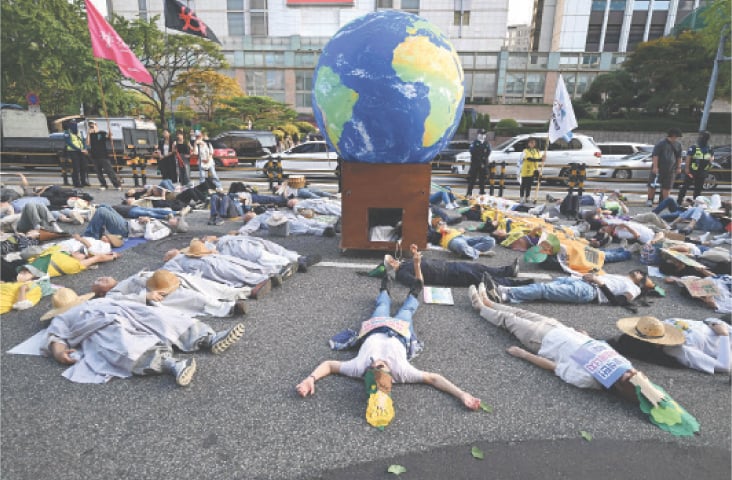
SEOUL: Protesters stage a ‘die-in’ performance during a rally for Climate Justice on Saturday. Tens of thousands of people took to the streets of South Korea’s capital demanding the government set ambitious greenhouse gas reduction targets, just days after President Lee Jae Myung addressed the UNGA, where US President Donald Trump dismissed climate change as ‘the greatest con job’ in the world.—AFP
ISLAMABAD: The Asian Development Bank (ADB) has approved technical assistance to operationalise the ‘Glaciers to Farms (G2F)’ regional programme, covering Pakistan and several Central and West Asian countries, as the region faces intensified climate disaster risks.
According to an ADB report, the support will back the Climate Action Roadmap through glacier monitoring, river basin planning and regional knowledge sharing. It will also help countries establish institutional and operational mechanisms, and prepare diagnostics, studies and capacity requirements needed to implement the programme.
The early ADB support ensures that the G2F programme seamlessly transitions into the implementation phase, minimising delays, strengthening readiness of proposed projects and enhancing the overall effectiveness and sustainability of the interventions in key sectors, including agriculture, health, social protection, and water, the report said.
Anchored by the ADB and aligned with Green Climate Fund (GCF) priorities, G2F mobilises up to $3.5 billion in public and private finance, including $325 million in GCF concessional support, to build resilience from glacier to farmland.
The programme establishes a full-cycle adaptation framework by linking upstream glacier monitoring with downstream interventions in agriculture, water management and disaster risk reduction, underpinned by integrated science-policy-finance mechanisms.
The G2F feasibility assessment has confirmed that climate finance systems across Central West Asia are underdeveloped and misaligned with national priorities. Critical gaps — including the absence of green taxonomies; environmental, social, and governance (ESG) standards; and risk-sharing mechanisms — continue to undermine the ability of both governments and private actors to scale adaptation investments.
G2F is structured as a phased, ecosystem-based programme that leverages regional platforms such as the Central Asia Regional Economic Cooperation Programme (CAREC), while avoiding duplication and fostering country-led adaptation at scale.
It is a regionally integrated, multi-sectoral climate adaptation programme aimed at safeguarding the lives, livelihoods and ecosystems of over 370m people in Central and West Asia.
The region is experiencing rapid and severe climate impacts — glaciers are retreating at rates of up to one per cent per year, water flows are becoming increasingly erratic, and both food insecurity and climate-related health risks are intensifying. “These cascading threats are especially acute in major transboundary basins such as the Indus, Amu Darya, and Syr Darya, where communities are heavily reliant on cryosphere-fed water systems,” the ADB report said.
Central West Asia is among the fastest-warming regions globally, with average temperatures rising by 0.2 to 0.4 degrees Celsius per decade. If these trends continue, more than 50pc of glacier volume in the Pamir and Tien Shan ranges could be lost by 2100, posing an existential threat to water, food and energy security across the region.
Glacier retreat is already destabilising seasonal water availability, intensifying natural hazards — such as glacial lake outburst floods (Glofs), avalanches and flash floods — and placing enormous pressure on already fragile agricultural systems. In addition to glacial retreat, snowpack is melting earlier in the year due to rising temperatures, shifting peak water availability to months when agricultural demand is still low.
This temporal mismatch between water supply and irrigation diminishes agricultural productivity and increases reliance on groundwater and reservoir storage — resources already under strain, the report said.
Any alteration in water timing, quality or quantity disproportionately affects vulnerable communities, particularly in water-stressed and low-capacity regions. Rural households, women-headed farms, and agri-micro-small-and-medium-enterprises (MSMEs) — already facing limited access to finance, infrastructure, and support services — are often the first to feel the effects of water stress and production losses.
GAZA CITY: At least 72 Palestinians were killed in relentless Israeli strikes throughout the besieged Gaza Strip, on Saturday, said Gaza’s civil defence agency while quoting hospitals in the territory’s largest urban area.
Israeli army fire killed at least 42 people in Gaza City as it attempts to capture and occupy the territory’s largest urban centre.
In less than two years, Israel’s war on Gaza has killed at least 65,549 people and wounded 167,518, besides displacing millions from their areas.
Footage from a hospital courtyard in central Gaza on Saturday showed several bodies in white shrouds, victims of a strike on Nuseirat refugee camp. Women wept over the dead, while men stood in prayer beside the bodies.
Piles of concrete blocks and gaping holes marked the site of the strike that hit a building in the camp.
Groups of men and children picked through the debris, salvaging what they could of their belongings.
Iyad Shokr, who survived the strike on Nuseirat, said the attack came just before dawn. “The debris collapsed on our floor. By the will of God some survived while others were martyred,” he said.
Seven members of the Bakr family were killed overnight in the strike on Al-Shati refugee camp in Gaza City, where Israeli forces have stepped up a ground and air assault.
The dead included children and women, according to the Gaza civil defence agency, a rescue force operating under Hamas authority, which said several others were also wounded in the Israeli strike.
“What is happening are massacres, massacres that are condemned internationally,” said Umm Khaleel, who survived when the family home was hit.
Gaza’s main Al-Shifa hospital confirmed receiving six bodies of victims killed in the strike.
“We cannot sleep because of the bombing and shelling on Al-Shati… the children were sleeping when suddenly a missile landed on us,” said Salwa Subhi Bakr.
“What does the world want from us?”.
Bakr, displaced by the nearly two-year-long war, said families had nowhere safe to flee. “They tell us go there, then come back here. Where do we get the money for trucks?” she said. “People are in the streets, in the south scattered everywhere. Where should we go? Find us a solution.”
While Trump is due to meet Israeli Prime Minister Benjamin Netanyahu after on Sept 29 after telling reporters on Friday it “looks like we have a deal on Gaza”, a Hamas official said on Saturday the Palestinian group had not received Trump’s Gaza ceasefire plan.
CAN Pakistan do it? Nobody expects them to. India’s captain Suryakumar Yadav, or SKY for short, doesn’t even think that Pakistan deserve being called rivals.
But here they are, the “non-rivals” with a chance to upset India’s pre-scripted march to glory in the Asia Cup. T20 cricket is certainly a game of skill, but it is also a game of chance. And Pakistan, the underdogs, the non-rivals, have a chance.
The first two games in this minor trilogy of contests between the ex-rivals were one-sided and ill-tempered. It isn’t partial to say that India brought the bad vibes. Haris Rauf responded with some low insults and was rightly fined — along with Mr SKY for his comments after the group game.
It’s hard to imagine a final free of needle. That’s probably a good thing for Pakistan, who were more competitive in the Super Fours game as the political row escalated.
India’s cricketing dominance is built on their formidable batting, in particular the brilliance of Abhishek Sharma, the world’s top rated T20 batsman.
Sharma is a purist’s delight as he hits cleanly through the ball, whether playing under his eyes or away from his body. He has taken a liking to Pakistan’s opening bowlers and gave India an unstoppable momentum in the other two games.
Yet the biggest positive for Pakistan over the tournament is the re-emergence of its strike bowlers as a force to be reckoned with. Shaheen Shah Afridi, in particular, has started to remind us of the bowler that he was. Shaheen has a poor record against India, but his confidence should be high, and dismissing Sharma early can change the mental dynamic between the players.
This is added pressure for Shaheen, but it should be welcome for a player who wants to reclaim his status as one of the world’s premier fast bowlers.
There is a lot about Shaheen’s game that is encouraging. He is back to batting with aggression, a style reminiscent of the great all-rounder Wasim Akram.
More importantly, Pakistan need Shaheen to get closer to Wasim’s level as a strike bowler.
Inept top order
The second key area for Pakistan in this final will be the performance of the top order. Other than Sahibzada Farhan, Pakistan’s main hitters have been inconsistent and below par.
The top order lacks quality and is overreliant on the form of its middle and late order. It’s good that Pakistan’s all-rounders have some collective batting form, and that’s enough against lesser teams, but without something major from the top order Pakistan will find it hard to win.
All-round depth is something that Pakistan coach, Mike Hesson, seems to like. It certainly works when Saim Ayub chips in with vital wickets or Mohammad Nawaz scores late runs.
But you can’t build a consistently successful team around the quality of Pakistan’s selected all-rounders.
Pakistan might have lost to India only in this Asia Cup, but they are ranked above the other teams in this tournament. They should be winning those games.
When the World Cup comes around, five more teams ranked higher than Pakistan will also be there. None of those teams will be worried about the quality of Pakistan’s batting.
So, whatever happens today there is some serious work to be done if Pakistan are to be competitive in the T20 World Cup in February.
The extent of our T20 batting failure is confirmed by international rankings where there is no Pakistani player in the top 20. Where might Pakistan get that quality from? The obvious people to reconsider are Babar Azam and Mohammed Rizwan. The next place to look is among the next crop of young batsmen, and it’s a shame that the management didn’t stick with Hasan Nawaz.
Bowling shaping up well
Pakistan’s bowling is developing to be more competitive. There are four wicket takers in Shaheen, Haris, and Abrar Ahmed. Sufiyan Muqeem can’t get a game. Question marks hang over what to do with Faheem Ashraf, Mohammad Nawaz, and Saim Ayub.
Of these, Saim offers the most promise. His wickets are proving vital. A move down the order might work for him in the way that it has done for Mohammad Haris. The other two might make or break their futures today.
The other big question for Pakistan is around the selection of Salman Ali Agha. We don’t even need to get into his captaincy because he does not look like a T20 cricketer at international level.
Agha is a tremendous asset for Pakistan in Test cricket and 50-over cricket, but his T20 journey should end here.
A win in the Asia cup will be a tremendous boost, especially against the odds, but whatever happens today the underlying problems in Pakistan’s T20 formula must not be ignored.
Pakistan’s coach has a record of success with New Zealand and some franchise cricket, but he is still getting to grips with the bamboozling world of Pakistan’s international cricket.
He has a big job to do because the selection is wrong and the batting performances are dismal.
First things first, though, and Pakistan must show Mr Blue SKY and his Indian team what a “non-rivalry” really looks like. Salman’s team have a point to prove — and some pride to restore.
LAHORE: The Lahore High Court (LHC) has dismissed petitions filed by cinema operators seeking to extend the scope of the Motion Pictures Ordinance, 1979, to cover Over-the-Top (OTT) platforms such as Netflix and Amazon Prime, ruling that the law cannot be applied to digital streaming services.
Justice Raheel Kamran, delivering a detailed 20-page judgement, observed that the ordinance was enacted in a pre-digital era to regulate films exhibited through cinematographs in cinemas and other public venues, and was not designed for online streaming services.
The petitioners, including NC Entertainment (Pvt) Ltd, had argued that requiring cinemas to obtain film certification while leaving digital platforms unregulated was discriminatory and infringed their fundamental rights.
They contended that censorship principles under Section 6 of the Ordinance, derived from Article 19 of the Constitution, should apply equally across all platforms to uphold social norms of decency and morality.
Says extending Motion Pictures Ordinance to streaming services will be ‘judicial legislation’
The counsel argued that provisions of the ordinance had not been enforced equally against all mediums and platforms of public and private exhibition and the same were being applied selectively and arbitrarily against the petitioners, leaving all other digital platforms to continue unchecked.
A law officer for the federal government opposed the writ petitions as not maintainable.
He said the petitioners were not aggrieved and none of their established rights had been restricted or hindered by any of the respondents.
He maintained that following the 18th constitutional amendment, the subject of cinematograph censorship devolved upon the provinces, granting them exclusive authority in this regard.
He contended that the term “cinematograph” shall be construed keeping in view the context of the ordinance and OTT platforms were not covered by it.
A law officer for the Punjab government stated that the Pakistan Electronic Media Regulatory Authority (Pemra) exclusively deals with electronic media and that the jurisdiction of the Punjab Film Censor Board was only restricted to the censorship of films.
He also emphasised that the term “cinematograph” was to be construed in the context of the ordinance, which had no application to the OTT platforms.
A lawyer for Pemra argued that the body was a regulatory authority for the broadcasting media and distribution of services and it was responsible only for improving the quality standards of the channels shown to the people of Pakistan.
He contended that Pemra had no nexus with the motion picture law and the petitioners. He also questioned the locus standi of the petitioners.
A counsel for the Pakistan Telecommunication Authority (PTA) also stated that it had no mandate or jurisdiction to regulate matters pertaining to content that was available for viewership on OTT platforms.
Advocate Zeeshan Zafar Hashmi, an amicus curiae (an impartial adviser to a court of law), also stated that the ordinance essentially deals with the exhibition of films by means of cinematograph, which is controlled by the Censor Board through censorship.
Justice Kamran observed that OTT platforms, which operate globally and deliver content directly to users on personal devices, fall outside the framework of the ordinance.
The judge noted that pre-censorship of OTT platforms was not only legally untenable but also logistically impossible given the vast, continuously updated nature of digital content.
Justice Kamran ruled that extending the motion pictures ordinance to cover OTT platforms would amount to judicial legislation, which is beyond the court’s domain.
The judge observed that cinemas and OTT platforms are fundamentally distinct and therefore not “similarly circumstanced” entities under Article 25 of the Constitution.
The judge also dismissed the petitioners’ contention that importing digital content is exempt from the Import Policy Order 2022, holding that once content is exhibited publicly in Pakistan, it must comply with domestic laws governing public exhibition.
Justice Kamran then dismissed the petitions, declaring that they were not maintainable on legal or practical grounds.
The Pakistan Telecommunications Authority (PTA) on Friday approved the adoption of the latest WiFi generation, WiFi 7, making it one of the first nations in the Asia-Pacific region to use the network.
According to a press release, WiFi 7 and future generations will operate on the 6 GHz network band, underscoring Pakistan’s commitment to digital innovation and leadership.
“Wi-Fi 7 delivers ultra-high data rates, low latency, and robust reliability, enabling 8K streaming, AR/VR, and industrial automation,” the press release read.
“By easing congestion in legacy bands and reducing broadband delivery costs, it will strengthen connectivity for households, SMEs (small-medium enterprises), campuses, healthcare, and smart cities.”
This development comes a week after Information and Technology Secretary Zarrar Hasham said that restoring damaged undersea internet cables may take four to five weeks.
During a meeting of the National Assembly’s Standing Committee on Information Technology and Telecommunication, while responding to a query raised about slow internet and disruptions, the IT secretary replied that multiple cables had been cut off the coast of Yemen, affecting internet services.
Trade negotiators from the United States have told their Indian counterparts that curbing purchases of Russian oil is crucial to reducing India’s tariff rate and sealing a trade deal, two people familiar with the talks told Reuters.
While trade negotiations are on a positive track, a US official said, more work is needed to ensure India addresses US concerns over market access, the trade deficit and purchases of Russian oil.
US President Donald Trump has sought to pressure India, the European Union and members of Nato to curb purchases of Russian oil as a way to cut Moscow’s revenue and hasten an end to the war in Ukraine.
The Trump administration has shown a willingness to use maximum leverage to advance its policy goals, as evidenced by its linking trade negotiations with India to demands that it curb Russian oil purchases.
Trump has expressed growing frustration over the slow progress toward ending Russia’s war in Ukraine, a conflict he pledged to resolve from his first day in office.
The US has already imposed an extra 25 per cent tariff on imports from India to pressure New Delhi to halt its purchases of discounted Russian crude oil, bringing total punitive duties on Indian goods to 50pc and souring trade negotiations between the two democracies.
But Trump has refrained from imposing additional tariffs on Chinese imports over China’s purchases of Russian oil, as his administration navigates a delicate trade truce with Beijing.
India and China are the two largest buyers of Russian oil, which is already subject to numerous US sanctions that have constrained Moscow’s access to global markets.
In response, India has defended its oil imports, emphasising the economic benefits and accusing Western nations of hypocrisy for continuing trade with Russia despite sanctions.
• Seniority concerns cannot override constitutional transfers, holds Justice Mazhar
• Justice Panhwar suggests creating unified seniority list of all high court judges
ISLAMABAD: Justice Muhammad Ali Mazhar on Thursday ruled that the transfer of a judge from one high court to another under Article 200(1) of the Constitution cannot be declared “against the public interest” merely because it affects the seniority of a few existing judges.
“The best interest of public at large is always with the expeditious disposal of their cases and not in forum shopping,” emphasised Justice Muhammad Ali Mazhar in a detailed judgement.
Justice Mazhar had presided over the Supreme Court’s five-judge Constitutional Bench that heard a joint petition by five Islamabad High Court (IHC) judges — Justices Mohsin Akhtar Kayani, Tariq Mehmood Jahangiri, Babar Sattar, Sardar Ejaz Ishaq Khan and Saman Rafat Imtiaz — who had argued that three transferred judges, including IHC Chief Justice Sardar Muhammad Sarfraz Dogar, should not be treated as IHC judges until they took a fresh oath under Article 194, read with Schedule III of the Constitution.
Justice Mazhar observed that the Islamabad High Court Bar Association (IHCBA) had also filed a petition, initially fixed along with these petitions, but later withdrew it on April 17. This, he said, clearly showed that the parent bar association accepted the transfer of judges and did not consider it contrary to public interest or judicial independence.
Article 200 of the Constitution makes it clear that “public interest” is not a precedent or a hard and fast rule and the pros and cons are left to the consultees to decide, being the sole arbiters in terms of the relevant constitutional article.
Had the consultees felt that a proposed transfer was politically motivated, mala fide, or against public interest, they could have withheld consent during the consultation process. However, in this case, Chief Justice of Pakistan (CJP) Yahya Afridi and other chief justices of the high courts gave their unanimous assent.
“All the transfers were by consensus, and no transferee judge approached this court to claim that his transfer was made without consent, under duress, or for punitive or political reasons,” Justice Mazhar observed, adding that the CJP’s concurring note even applauded the transfer.
Nothing was articulated, Justice Mazhar noted, to explain how the transfers adversely affected public interest. “Has the IHC’s working come to a halt? Have the transferee judges failed led to perform their duties? Has the court stopped functioning?” he wondered.
On the issue of seniority, Justice Mazhar clarified that such disputes fall within the administrative authority of the high court’s chief justice. Whether the transfer was permanent or temporary, this should be specifically mentioned in the notification of transfer.
In a separate note, Justice Salahuddin Panhwar proposed the creation of a unified national seniority list of all high court judges. This list, he suggested, should be maintained and annually notified by the president’s office in consultation with the CJP, to apply specifically to IHC transfers, subject to the principle of diversity. Such a reform, he argued, would ensure transparency, equality and consistency in judicial administration and matters of elevation.
United States President Donald Trump on Thursday urged Turkish counterpart Recep Tayyip Erdogan to stop buying Russian oil over the war in Ukraine, as Erdogan sought a long-awaited deal to buy US stealth fighter jets.
As Erdogan visited the White House for the first time since 2019 during Trump’s first term, Trump called on him to use his influence with Russian President Vladimir Putin to end Moscow’s invasion.
Trump said that he would discuss Ankara’s wish to buy high-tech F-35 aircraft and was ready to end sanctions on Turkey over its purchase of Russian air defence missiles.
Nato ally Turkey was booted out of the flagship US stealth fighter programme during Trump’s first term after it defiantly bought Russia’s S-400 surface-to-air missile system.
“I’d like to have him stop buying any oil from Russia while Russia continues this rampage,” Trump told reporters alongside Erdogan in the Oval Office.
Trump said Erdogan was “very respected” by both Putin and Ukrainian President Volodymyr Zelensky and “could have a big influence if he wanted to. Right now, he’s being very neutral.
“The best thing he could do is not buy oil and gas from Russia,” Trump added.
Asked when the US sanctions on Turkey’s defence sector imposed over the Russian missiles could end, Trump replied: “If we have a good meeting, almost immediately.”
The first Trump administration took the action out of concern that Turkey’s purchase of the Russian anti-aircraft system would end up giving Nato’s main adversary a window into the alliance’s capabilities.
‘Highly opinionated’
Trump, who was wearing a badge of a gold fighter jet on the lapel of his suit jacket, confirmed that they would discuss Turkey’s push to end the long-running rift over buying more US aircraft.
“He wants the F-35 and he’s wanted that, and we’re talking about that very seriously,” Trump said, adding that Turkey also wanted to buy more of the older F-16 jets and “you’ll know about that by the end of the day”.
Trump, known for his admiration for forceful foreign leaders, has long shown a fondness for Erdogan and is embracing him despite a crackdown in Turkey on the opposition. His warm welcome also came despite the fact that Erdogan is at odds with key US ally Israel on Gaza and Syria.
“This is a guy who’s highly opinionated. Usually, I don’t like opinionated people, but I always like this one, but he’s a tough one,” Trump told reporters.
“He knows about rigged elections better than anybody,” Trump added about his counterpart, after saying that they had stayed friends even while the Republican was out of office due to what he called a “rigged election”.
THE World Bank has issued a stark warning to Pakistan in a report released on Tuesday.
The country’s growth model has run its course, and over the past five years, the number of people living below the poverty line has begun to swell after two decades of shrinkage.
Not only that. Nearly 40 per cent of children are stunted, and this percentage has not changed much over a long period of time. One quarter of children of primary school age remain out of school. Of the ones that do go to school, 75pc of those who finish primary schooling cannot read, or follow a simple story.
One after another, the dismal state of the population as seen in the social indicators testifies to the fact that the economy is not delivering, whether or not it grows. The middle of the decade of the 2010s saw a high-growth spurt, yet between the years 2011 and 2021, “real wage growth in sectors employing the poor remained minimal at just 2-3pc” the report notes, “making the poor ill-equipped to convert economic growth into income-generating opportunities”.
The report is a strong reminder that Pakistan’s economic urgency is actually not about growth. It is about reform. This economy cannot lift people out of poverty even when it grows. It cannot reduce income disparities between urban and rural, or between geographical regions. It cannot create enough jobs for the youth, or furnish income-generating opportunities for women at a rate sufficiently fast to make any meaningful impact in the lives of the multitude.
One reason for this, the report points out, is that 95pc of all job growth for the poor in the early years of the 2000s, when poverty levels fell sharply, was due to opportunities in the informal sector, and the movement of labour from agriculture to low-quality jobs in services and construction. That drop in poverty was not brought about due to expanding opportunities in the formal sector.
The World Bank report is a strong reminder that Pakistan’s economic urgency is actually not about growth.
Meanwhile, the state as presently constituted cannot educate its children, reduce the incidence of stunting among them, build resilience to shocks (such as floods) at the local level — and on and on and on.
The report proposes a number of pathways forward. These include strengthened public service delivery, devolution to local governments and their empowerment via a fiscal model that provides them with the resources they need to discharge their responsibilities.
Other ways forward include what they call “building resilience” via social safety nets and improved targeting through the National Socio-Economic Registry, and finally developing better data systems “through a robust statistical infrastructure that produces accessible, high-frequency, and granular data” to drive evidence-based research, which can serve both as a feedback loop and an input in policy design.
Of all these, the last deserves particular mention. I have long argued for more legally mandated data release templates across government departments. This has many benefits that appear slowly, but reliably, and help focus attention on metrics against which to measure progress.
For now, the single most robust data dissemination template that operates in the country is the one that focuses on the health of the external sector. We get high-quality data on the balance of payments and trade, and multiple data points against which to measure the foreign exchange reserves, as well as the forward positions taken by the State Bank. The debt statistics are more thorough than any other, and a clear picture of Pakistan’s debt profile can be easily built very quickly.
Try finding out a few basic facts about education or health, however, and you’ll notice how woefully inadequate our data is. Try looking for more regular data on the power sector, and you will have to wade through unspeakably complex Nepra documents to piece the picture together yourself. Forget about employment. That data gets released once a year in a good year.
Maybe the World Bank can play a proactive role here in helping develop a data release template for the power sector, for starters. Maybe it would be a good idea for data on the accumulation of circular debt to be released officially, as per pre-defined protocols, on a fortnightly basis.
Maybe there should be a simple data page on the Nepra website, where we can see fuel consumption data broken down by power plant every month. Maybe units sent out can be shown on a map by coverage area, and next to it we can see recoveries made in the same area during the same period.
There is a lot of room for expansion here. The provincial governments should also be mandated to release key data relating to health and education on a regular basis. The template for this release should be standardised to enable comparisons across provinces, and ideally with other countries as well.
This sort of data release requirement helps bring some discipline in government departments. It enables outsiders to track performance. It helps identify those areas where policy needs to be strengthened. And it reduces the scope for discretionary decision-making. In short, an expansive and standardised data collection and disclosure requirement on government departments can help bring about the kinds of reforms the World Bank is saying Pakistan needs to undertake.
One big reason why change is so hard to bring about in this country is precisely because large swathes of it operate in the dark, in the sense that there is no transparency. Without transparency, it is hard to build accountability. And without accountability, there is no incentive to change, because continuing with business as usual is easier and risk-free.
Maybe a little daylight in the darker recesses of the state will help jolt a few civil servants out of their complacency. Maybe some evidence-based metrics will help light the way, away from the culture of idle complaining that has taken root among the elites.
• Allowing judges to target peers would lead to ‘internal conflicts’, Justice Mandokhail warns
• Ruling underscores principle of judicial equality, places emphasis on judicial discipline; affirms that judges cannot ‘pick and choose’ cases
• IHC judges’ pleas ‘still under review’, says SC spox
ISLAMABAD: Justice Jamal Khan Mandokhail of the Supreme Court, in an 11-page verdict, has ruled that judges cannot initiate contempt proceedings against their peers, establishing that only the Supreme Judicial Council (SJC) has the constitutional authority to probe misconduct allegations against the judges of both the apex and high courts.
He explained that judges within the superior courts share equal power and status, with no individual holding superiority or inferiority over another. He warned that allowing judges to take such punitive measures against one another would cripple the judiciary.
The ruling formally justified why a six-judge Supreme Court bench on Jan 27 disposed of an Intra-Court Appeal (ICA) filed by Additional Registrar (Judicial) Nazar Abbas. Mr Abbas had faced contempt proceedings from a smaller two-judge bench for his non-compliance with a judicial order.
The additional registrar was subsequently removed from his office for withdrawing a case challenging the Customs Act from that two-judge bench, which was headed by a senior puisne judge Justice Syed Mansoor Ali Shah, and transferring it to a larger Constitutional Bench.
Justice Mandokhail warned that permitting judges to hold their colleagues in contempt could ignite internal conflicts, ultimately threatening the integrity of the entire justice system.
“Permitting superior court judges to initiate contempt proceedings against his fellow judges would militate against the necessity of maintaining a high degree of comity amongst them,” Justice Mandokhail wrote.
He cautioned that such a practice would foster an environment of hostility rather than collegiality, severely damaging the institution’s credibility.
“The maintenance of cordial relations amongst members of the superior judiciary is important for the smooth functioning of courts and issuing a process of contempt of court by a judge against his fellow judge would create internal conflicts, grievances and grudges amongst themselves,” the judgement said.
The justice painted a dire picture of the potential consequences.
“There would be anarchy and justice system would crumble, which will be against the principle of ‘Esprit de corps’ (common spirit existing in the members of a group and inspiring enthusiasm, devotion, and strong regard for the honour of the group),” Justice Mandokhail observed.
He added that “the trend will erode public trust and that no legal system can permit judicial system to collapse.”
The judgement affirmed that while judges possess inherent constitutional power to initiate contempt of court proceedings, this authority does not extend to their colleagues on the bench.
“Judges of the superior courts possess the same status and power within their hierarchy, therefore, no one amongst them neither was superior or inferior to issue direction nor can punish the other,” he noted.
The ruling clarified the boundaries of judicial immunity, observing that while judges are generally protected for their judicial work and administrative functions, this protection is not absolute and does not shield them from accountability for misconduct. However, the proper and sole channel for such accountability is the Supreme Judicial Council.
“The allegation of misconduct against a judge of the Supreme Court or of a high court can only be inquired into and dealt with under Article 209 of the Constitution by the Supreme Judicial Council (SJC),” Justice Mandokhail observed.
Recalling a rare historical instance, the justice referenced the case of Iftikhar Chaudhry and others, in which the Supreme Court had issued contempt notices to several apex and high court judges for violating a restraining order from Nov 3, 2007. However, Justice Mandokhail stressed that the context of that case was unique and markedly different from the matter at hand.
The judgement also delved into crucial matters of judicial procedure and discipline, particularly the handling of “part-heard” cases.
Justice Mandokhail affirmed the well-settled legal principle that matters partially heard by a bench should not be transferred administratively unless explicitly permitted by law or constitutional rules.
“The purpose behind this principle was that once a bench or a court hears a case at a considerable length, transferring that case from that court can lead to a denovo hearing,” he explained.
However, he introduced a critical exception that directly applied to the registrar’s case: if a court’s jurisdiction is removed through new legislation or a constitutional amendment while a matter is pending, that court loses all authority to proceed. “The court where the matter is pending or is treated as part-heard, it loses its authority to take any further action into the matter, hence, must stop proceedings,” Justice Mandokhail observed.
“With great respect, there was no justification for the regular bench for further proceedings into the matter in contravention of the relevant provisions of the Constitution after the amendment,” he emphasised. He noted that court committees also had no power to override the constitutional change.
Underscoring that judges are bound by their oath and a strict Code of Conduct, he said, “If every judge of the SC or of a High Court starts picking and choosing cases for disposal by him, without following the practice and procedure in vogue, of their respective courts, the discipline in the court will be damaged.”
IHC judges’ petition under review
Separately, the Supreme Court said that petitions filed by five senior sitting judges from the Islamabad High Court are in the normal process of review and that any order regarding their fate will be made in due course.
“Petitions are in the normal process of procedural scrutiny and any order thereon is to be made in due course,” said Dr. Shahid Hussain Kamboyo, a spokesperson for the Supreme Court.
On Sept 19, five judges — Justice Mohsin Akhtar Kayani, Justice Tariq Mehmood Jahangiri, Justice Babar Sattar, Justice Sardar Ejaz Ishaq Khan and Justice Saman Raffat Imtiaz — personally appeared before the apex court to file their constitutional petitions.
The petitioner judges pleaded with the Supreme Court to declare that the administrative powers of the Chief Justice of the Islamabad High Court cannot be deployed to undermine or trump the judicial powers of high court judges. They sought a declaration that the CJ-IHC was not authorised to constitute benches or transfer cases once a high court bench was already seized of a matter.
It also asked the apex court to declare that the CJ-IHC cannot exclude available judges from the roster at will and use the power to issue a roster to oust judges from performing judicial functions.
Iranian President Masoud Pezeshkian on Wednesday welcomed the mutual defence deal struck between Pakistan and Saudi Arabia as the beginning of a “comprehensive regional security system”.
Pakistan and Saudi Arabia entered into a landmark mutual defence agreement, under which any aggression against one state will be considered an attack on both. The pact was signed by Prime Minister Shehbaz Sharif and Saudi Crown Prince Mohammad Bin Salman at the Al-Yamamah Palace in Riyadh last week.
The agreement came amid diplomatic upheaval in the Middle East and just months after a deadly India-Pakistan conflict in May, as well as the 12-day war between Iran and Israel in June.
The Iranian president praised the defence deal while addressing the General Debate of the 80th Session of the United Nations General Assembly (UNGA) today.
“Iran welcomes the defensive pact between the two brotherly Muslim countries, the Kingdom of Saudi Arabia and the Islamic Republic of Pakistan, as a beginning for a comprehensive regional security system with the cooperation of the Muslim states of West Asia in the political security and defence domains,” he said.
Deputy Prime Minister and Foreign Minister Ishaq Dar had hinted that some countries were showing interest in building strategic defence agreements with Pakistan following the deal.
“It’s premature to say anything, but some other countries want to enter into an agreement of this nature,” FM Dar had told reporters in London, replying to a question about whether other states will join the pact or ink similar deals.
Iran and Saudi Arabia have often been on opposing sides of regional conflicts, including in Syria and Yemen. The two regional heavyweights broke off diplomatic relations in 2016 before re-establishing them in 2023 under a rapprochement deal brokered by China.
The two Muslim countries have since been witnessing warming relations with high-level meetings of their leaders.
Saudi Arabia had condemned the Israeli strikes on Iran in May, calling them “aggressions” and a “clear violation of international laws”. Riyadh had also expressed its “great concern” following the US strikes on Iranian nuclear facilities.
Tells UN Tehran will never seek to build nuclear bomb
President Pezeshkian also said Iran has no intention to build nuclear weapons, just days before international sanctions could be reimposed on his country over Tehran’s nuclear ambitions.
“I hereby declare once more before this assembly that Iran has never sought and will never seek to build a nuclear bomb. We do not seek nuclear weapons,” Pezeshkian said.
On August 28, Britain, France and Germany launched a 30-day process to reimpose UN sanctions that ends on September 27, accusing Tehran of failing to abide by a 2015 deal with world powers aimed at preventing it from developing a nuclear weapon.
The European powers have offered to delay reinstating sanctions for up to six months to allow space for talks on a long-term deal if Iran restores access for UN nuclear inspectors, addresses concerns about its stock of enriched uranium, and engages in talks with the US
Pezeshkian criticised the move by European powers as “illegal”, saying it was made at “the behest of the United States of America”.
The US, its European allies and Israel accuse Tehran of using its nuclear programme as a veil for efforts to try to develop the capability to produce weapons. Iran says its nuclear programme is for peaceful purposes only.
“In doing so, they (the E3) set aside good faith. They circumvented legal obligations. They sought to portray Iran’s lawful remedial measures … as a gross violation,” Pezeshkian said.
But amid the looming threat of sanctions and last-ditch talks on the sidelines of the UNGA, gaps remain between Tehran and European powers over a deal to avert the snapback of sanctions.
Still, both sides have left the door open to further negotiations. While the E3 says Iran’s clerical rulers have so far failed to meet the conditions it set, Tehran says it will not offer concessions.
Iran’s Supreme Leader Ayatollah Ali Khamenei, who has the last say on key state matters such as foreign policy and Iran’s nuclear programme, has ruled out negotiations with the US under threat.
If Tehran and the E3 fail to reach a deal on an extension by the end of September 27, then all UN sanctions will be reimposed on Iran, where the economy already struggles with crippling sanctions reimposed since 2018 after President Donald Trump ditched the pact during his first term.
The so-called “snapback” process would reimpose an arms embargo, a ban on uranium enrichment and reprocessing, a ban on activities with ballistic missiles capable of delivering nuclear weapons, a global asset freeze and travel bans on Iranian individuals and entities.
Soon after the US and Israeli attacks on Iranian nuclear sites in June, Iran’s parliament passed a law suspending cooperation with the International Atomic Energy Agency (IAEA).
However, the IAEA and Tehran reached a deal on September 9 to resume inspections at nuclear sites and UN nuclear watchdog chief Rafael Grossi said on Tuesday a team of inspectors was on its way to Iran should Tehran and the E3 strike a deal this week to avert revival of sanctions.
THE tragic loss of civilian lives in explosions in KP’s Tirah valley highlights the need for greater transparency in counterterrorism operations from the state. In particular, residents in the vulnerable area should be taken on board to minimise the chances of collateral damage.
Much confusion surrounds the incident, which occurred in the early hours of Monday. At least two dozen residents of Tirah, including women and children, lost their lives in the blasts, which officials claim were caused by terrorists storing and manufacturing explosive devices in houses. Sources quoted in the media say that TTP militants had forcibly occupied the dwellings and used them to store explosives. They said that several militants also perished in the blasts.
However, residents of the area and provincial lawmakers dispute these claims, asserting that the valley came under aerial bombardment. A statement attributed to the KP chief minister quotes him as saying that the “martyrdom of civilians” due to “operations against terrorists is unacceptable”.
The civilian deaths have resulted in protests in the region, with local tribesmen, as well as the HRCP, calling for an inquiry into the matter. It is the state’s responsibility to clear the confusion and shed light on the facts. Experience has shown that ‘collateral damage’ can result in increased restiveness in the areas affected by terrorism, and when there is radio silence from the state in situations where civilian lives are lost, hostile narratives and conspiracy theories begin to dominate. That is why the facts must be told.
Having said that, it is unwise for the PTI-led provincial government to politicise the incident. Such sensitive issues should not be used to get back at political opponents, and both the centre and provincial government need to work together to uncover the facts behind the Tirah deaths, and prevent further loss of innocent lives during CT operations.
The unfortunate truth is that KP, particularly its tribal districts, has been in the grip of terrorism for over two decades. That is why along with thorough probes into incidents like the one in Tirah, SOPs need to be developed that can ensure minimum or no collateral damage during CT operations.
There can be little argument with the fact that all areas need to be cleared of terrorists. Yet these kinetic actions must be undertaken with the buy-in and support of local tribes.
When there is lack of credible information from the state, especially if civilians are caught in the crossfire, anger and resentment in local communities will only grow. Therefore, along with transparency, the residents of the affected areas must be on board in the battle against militancy. With a cooperative approach terrorism can be defeated, and the people of the tribal districts can live in peace.
QUETTA: Twelve people, including women and children, were injured when the Quetta-bound Jaffar Express was targeted in a bomb blast in the Spizend area of Mastung on Tuesday.
According to railway officials, six bogies of the train coming from Peshawar derailed after the blast and one overturned, injuring the passengers in that carriage.
It was the second blast in the same area within 10 hours. Earlier in the morning, an explosion had occurred near the main track linking Balochistan to the rest of the country, just as the Peshawar-bound Jaffar Express was preparing to leave Quetta Railway Station. The train was briefly halted but allowed to continue after security clearance, as the track was not damaged.
Police officials said an explosive device planted on the track was detonated when the Quetta-bound train was passing through the Spizend area.
“Six bogies of the Jaffar Express derailed after the blast and one of them overturned,” a senior Pakistan Railways official told Dawn, adding that five passengers sustained injuries.
Security forces and police rushed to the site soon after the blast and shifted the injured to a nearby health facility.
The railway officials confirmed 270 passengers were on board at the time of the blast. They said the damaged part of the track would be repaired after security clearance on Wednesday, during which train service would remain suspended.
The government is set to hold a signing ceremony today for a financing facility agreement to reduce the circular debt in the power sector, according to the Prime Minister’s Office (PMO).
A letter from the Central Power Purchasing Agency to all banks and power sector entities invited their chief executive officers and heads to attend the event.
It said the event will be held at the PMO and PM Shehbaz Sharif will also virtually address the event as he is currently in New York for the UN General Assembly session.
Pakistan’s debt burden has become the defining constraint of its fiscal and economic future. According to data released by the State Bank of Pakistan, the total government debt (excluding the International Monetary Fund) increased from Rs69 trillion in June 2024 to Rs78tr by June 2025.
The public debt (including the IMF debt) increased to Rs80.5tr from Rs71.2tr in June 2024. Both the numbers understate the full level of the government’s indebtedness.
Developments suggest that the government is negotiating with banks to borrow Rs1.2tr to settle the power sector’s circular debt.
It was planned to borrow Rs1.275tr from banks as the government is willing to settle a portion of the circular debt, which has surged to Rs2.3tr.
What is strange is that this loan will be repaid over six years through a Debt Service Surcharge (DSS) included in the electricity bills.
Initially, the banks were hesitant to meet the government’s request to lend money at a lower rate than the policy rate, but eventually, 18 commercial banks agreed to do so. The loan will be repaid over a six-year period.
“The government has been borrowing less than the maturity amount of treasury bills during FY25, which has substantially increased the outstanding amount. This new borrowing could address this accumulation,” said a banker.
Barcelona and Spain star Aitana Bonmati won the Women’s Ballon d’Or at an awards ceremony in Paris on Monday, the third consecutive year she has taken the prize.
Bonmati edged out Mariona Caldentey, her teammate in the Spain side beaten on penalties by England in the Women’s Euro 2025 final in July.
The 27-year-old midfielder also lost the Women’s Champions League final with her club last season, at the hands of Caldentey’s Arsenal.
Bonmati was named player of the tournament at the Euros, despite not starting either of Spain’s first two matches as she recovered from a bout of viral meningitis.
Alessia Russo, one of the nominees from the triumphant England European Championship team, came in third place.
The Ballon d’Or is the most prestigious individual prize in both men’s and women’s football, and Bonmati’s run of three in a row follows back-to-back victories for her Barcelona and Spain teammate Alexia Putellas.
Norway’s Ada Hegerberg and USA star Megan Rapinoe are the only other players to have won the Women’s Ballon d’Or since it was introduced in 2018.
PSG star Ousmane Dembele wins men’s Ballon d’Or
France forward Ousmane Dembele won the men’s Ballon d’Or at a ceremony in Paris, the most prestigious individual award in football rewarding his starring role in the Paris Saint-Germain side that won the Champions League last season.
Dembele, 28, pipped Barcelona and Spain teenage sensation Lamine Yamal to the prize and succeeds Manchester City and Spain midfielder Rodri, who won the trophy in 2024.
Pakistan twice came from behind in an enthralling South Asian Football Federation (SAFF) Under-17 Championship clash against India, only for their arch-rivals to go ahead for a third time and eventually clinch a 3-2 victory at the Colombo Racecourse Stadium on Monday that secured top spot in the group.
Goals in each half by Pakistan’s Mohammad Abdullah, from the penalty spot, and Hamza Yasir had levelled the Group ‘B’ clash at 2-2 by the 70th minute but India’s substitute Rahan Ahmed found the winner in the 73rd to take his side through to a semi-final against Group ‘A’ runners-up Nepal.
Pakistan, meanwhile, take on Group ‘A’ winners Bangladesh with both last-four clashes to be held on Thursday.
Both teams had already secured semi-final berths and heading into the final group game, Pakistan held the advantage by the barest of margins — on goals scored — and a draw would’ve sufficed for Nasir Ismail’s side to avoid Bangladesh, who have ousted them in the semi-final stage of each of the last two editions.
Bangladesh also beat Pakistan in the final of the 2018 edition but the current crop would be confident of their chances, especially after a valiant display against four-time defending champions India.
After even exchanges in the opening half hour, India took the lead in the 31st minute when Danny Singh Wangkhem’s cutback was hammered in by Dallalmoun Gangte.
Pakistan immediately sought an equaliser, and it arrived two minutes before half-time when Hamza’s darting run drew a foul in the box and Abdullah sent Indian custodian Manashjyoti Baruah the wrong way from the resulting spot-kick.
An end-to-end game then swung into India’s favour in the 63rd when Gunleiba Wangkheirakpam ran onto a throughball and slotted it past the advancing Saamar Razzak.
Hamza ensured parity seven minutes later when he turned in a rebound after Baruah spilt a long-range effort from Mohammad Awais.
It didn’t last long, though, as Rahan reacted first to a save by Razzak and netted the winner.
As of August 2025, Palestine has been recognised as a state by 147 of the United Nations’ 193 member states. Despite nearly three-quarters of the world’s nations accepting it as one of them, Palestine’s status remains contested. Whilst it has the status of a permanent observer state at the UN, which allows for participation but does not grant voting rights, its actual status seems to be in between — it is neither a state nor entirely not a state. Its status is all the more perplexing given that the issue of how an entity becomes a state in international law is itself highly uncertain.
Becoming a State
States are formally equal sovereigns in international law and all have the same legal personality. In the international system, they are juridically equal, with inequalities of power between them not affecting this inherent equality. The concept of independence and equality of a sovereign state is one of the axiomatic principles of international law. States remain the most fundamental actors in the global legal order as they are able to actually make international law.
The question of what is or is not a state was addressed in Article 1 of the Montevideo Convention (1933) which offers the factual criteria necessary for statehood: permanent population, defined territory, effective government and the capacity to enter into legal relations.
However, these criteria are themselves debated, and often entities become states without fulfilling all of them. For instance, the International Court of Justice has accepted that a precise delimitation of a state’s borders is not necessary. Arguably, the presence of disputed territory does not prohibit an entity from becoming a state. Moreover, even when a state did not emerge onto the international plane with an effective government (such as in the case of the Democratic Republic of the Congo), this was overlooked in determining it to be a state.
These criteria have also not been treated as exhaustive. In the Island of Palmas case, it was held that a state had to be independent from another’s control. Furthermore, in the Åland Islands case (1920), it was held that Finland was not a state until a stable political organisation was created and its public authorities could assert themselves throughout the territory without the assistance of foreign troops.
Some commentators have also posited that states should be democratic to be granted statehood, however, in the Western Sahara Advisory Opinion, the International Court of Justice held that there was no rule of international law requiring that the structure of a state follow any particular pattern.
This is particularly since doing so would discount many states. It has also been argued that the prohibition of racial discrimination is a further criterion for statehood. However, there is no customary international law rule denying statehood to an entity for violating this. For instance, South Africa did not cease to become a state because it was practicing apartheid. These additional factors may however, play a role in other states’ decision to recognise an entity as a state.
Recognition of States
Recognition is the formal acknowledgment of the status of an independent State by other existing states. The role that recognition plays in defining statehood remains controversial and there are two approaches which determine its significance; the declaratory and the constitutive.
Under the declaratory approach to recognition, a state exists as a subject of international law at the moment at which it possesses the marks of a state as defined under the Montevideo Convention.
According to the constitutive approach, the legal existence of a state is dependent upon its recognition by others. Professor Oppenheim asserted that a state becomes an international person through recognition only and exclusively.
However, the problem with this theory is the absence of either the duty to recognise or the existence of an agency which is competent enough to adjudicate on this. It means the question of status is entirely dependent upon the individual position of the recognising state.
And so a state exists in regard to some states which have recognised it and not in relation to others. In that, what if States X and Y recognise A as a state but State Z does not? Is A a state for the former but not for Z? It is difficult to make sense of this approach, as statehood cannot be relative.
Moreover, much denial of recognition can be politically motivated, but even states that do not recognise another sometimes do ascribe responsibility under international law as they would to a state. For instance, the states that do not recognise Israel still believe it to be bound by the Geneva Conventions as if it were a state.
The Role of Non-Recognition
While recognition may not make a state, non-recognition may prevent one from coming into being. The Security Council and the International Court of Justice have enforced an obligation of non-recognition on states, especially when fundamental principles of international law or peremptory norms are violated.
For instance, Turkey recognised the Turkish Republic of Northern Cyprus as a state after it used force to impose that entity in the territory. The Security Council placed an obligation of non-recognition of this entity as a state on the international community. The TRNC is still only recognised by Turkey and no other state.
The Security Council also imposed an obligation of non-recognition on Rhodesia as, if its claim to statehood was accepted, the right of self-determination of the majority of Rhodesians would be violated, given the racist minority regime on which the purported state was found.
Non-recognition is, practically, the only means by which statehood has been withheld. It operates as a sanction in denying state status to entities which became states through violations of international law.
The recognition of statehood here was shrewdly done in order to enable the commission of an internationally wrongful act and therefore should not be recognised by other states. Only two other states, Syria and North Korea, which are allies of Russia, recognise these entities as states.
A Palestinian State
In 2007, Professor James Crawford in his seminal work, The Creation of States in International Law, stated that “the State of Palestine has not yet become a fact as distinct from an aspiration”. It is unclear whether that is any different today in 2025 than it was in 2007.
On September 12, 2025, 142 states voted in favour of a two-state solution to the Israeli-Palestinian conflict and it is likely more states are looking to recognise Palestine by the end of this month. If independence from another state’s control is indeed a criteria for statehood, then all of Palestine is currently occupied by Israel, and therefore its statehood is compromised as a result until it can relinquish itself of that control.
However, recognition itself in this case may be a way for Palestine to oust Israeli control. It is an indication of the extent to which the international community believes that Palestine’s claim to statehood is valid, and Israel’s denial of it is not.
Ironically, if the law relating to non-recognition was followed in 1948, there would be a duty on the international community not to recognise the Israeli state, as it came into being by violating fundamental principles of international law, including the ethnic cleansing of the Palestinian people through the Nakba.
However, as Alonso Gurmendi, Lecturer in International Relations at King’s College London states, ‘as international lawyers, we can argue endlessly about the validity of collective (even UN) recognition or whether Palestine really possesses the elements of the Montevideo Convention, but at the end of the day, the international law of state creation is as indeterminate as any law – its rules are always sustained by their exceptions. The real hurdle is that our world order is organised on the basis of racial hierarchies and that communities like Palestine have historically been unequally integrated into a burdened membership.’
This article by Ayesha Malik was produced with the support of the International Committee of the Red Cross (ICRC) as part of the Legally Speaking podcast series. The views expressed are the author’s own.